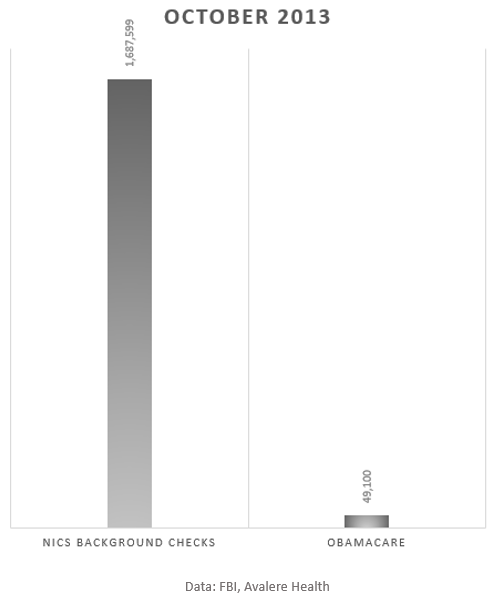
Americans 34 Times More Interested In Buying Guns Than Obamacare
November 13th, 2013Via: Zerohedge:
Kickstarter: Heirloom Chemistry Set
November 12th, 2013Treasure ahead.
Via: Kickstarter:
This is the chemistry set you always wanted as a kid but either didn’t get it or you got stuck with some cheap plastic wannabe.
The Second Operating System Hiding in Every Mobile Phone
November 12th, 2013Back in July 2013, The Washington Post reported that nearly a decade ago, the National Security Agency developed a new technique that allowed spooks to “find cellphones even when they were turned off. JSOC troops called this ‘The Find,’ and it gave them thousands of new targets, including members of a burgeoning al-Qaeda-sponsored insurgency in Iraq, according to members of the unit.”
Many security researchers scratched their heads trying to figure out how this could be so.
—
Maybe it’s malware.
Maybe it’s a feature.
Via: OSNews:
I’ve always known this, and I’m sure most of you do too, but we never really talk about it. Every smartphone or other device with mobile communications capability (e.g. 3G or LTE) actually runs not one, but two operating systems. Aside from the operating system that we as end-users see (Android, iOS, PalmOS), it also runs a small operating system that manages everything related to radio. Since this functionality is highly timing-dependent, a real-time operating system is required.
This operating system is stored in firmware, and runs on the baseband processor. As far as I know, this baseband RTOS is always entirely proprietary. For instance, the RTOS inside Qualcomm baseband processors (in this specific case, the MSM6280) is called AMSS, built upon their own proprietary REX kernel, and is made up of 69 concurrent tasks, handling everything from USB to GPS. It runs on an ARMv5 processor.
The problem here is clear: these baseband processors and the proprietary, closed software they run are poorly understood, as there’s no proper peer review. This is actually kind of weird, considering just how important these little bits of software are to the functioning of a modern communication device. You may think these baseband RTOS’ are safe and secure, but that’s not exactly the case. You may have the most secure mobile operating system in the world, but you’re still running a second operating system that is poorly understood, poorly documented, proprietary, and all you have to go on are Qualcomm’s Infineon’s, and others’ blue eyes.
The insecurity of baseband software is not by error; it’s by design. The standards that govern how these baseband processors and radios work were designed in the ’80s, ending up with a complicated codebase written in the ’90s – complete with a ’90s attitude towards security. For instance, there is barely any exploit mitigation, so exploits are free to run amok. What makes it even worse, is that every baseband processor inherently trusts whatever data it receives from a base station (e.g. in a cell tower). Nothing is checked, everything is automatically trusted. Lastly, the baseband processor is usually the master processor, whereas the application processor (which runs the mobile operating system) is the slave.
So, we have a complete operating system, running on an ARM processor, without any exploit mitigation (or only very little of it), which automatically trusts every instruction, piece of code, or data it receives from the base station you’re connected to. What could possibly go wrong?
Related: iPads Banned from Cabinet Meetings Over Surveillance Fears
Qatar: Sahara Forest Project
November 12th, 2013Via: Science:
A project to “green” desert areas with an innovative mix of technologies—producing food, biofuel, clean water, energy, and salt—reached a milestone this week in the Gulf state of Qatar. A pilot plant built by the Sahara Forest Project (SFP) produced 75 kilograms of vegetables per square meter in three crops annually, comparable to commercial farms in Europe, while consuming only sunlight and seawater. The heart of the SFP concept is a specially designed greenhouse. At one end, salt water is trickled over a gridlike curtain so that the prevailing wind blows the resulting cool, moist air over the plants inside. This cooling effect allowed the Qatar facility to grow three crops per year, even in the scorching summer. At the other end of the greenhouse is a network of pipes with cold seawater running through them. Some of the moisture in the air condenses on the pipes and is collected, providing a source of fresh water.
Sweden Closes Four Prisons as Number of Inmates Plummets
November 12th, 2013Wikipedia: United States Incarceration Rate:
The incarceration rate in the United States of America is the highest in the world today. As of 2009, the incarceration rate was 743 per 100,000 of national population (0.743%). In comparison, Russia had the second highest, at 577 per 100,000, Canada was 123rd in the world at 117 per 100,000, and China had 120 per 100,000.
While Americans represent about 5 percent of the world’s population, nearly one-quarter of the entire world’s inmates have been incarcerated in the United States in recent years. Imprisonment of America’s 2.3 million prisoners, costing $24,000 per inmate per year, and $5.1 billion in new prison construction, consumes $60.3 billion in budget expenditures.
Via: Guardian:
Sweden has experienced such a sharp fall in the number of prison admissions in the past two years that it has decided to close down four prisons and a remand centre.
“We have seen an out-of-the-ordinary decline in the number of inmates,” said Nils Öberg, the head of Sweden’s prison and probation services. “Now we have the opportunity to close down a part of our infrastructure that we don’t need at this point of time.”
Prison numbers in Sweden, which have been falling by around 1% a year since 2004, dropped by 6% between 2011 and 2012 and are expected to do the same again both this year and next, Öberg said.
As a result, the prison service has this year closed down prisons in the towns of Åby, Håja, Båtshagen, and Kristianstad, two of which will probably be sold and two of which will be passed for temporary use to other government authorities.
Öberg said that while nobody knew for sure why prison numbers had dropped so steeply, he hoped that Sweden’s liberal prison approach, with its strong focus on rehabilitating prisoners, had played a part.
“We certainly hope that the efforts we invest in rehabilitation and preventing relapse of crime has had an impact, but we don’t think that this could explain the entire drop of 6%,” he said.
In the opinion piece in Sweden’s DN newspaper in which he announced the closures, Öberg said that Sweden needed to work even harder on rehabilitating prisoners, doing more to help them once they had returned to society.
One partial explanation for the sudden drop in admissions may be that Swedish courts have given more lenient sentences for drug offences following a ruling of the country’s supreme court in 2011. According to Öberg, there were about 200 fewer people serving sentences for drug offences in Sweden last March than a year previously.
State Obamacare Exchanges Enroll Only 3 Percent of Target
November 12th, 2013Via: Reuters:
President Barack Obama’s healthcare reform has reached only about 3 percent of its enrollment target for 2014 in 12 U.S. states where new online health insurance marketplaces are mostly working smoothly, a report released on Monday said.
States with functioning exchanges have signed up 49,100 people compared with the 1.4 million people expected to be enrolled for 2014, according to the report by healthcare research and consultancy firm Avalere Health.
Stuxnet Infected Russian Nuclear Plant, International Space Station
November 11th, 2013Via: SC Magazine:
Stuxnet had ‘badly infected’ the internal network of a Russian nuclear plant after the sophisticated malware caused chaos in Iran’s uranium facilities in Natanz.
The malware, widely considered to have been developed by the US Government as a means to disrupt Iran’s uranium enrichment plans, had crossed a physically separated ‘air-gapped’ network in the Russian plant after it was carried across on a USB device.
Eugene Kaspersky, the charismatic boss of the Russian antivirus company bearing his name, said a staffer at the unnamed nuclear plant informed him of the infection.
“[The staffer said] their nuclear plant network which was disconnected from the internet … was badly infected by Stuxnet,” Kaspersky said.
“So unfortunately these people who were responsible for offensive technologies, they recognise cyber weapons as an opportunity.”
But USB devices were used to ferry malware cross a far greater air-gap: Russian astronauts had carried a virus on removable media to the International Space Station infecting machines there, Kaspersky said.
New DHS Funded WiFi Network and Probable Tracking System Installed Throughout Downtown Seattle
November 11th, 2013There are a variety of apps out there that use GPS as a proximity switch to turn your phone’s WiFi radio on and off. With the WiFi radio off, networks like the one described below can’t track your phone.*
* Of course, the mobile operating system and cellular radio are giving you up about a dozen different ways. So… *sigh*
Via: The Stranger:
If you’re walking around downtown Seattle, look up: You’ll see off-white boxes, each one about a foot tall with vertical antennae, attached to utility poles. If you’re walking around downtown while looking at a smartphone, you will probably see at least one—and more likely two or three—Wi-Fi networks named after intersections: “4th&Seneca,” “4th&Union,” “4th&University,” and so on. That is how you can see the Seattle Police Department’s new wireless mesh network, bought from a California-based company called Aruba Networks, whose clients include the Department of Defense, school districts in Canada, oil-mining interests in China, and telecommunications companies in Saudi Arabia.
The question is: How well can this mesh network see you?
How accurately can it geo-locate and track the movements of your phone, laptop, or any other wireless device by its MAC address (its “media access control address”—nothing to do with Macintosh—which is analogous to a device’s thumbprint)? Can the network send that information to a database, allowing the SPD to reconstruct who was where at any given time, on any given day, without a warrant? Can the network see you now?
The SPD declined to answer more than a dozen questions from The Stranger, including whether the network is operational, who has access to its data, what it might be used for, and whether the SPD has used it (or intends to use it) to geo-locate people’s devices via their MAC addresses or other identifiers.
Research Credit: bretwalda
Atheist ‘Mega-Churches’ Take Root Across U.S., World
November 11th, 2013Via: AP:
It looked like a typical Sunday morning at any mega-church. Several hundred people, including families with small children, packed in for more than an hour of rousing music, an inspirational talk and some quiet reflection. The only thing missing was God.
Nearly three dozen gatherings dubbed “atheist mega-churches” by supporters and detractors have sprung up around the U.S. and Australia — with more to come — after finding success in Great Britain earlier this year. The movement fueled by social media and spearheaded by two prominent British comedians is no joke.
On Sunday, the inaugural Sunday Assembly in Los Angeles attracted several hundred people bound by their belief in non-belief. Similar gatherings in San Diego, Nashville, New York and other U.S. cities have drawn hundreds of atheists seeking the camaraderie of a congregation without religion or ritual.
The founders, British duo Sanderson Jones and Pippa Evans, are currently on a tongue-in-cheek “40 Dates, 40 Nights” tour around the U.S. and Australia to drum up donations and help launch new Sunday Assemblies. They hope to raise more than $800,000 that will help atheists launch their pop-up congregations around the world. So far, they have raised about $50,000.
They don’t bash believers but want to find a new way to meet likeminded people, engage in the community and make their presence more visible in a landscape dominated by faith.
Jones got the first inkling for the idea while leaving a Christmas carol concert six years ago.
“There was so much about it that I loved, but it’s a shame because at the heart of it, it’s something I don’t believe in,” Jones said. “If you think about church, there’s very little that’s bad. It’s singing awesome songs, hearing interesting talks, thinking about improving yourself and helping other people — and doing that in a community with wonderful relationships. What part of that is not to like?”
The movement dovetails with new studies that show an increasing number of Americans are drifting from any religious affiliation.
The Pew Forum on Religion & Public Life released a study last year that found 20 percent of Americans say they have no religious affiliation, an increase from 15 percent in the last five years. Pew researchers stressed, however, that the category also encompassed majorities of people who said they believed in God but had no ties with organized religion and people who consider themselves “spiritual” but not “religious.”
Sunday Assembly — whose motto is Live Better, Help Often, Wonder More — taps into that universe of people who left their faith but now miss the community church provided, said Phil Zuckerman, a professor of secular studies at Pitzer College in Claremont.
NYC Food Bank Head: 40% of Veterans Need Food Assistance
November 11th, 2013Via: CBS:
“On this Veterans Day, when we’re waving our flags — I need every New Yorker to know — 40 percent of New York City veterans are relying on soup kitchens and pantries,” Purvis said.
That amounts to 95,000 people.
“That is not a guesstimate; that is a fact,” she said.




