WikiLeaks Was Launched With Documents Intercepted From Tor
June 2nd, 2010Many technologies that amateur anonymity fetishists are attracted to are actually designed to harvest information. Put yourself in the shoes of the NSA. If you wanted a concentrated haul of the most interesting information what would you do?
You would establish a honeypot: a service (free or paid) that purported to provide an anonymous web browsing/email capability. Who knows what people might get up to if they thought nobody was looking? That, of course, is the idea with honeypots.
If you’re relying on a proxy server, how will you know that it’s not simply recording your entire session for examination by acreages of the Homeland’s supercomputers that are running advanced statistical Magic 8 Ball algorithms? Because the company or individual providing your proxy service says that they don’t keep logs? HA
Am I saying that all proxies are run by the NSA. No. Am I saying that some number of them are. I’d bet my life on it. How many of them are run by governments? I don’t know. Unless you know which governments are running which proxies, you must assume that all of them are compromised.
In reality, the NSA would probably be the least of your worries when using a proxy server or open base station.
Nerds with too much time on their hands get up to all kinds nonsense. Do they set up anonymous proxy servers and open base stations just to see what people do with them? Yes. Do criminals do it to find out personal information about you? Yes.
So even if the proxy or base station you’re on isn’t run by the NSA, who is running it? And why?
—High-Traffic Colluding Tor Routers in Washington, D.C., and the Ugly Truth About Online Anonymity
It’s an old essay, but it has held up remarkably well.
Via: Wired:
WikiLeaks, the controversial whistleblowing site that exposes secrets of governments and corporations, bootstrapped itself with a cache of documents obtained through an internet eavesdropping operation by one of its activists, according to a new profile of the organization’s founder.
The activist siphoned more than a million documents as they traveled across the internet through Tor, also known as “The Onion Router,” a sophisticated privacy tool that lets users navigate and send documents through the internet anonymously.
The siphoned documents, supposedly stolen by Chinese hackers or spies who were using the Tor network to transmit the data, were the basis for WikiLeaks founder Julian Assange’s assertion in 2006 that his organization had already “received over one million documents from 13 countries” before his site was launched, according to the article in The New Yorker.
Only a small portion of those intercepted documents were ever posted on WikiLeaks, but the new report is the first indication that some of the data and documents on WikiLeaks did not come from sources who intended for the documents to be seen or posted. It also explains an enduring mystery of WikiLeaks’ launch: how the organization was able to amass a collection of secret documents before its website was open for business.
Tor is a sophisticated privacy tool endorsed by the Electronic Frontier Foundation and other civil liberties groups as a method for whistleblowers and human rights workers to communicate with journalists, among other uses. In its search for government and corporate secrets traveling through the Tor network, it’s conceivable that WikiLeaks may have also vacuumed up sensitive information from human rights workers who did not want their data seen by outsiders.
The interception may have legal implications, depending on what country the activist was based in. In the United States, the surreptitious interception of electronic communication is generally a violation of federal law, but the statute includes a broad exception for service providers who monitor their own networks for legitimate maintenance or security reasons. “The statutory language is broad enough that it might cover this and provide a defense,” says former U.S. federal prosecutor Mark Rasch.
The New Yorker article did not indicate whether WikiLeaks continues to intercept data from the Tor network. Assange did not immediately return a call for comment from Threat Level.
WikiLeaks uses a modified version of the Tor network for its own operations, moving document submissions through it to keep them private. WikiLeaks computers also reportedly feed “hundreds of thousands of fake submissions through these tunnels, obscuring the real documents,” according to The New Yorker.
The intercepted data was gathered from Tor sometime before or around December 2006, when Assange and fellow activists needed a substantial number of documents in their repository in order to be taken seriously as a viable tool for whistleblowers and others.
The solution came from one of the activists associated with the organization who owned and operated a server that was being used in the Tor anonymizing network. Tor works by using servers donated by volunteers around the world to bounce traffic around, en route to its destination. Traffic is encrypted through most of that route, and routed over a random path each time a person uses it.
Under Tor’s architecture, administrators at the entry point can identify the user’s IP address, but can’t read the content of the user’s correspondence or know its final destination. Each node in the network thereafter only knows the node from which it received the traffic, and it peels off a layer of encryption to reveal the next node to which it must forward the connection.
By necessity, however, the last node through which traffic passes has to decrypt the communication before delivering it to its final destination. Someone operating that exit node can therefore read the traffic passing through this server.
According to The New Yorker, “millions of secret transmissions passed through” the node the WikiLeaks activist operated — believed to be an exit node. The data included sensitive information of foreign governments.
The activist believed the data was being siphoned from computers around the world by hackers who appeared to be in China and who were using the Tor network to transmit the stolen data. The activist began recording the data as it passed through his node, and this became the basis for the trove of data WikiLeaks said it had “received.”
The first document WikiLeaks posted at its launch was a “secret decision” signed by Sheikh Hassan Dahir Aweys, a Somali rebel leader for the Islamic Courts Union. The document, which called for hiring hit men to execute government officials, had been siphoned from the Tor network.
Assange and the others were uncertain of its authenticity, but they thought that readers, using Wikipedia-like features of the site, would help analyze it. They published the decision with a lengthy commentary, which asked, “Is it a bold manifesto by a flamboyant Islamic militant with links to Bin Laden? Or is it a clever smear by US intelligence, designed to discredit the Union, fracture Somali alliances and manipulate China?”
The document’s authenticity was never determined, and news about Wikileaks quickly superseded the leak itself.
Since then, the site has published numerous sensitive documents related to the U.S. military, foreign governments and corporations. WikiLeaks made headlines in April when it published a classified U.S. Army video showing a 2007 attack by Apache helicopters in an Iraqi neighborhood. The raid killed at least 18 people — including two Reuters employees — and injured two children.
WikiLeaks, whose website is hosted primarily through a Swedish Internet service provider called PRQ.se, never reveals the sources of its documents, and in the case of the Apache video, Assange has said only that it came from someone who was angry about the military’s frequent use of the term “collateral damage.”
The New Yorker doesn’t identify the WikiLeaks activist who was the source for the documents siphoned from Tor, but the description of how the documents were obtained is similar to how a Swedish computer security consultant named Dan Egerstad intercepted government data from five Tor exit nodes he set up in 2007 — months after WikiLeaks launched — in Sweden, Asia, the United States and elsewhere.
Egerstad told Threat Level in August 2007 that he was able to read thousands of private e-mail messages sent by foreign embassies and human rights groups around the world by turning portions of the Tor internet-anonymity service into his own private listening post. The intercepted data included user names and passwords for e-mail accounts of government workers, as well as correspondence belonging to the Indian ambassador to China, various politicians in Hong Kong, workers in the Dalai Lama’s liaison office and several human rights groups in Hong Kong.
Egerstad, who says he has no association with WikiLeaks and was not the source for the intercepted Tor documents the site received, told Threat Level at the time that he believed hackers were using the Tor network to transmit data stolen from government computers and that he was able to view the data as it passed through his node unencrypted.
Egerstad was never able to determine the identity of the hackers behind the data he intercepted, but it’s believed that he may have stumbled across the so-called Ghost Net network — an electronic spy network that had infiltrated the computers of government offices, NGOs and activist groups in more than 100 countries since at least the spring of 2007.
The Ghost Net network was exposed by other researchers last year who discovered that hackers — believed by some to be based in China — were surreptitiously stealing documents and eavesdropping on electronic correspondence on more than 1,200 computers at embassies, foreign ministries, news media outlets and nongovernmental organizations based primarily in South and Southeast Asia.
It’s not known if the data the WikiLeaks activist siphoned was data stolen by the Ghost Net hackers.
Foreign Banks Find Fortune in Crisis
June 2nd, 2010Via: Politico:
Foreign banks are flexing newfound muscle in Washington, spreading their money and influence while winning government business that’s off-limits to their politically toxic American cousins.
While Congress and President Barack Obama have been bashing big American banks as the cause of the nation’s economic troubles, foreign banks have been quietly increasing their presence in Washington with unprecedented lobbying and campaign spending.
The foreign companies have found a lucrative niche, essentially acting as brokers for the federal government’s bailout money. Domestic banks with the size and expertise for that role are largely banned from competing for the contracts because they have been recipients of the emergency funds.
“There is tremendous opportunity for the foreign banks, and it makes an enormous amount of sense for them to build up their lobbying power in Washington,” said Dick Bove, a financial strategist at the research firm Rochdale Securities.
“The foreign banks have come to Washington to take advantage of the shift in financial business that’s occurring in this country because of the anti-financial sentiment of the American government,” Bove said. “There is an opportunity here. They got the money. They got the freedom to operate. And we need the money, and we’re constricting the ability of our banks to function.”
Put simply, he said, “everything is right for them to come in and pick the bones of American banks.”
Like U.S. banks, the lobbyists are also engaged in monitoring and influencing the Wall Street reform legislation working its way through Congress, which has huge ramifications for the industry. The Institute of International Bankers, a foreign bank trade group, spent $810,000 lobbying last year, almost twice its 2008 total.
“Everybody has upped their game. We’re not alone,” a lobbyist for a foreign bank said. “We always have to watch for anti-foreign sentiment. The issues are meaty. The discussion is, shall we say, lively.”
And so is the spending.
Deutsche Bank spent more than it ever has on lobbying last year with close to $1 million flowing out of its one-man, in-house lobbying shop. And the seven-year old operation is on track to top that spending this year, having spent close to $750,000 in the first quarter alone.
The money has bought the services of Washington veterans Peter Madigan, a former Treasury official under President Ronald Reagan, and Jeffrey Peck, a former Senate aide to Vice President Joe Biden.
But the spending of the Frankfurt-based bank so far this year is only about half JPMorgan Chase’s 2010 lobbying bill. The U.S. bank’s $1.5 million tab makes it the top-spending American commercial bank, according to the Center for Responsive Politics, a government watchdog group that tracks political spending.
Still, Deutsche’s comparatively modest advocacy budget appears to be paying off.
The German bank was selected in an open-bidding process to auction the stock options of 11 banks on behalf of the Treasury Department. After the banks repaid their bailout money, Treasury needed to sell the stock options it had been given in exchange for its investments. When Treasury and the banks couldn’t come to terms on a price, Treasury hired Deutsche to auction them off to investors, netting the government at least $3.2 billion.
For its work, Deutsche hauled in a total commission valued at no less than $40.6 million.
Goldman Sachs May Settle for $1 Per Share, or About $621 Million
June 2nd, 2010Maybe they’ll pass the hat around and collect some pocket lint before heading out for martinis.
—Goldman Set to Settle SEC Fraud Case Soon
No. It’s not comedy hour on Cryptogon.
Via: Bloomberg:
Goldman Sachs Group Inc. will probably settle a lawsuit brought by the Securities and Exchange Commission at a cost of a little more than $1 a share, Sanford Bernstein & Co. analyst Bradley Hintz said.
…
Hintz said in a note last week that Goldman Sachs may spend about $621 million to settle the case.
U.S Launches Criminal Investigation Into Oil Spill
June 2nd, 2010Ahh, like the criminal investigations into AIG and the squid.
Also:
BP Collects Billions in U.S. Government Contracts
Obama Biggest Recipient of BP Campaign Cash
Via: The Hill:
The U.S. government has launched a formal criminal and civil investigation into the oil spill in the Gulf of Mexico, Attorney General Eric Holder said Tuesday.
Holder said during a trip to New Orleans that the government was reviewing whether BP and federal regulators had violated federal laws in the lead-up to the explosion of a BP-leased rig in April, which triggered the massive, ongoing oil spill.
“We will make certain that those responsible clean up the mess they have made and restore or replace the natural resources lost or injured in this tragedy,” Holder said in his remarks. “And we will prosecute to the full extent any violations of the law.”
Holder delivered his remarks following a meeting in Louisiana with prosecutors from Gulf Coast regions, which have been affected by the aftermath of the ecological disaster.
“[A]s we have said all along, we must also ensure that anyone found responsible for this spill is held accountable,” Holder said. “That means enforcing the appropriate civil — and if warranted, criminal — authorities to the full extent of the law.”
German President Resigns After Comment Linking Military Deployments with Economic Interests
June 2nd, 2010It’s dangerous to take a page out of the Captain Obvious playbook when you’re a national political figure.
Via: The Local:
German President Horst Köhler sparked a political storm on Thursday by suggesting Germany’s military involvement in Afghanistan was partly motivated by its economic interests rather than solely to guarantee its security.
Japan’s Prime Minister Announces Resignation
June 2nd, 2010Change we can believe in, Japanese style.
Via: CNN:
Japanese Prime Minister Yukio Hatoyama announced Wednesday he will resign after eight months in power.
“I’m going to step down,” Hatoyama declared in a live broadcast on Japanese television NHK, while addressing party members of both the upper and lower houses of the Diet, Japan’s parliament.
“I have had many shortcomings, I have been allowed to lead all of you for the past eight months to today. I am extremely grateful for having been given this opportunity,” he said.
Eight months ago, Hatoyama’s Democratic Party of Japan won a sweeping victory, an outcome hailed by many as a revolution in Japanese politics.
With promises of a cleaner government, Hatoyama worked to shift the political dynamics in Japan by taking away power from the bureaucrats and granting more power to politicians and local governments.
In his first speech as Japan’s 92nd prime minister, Hatoyama made promises that he would conduct a clean and transparent government, launching a task force to monitor government spending.
But soon afterwards, allegations of illegal campaign financing tarnished his administration’s image. Some of his cabinet members were investigated for corruption.
His approval rating took further hits over his failed promise to move a major U.S. Marine base off Okinawa to ease the burden of the island, which hosts the majority of the United States military presence in Japan. Earlier this month, calling his decision “heartbreaking,” he announced that the base would remain on Okinawa, although relocated to a different part of the island.
Hatoyama’s critics claimed he gave in to U.S. pressure, and his government coalition broke up.
Hatoyama said that while he did lose public trust, he hopes future generations will remember his legacy.
“Ladies and gentlemen, I have often been dubbed as an alien and how I understand this is that I see not current Japan but always try to see future Japan,” he said.
“Local government, local communities should be the main actors,” said Hatoyama.
“In five or ten years people of Japan will understand what I am talking about.”
Parliamentary elections are scheduled to take place in July.
The DPJ will now elect a new leader of the party — most likely on Friday — who will be in line to be the next prime minister of Japan.
Some time early next week, Hatoyama will dissolve his cabinet in the morning and the new party leader will stand for election as new prime minister by both upper and lower houses of parliament.
Next Up for BP Oil Disaster: Hurricane Season
June 1st, 2010Via: Miami Herald:
If the growing oil disaster in the Gulf of Mexico isn’t contained soon – and the latest efforts suggest that’s unlikely – then the damage to the fragile region will intensify over the coming summer months as changing currents and the potential for hurricanes complicate the containment and cleanup efforts.
“It’s all lose, lose, lose here,” said Rick Steiner, a retired University of Alaska marine scientist who’s familiar with both the current Gulf oil spill and the Exxon Valdez disaster two decades ago.
“The failure of the top kill really magnified this disaster exponentially,” he said. “I think there’s a realistic probability that this enormous amount of oil will keep coming out for a couple months. This disaster just got enormously worse.”
As the federal government and BP try yet another strategy to curb the flow of oil from the blown well a mile below the surface of the Gulf – one that could increase the flow of oil by as much as 20 percent – scientists anticipate a range of disastrous effects, only some of which are well understood.
The damage to the shorelines of Gulf states such as Louisiana, Mississippi, Alabama and Florida is literally only the surface of the problem: The damage to the sea floor could be extensive, and oil could also devastate marine life between the Gulf floor and its surface, as well as in coastal areas far from the leaking wellhead.
If none of the short-term solutions plugs the well, the only long-term fix – drilling two relief wells to stem the flow of oil – likely won’t be completed until late July or August. President Barack Obama on Saturday called the news about the latest failed attempt “as enraging as it is heartbreaking.”
“As I said yesterday, every day that this leak continues is an assault on the people of the Gulf Coast region, their livelihoods, and the natural bounty that belongs to all of us,” he said in a White House statement.
Larry Crowder, a professor of marine biology at Duke University, said if the spill continues for a couple more months, then oil almost certainly would get into the Loop Current that flows clockwise around the Gulf. It then would be a week to 10 days before it got to the Florida Keys, and a couple of weeks more before the Gulf Stream carried it to North Carolina.
If the leak had been stopped this weekend, the oil might have been diluted, but if there’s two to three times the current amount by August, he said: “It could go anywhere.”
“If you have enough oil, it can go a big distance,” and some 100 million gallons could be spilled by this summer. “There’s almost no place that’s off-limits,” Crowder said.
With summer approaching, hurricanes are the most obvious complication. The National Oceanic and Atmospheric Administration predicts an above-average hurricane season, and a hurricane getting into the Gulf and moving toward the Louisiana coast could force BP to halt its effort to drill the relief wells until the storm passed.
Hurricanes also could disperse the oil farther and wider – or roil the waters so oil at the surface plunges to great depths and poisons the deepwater ecosystem.
Any hurricane and its accompanying storm surge also could drive oil onto land, even into the rice and sugarcane fields that aren’t far from the coast in Louisiana, said James H. Cowan Jr., a biological oceanographer at Louisiana State University.
“It will probably get stranded if it gets to the upper estuary, and it’s very difficult to clean there,” he said.
Japan Plans to Build Robot Moon Base by 2020
June 1st, 2010Via: PhysOrg:
Believing that a moon base is essential for exploration of the solar system, Japan has recently announced plans to send humanoid robots to the moon to construct a robot lunar base. As part of the $2.2 billion project, the robots will begin surveying the moon around 2015, and then build the unmanned base near the moon’s South Pole by 2020.
A Japanese government panel chaired by Katsuhiko Shirai, President of Waseda University, has developed a rough outline of the project. First, the robots, weighing about 660 pounds each, will begin by surveying the moon, taking images of the surface, collecting rocks, and returning the rocks to Earth via rocket for seismographic research. Later, robots will be sent to the moon to construct the lunar base for themselves.
According to the government panel, the robots and the unmanned moon base will be powered by solar panels. The robots will be controlled from Earth, but will also have a high degree of autonomy that enables them to operate on their own to perform certain tasks. Ultimately, the base could serve as a starting point for future robot colonizers, and even human colonizers.
Navy’s Drone Death Ray Takes Out Targets at Sea
June 1st, 2010Via: Wired:
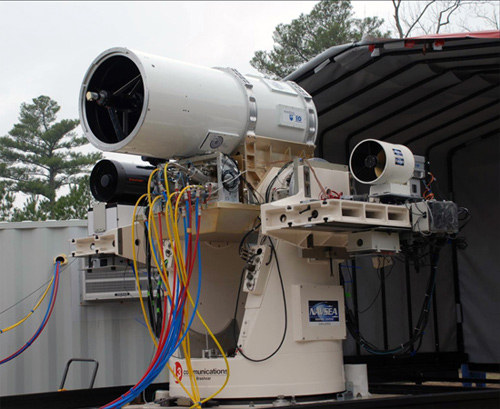
LaWS
For years, the U.S. Navy has been pursuing a workable ray gun that could provide a leap ahead in ship self-defenses. Now, with a series of tests of a system called the Laser Weapon System, or LaWS), it may be one step closer to that goal.
Naval Sea Systems Command (NAVSEA), the service’s technology development arm, announced today that LaWS had “successfully tracked, engaged, and destroyed” a drone in flight, during an over-the-water engagement at San Nicholas Island, Calif.
It’s certainly not the first time lasers have shot down an unmanned aerial vehicle — last year, the Air Force zapped several drones with beam weapons in a series of tests at China Lake, Calif. — but this test brings an additional bit of realism — and an extra technical challenge. Laser beams can lose strength as they move through the moist, salty sea atmosphere above the sea, so the Navy needs directed-energy weapons that can work effectively on ships.
The LaWS is essentially a laser upgrade to the MK 15 Close In Weapon System (CIWS), a.k.a. the Phalanx gun, a radar-guided autocannon that is already installed on Navy surface combatants. According to NAVSEA, the system tested (shown here) fired a laser through a beam director installed on a tracking mount, which in turn was controlled by a Mk 15 CIWS. That’s the basically same system that controls the Phalanx.
Cries From the Past: Torture’s Ugly Echoes
June 1st, 2010This is too long for general interest Cryptogonner reading, but well worth it for those who are interested in the mind control subject matter.
Via: Truthout:
A central Artichoke objective, according to one CIA document, centered on: “The problem exists of ascertaining whether effective and practical techniques exist, or could be developed, which could be utilized to render an individual subservient to an imposed will or control, thereby posing a potential threat to National Security.” [Italics added]
The same document explained that the Agency also wanted to put the same techniques to their own effective uses in the field offensively. Reads the document: “We need to also explore the ‘subtle’ means of making an individual say or do things he would normally not consider through the use of covertly administered drugs, ‘Black Psychiatry’*, hypnosis, and brain damaging processes. Dr. Chadwell feels these processes may be tried but they are ‘elaborate, impractical and unnecessary.'”[Italics added. Dr. Chadwell was H. Marshall Chadwell, the CIA’s director of Scientific Intelligence.]
A subsequent April 1954 Artichoke Conference meeting, attended by Frank Olson’s Fort Detrick superior, Col. Vincent Ruwet, explored the real nitty-gritty of Artichoke experimentation. Noted a CIA report on the meeting, “It was also recognized [by conference participants] that if Morse Allen and his group could produce bodies and if certain very rough, primitive, and ultimate tests could be carried out then a more accurate prediction could be made in connection with the ultimate goal of the group which is the running of selected foreign nationals back into Europe for specific work for this Agency.”
CIA Security Research chief Paul Gaynor, attending the same Artichoke Conference meeting, reminded the gathered Agency and Fort Detrick officials, “All individuals can be broken under mental and physical assaults and by such techniques as denying sleep, exhaustion, persuasion, starvation, pain, humiliation, and sickness.”




