AmTrust Largest of Six Bank Failures on FDIC Friday
December 6th, 2009Via: RTT News:
Regulators on Friday shut down six U.S. banks, taking the total number of bank closures in the year to 130. The banks closed on Friday include AmTrust Bank in Ohio, which is the fourth-largest bank to fail this year.
The Federal Deposit Insurance Corporation, or FDIC, said it took over AmTrust Bank, based in Cleveland, with about $12 billion in assets and approximately $8 billion in deposits.
The family-owned AmTrust had been in trouble for more than a year following its aggressive foray into mortgage and construction lending. The bank’s failure is expected to cost the federal deposit insurance fund about $2 billion.
New York Community Bancorp Inc., Westbury, New York, will acquire AmTrust and its 66 branches. In addition to assuming all of the deposits of the failed bank, New York Community Bank has agreed to purchase approximately $9.0 billion in assets of AmTrust Bank. The FDIC will retain the remaining assets for later disposition.
Last fall, AmTrust’ primary regulator, the Office of Thrift Supervision or OTS, had rejected the bank’s requests for aid through the federal government’s Troubled Asset Relief Program, or TARP. AmTrust operated under OTS’ approved risk reduction plan since the start of 2009, but the bank was unable to comply with the minimum capital requirements.
Attempts to find an investor to recapitalize the bank, which was first established in 1889 as The Ohio Savings and Loan Company, were unsuccessful.
The FDIC also seized three Georgia banks on Friday – Buckhead Community Bank in Atlanta, First Security National Bank in Norcross, and Tattnall Bank in Reidsville. State Bank and Trust Company, Macon, Georgia, will assume all of the deposits of First Security National Bank and Buckhead Community Bank, while HeritageBank of the South, Albany, Georgia, will assume all of the deposits of Tattnall Bank.
THE FDIC also said it closed Benchmark Bank, based in Aurora, Illinois, and entered into a purchase and assumption agreement with MB Financial Bank, National Association, Chicago Illinois, to assume all of the deposits of Benchmark Bank.
Greater Atlantic Bank of Reston, Virginia was also shuttered by the regulators. To protect the depositors, the FDIC entered into a purchase and assumption agreement with Sonabank, McLean, Virginia, to assume all of the deposits of Greater Atlantic Bank.
A total of 130 lenders have collapsed in 2009, the highest number of failures since 1992 as regulators have intensified their push to rid the industry of weak financial institutions. The number of failed banks in 1992 were 179.
Man Controlled Robotic Hand with Thoughts
December 5th, 2009Via: AP:
An Italian who lost his left forearm in a car crash was successfully linked to a robotic hand, allowing him to feel sensations in the artificial limb and control it with his thoughts, scientists said Wednesday.
During a one-month experiment conducted last year, 26-year-old Pierpaolo Petruzziello felt like his lost arm had grown back again, although he was only controlling a robotic hand that was not even attached to his body.
“It’s a matter of mind, of concentration,” Petruzziello said. “When you think of it as your hand and forearm, it all becomes easier.”
Though similar experiments have been successful before, the European scientists who led the project say this was the first time a patient has been able to make such complex movements using his mind to control a biomechanic hand connected to his nervous system.
The challenge for scientists now will be to create a system that can connect a patient’s nervous system and a prosthetic limb for years, not just a month.
The Italy-based team said at a news conference in Rome on Wednesday that in 2008 it implanted electrodes into the nerves located in what remained of Petruzziello’s left arm, which was cut off in a crash some three years ago.
The prosthetic was not implanted on the patient, only connected through the electrodes. During the news conference, video was shown of Petruzziello as he concentrated to give orders to the hand placed next to him.
During the month he had the electrodes connected, he learned to wiggle the robotic fingers independently, make a fist, grab objects and make other movements.
“Some of the gestures cannot be disclosed because they were quite vulgar,” joked Paolo Maria Rossini, a neurologist who led the team working at Rome’s Campus Bio-Medico, a university and hospital that specializes in health sciences.
The euro2 million ($3 million) project, funded by the European Union, took five years to complete and produced several scientific papers that have been submitted to top journals, including Science Translational Medicine and Proceedings of the National Academy of Sciences, Rossini said.
After Petruzziello recovered from the microsurgery he underwent to implant the electrodes in his arm, it only took him a few days to master use of the robotic hand, Rossini said. By the time the experiment was over, the hand obeyed the commands it received from the man’s brain in 95 percent of cases.
Britain: Cash Prizes for Catching CCTV Criminals
December 5th, 2009Via: BBC:
There are 4.2 million CCTV cameras in Britain watching our every move.
In London, there are more CCTV cameras than any other city in the world with one camera for every eight Londoners.
But as victims of crime have found to their cost, catching criminals on camera is dependent on the equipment being both monitored and maintained.
BBC Inside Out’s investigation has found that all too often Big Brother either is not watching, had a broken camera, lost the footage or could not be bothered to go through the tapes.
Even within the Metropolitan Police itself, there are differences of opinion about the value of CCTV.
One senior Met officer, Mick Neville, described London’s CCTV network as an “utter fiasco”, claiming it takes 1,000 cameras to solve just one crime per year.
But another senior Met officer disagrees. Detective Chief Inspector Julian Worker said: “For me, it is the most useful tool amongst the armoury of investigative tools that the Metropolitan Police and other police services throughout the country use. We are probably market leaders in the way that we utilise CCTV.”
One UK businessman thinks he has come up with a solution by recruiting volunteers to watch live CCTV footage streamed over the web in return for cash prizes.
Businessman Tony Morgan sees his company, Internet Eyes, as the future with an army of volunteer spies monitoring live CCTV footage online and alerting police to any criminal activity they witness.
Their only incentive is a monthly prize of £1,000 for the best crime spotter of the month yet more than 10,000 recruits have already signed up.
The Death of Mike Connell
December 5th, 2009Via: Brad Blog:
On December 18, 2008, Bush IT expert Mike Connell, a highly skilled pilot, was killed in a sudden crash while flying his small aircraft from Washington DC to his Akron/Canton home airport. The cause of the crash is still unknown and under investigation by the National Transportation Safety Board.
…
Although mainly un-reported, there’s a great deal of controversy surrounding Connell’s death – largely in part because he was the architect of many Republican websites including GeorgeWBush.com and GWB43.com, the site Karl Rove used for 95% of his email correspondence. Connell was also considered a key witness in the election fraud lawsuit King Lincoln Bronzeville Neighborhood Association v. Blackwell. The suit implicates Former Ohio Secretary of State Kenneth J. Blackwell, Karl Rove and others of 2004 election night vote rigging.
Attorneys in the case believe that Connell, who had not been accused of any wrongdoing, had firsthand knowledge about the missing White House emails and Rove’s alleged wrongdoing with respect to the 2004 Presidential election.
U.S. Senator Jim Bunning on Ben Bernanke: “Your Fed has become the The Creature from Jekyll Island”
December 5th, 2009Related: The Creature from Jekyll Island by G. Edward Griffin
Gold: Down $46, Quasi Shooting Star for the Week
December 5th, 2009WARNING: This is not a recommendation to buy, sell or hold any financial instrument.
This is from Questions on Gold, November 13, 2009:
Shorter term dollar bears and gold bulls, that upper channel line is your line in the sand.
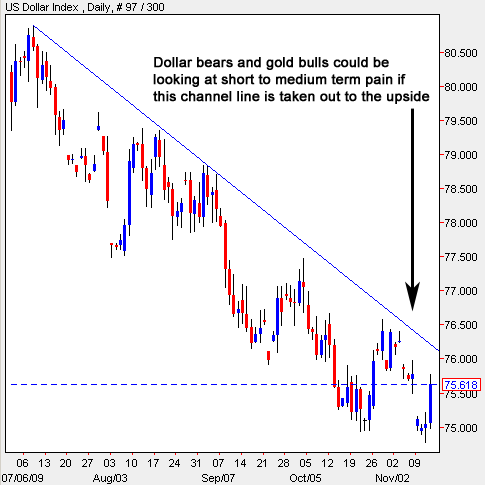
U.S. Dollar Index, Daily Interval
Short to medium outlook dollar bears and gold bulls: Stay the course as long as the downtrending channel on the USDX remains intact. Keep in mind, however, that a move up and out of the downtrending channel on the USDX above could mean substantial pain in the weeks and months ahead for dollar bears and gold bulls.
Now, let’s look at some charts with today’s closes printed. Anyone who has been following along doesn’t need this explained yet again. In case it’s not clear, here’s the summary:
There is an uptrending support line on the USDX that goes back to March 2008. The USDX is subtly indicating that it is going to bounce off of that support. On gold, we see a weekly quasi shooting star—a bearish pattern—that occurred after gold reached a new high. It is not a “text book” shooting star because there is some candle shadow below the body, indicating that bargain hunters were still buying. This bearish formation, however, must be considered along with the bullish divergence and channel breaks on the USDX.

U.S. Dollar Index Daily Interval

U.S. Dollar Index Weekly Interval

Spot Gold Weekly Interval
FCC Now Planning “All-IP” Phone Transition
December 5th, 2009Via: Ars:
The writing is on the wall for old school circuit-switched phone networks, and the world is going all-IP. Now, the FCC is gathering data to guide the next major transition of the country’s communications network.
Fat Finger: Tokyo Stock Exchange Told to Pay $121 Million in Damages
December 5th, 2009Via: BBC:
A Japanese court has ordered the Tokyo Stock Exchange (TSE) to pay 10.7bn yen ($121m; £73m) in damages for failing to stop a huge trading error in 2005.
The TSE must pay Mizuho Securities the compensation after admitting that a system fault prevented a trader from cancelling an erroneous share sale.
The trader had entered an order to sell 610,000 shares for one yen each instead of one share at 610,000 yen.
The error cost the firm 40.7bn yen. The TSE said it would consider appealing.
Google Offers Public DNS Service
December 4th, 2009Update: Some Thoughts on Google DNS
Interesting post from the CEO of DNS services company OpenDNS, who probably feels the bull’s-eye painted on his chest:
Google claims that this service is better because it has no ads or redirection. But you have to remember they are also the largest advertising and redirection company on the Internet. To think that Google’s DNS service is for the benefit of the Internet would be naive. They know there is value in controlling more of your Internet experience and I would expect them to explore that fully…
…It’s not clear that Internet users really want Google to keep control over so much more of their Internet experience than they do already — from Chrome OS at the bottom of the stack to Google Search at the top, it is becoming an end-to-end infrastructure all run by Google, the largest advertising company in the world. I prefer a heterogeneous Internet with lots of parties collaborating to make this thing work as opposed to an Internet run by one big company.
—End Update—
Update: What if DNS on my ISP sucks?
Someone mentioned that this could be helpful for people who use an ISP with crappy DNS. Ok, so if you don’t want to change ISPs pick a nearby university (public or private) type its name into a search engine along with DNS. Click around for a few seconds and you’re likely to find the DNS server addresses. I’m not saying that all of them offer public DNS, but many of them do.
—End Update—
My only commentary would be: You’d have to be out of your f*&%$#@ mind to use this.
But here’s a more balanced view, if you want it.
Via: PCWorld:
Today’s news can prompt two very different views of Google, based on the announcement of its free Google Public DNS.
In one view, Google is our best friend and a noble public servant. In the other, Google may be the darkest force on the Internet. Which is it? We all must decide.
Here’s the news: Today Google has begun offering an experimental, but stable, Public Domain Name Server (DNS), described in a Thursday post to Google’s Official Blog.
The goal is for the new DNS to increase browsing speed and improve Internet security. I have read the technical description and believe it to the extent that I have already changed the DNS at my office to point to the new Google Public DNS. It is, however, too early to tell if my browsing has become faster.
…
The downside is that Google’s Public DNS will also give the Internet giant an unparalleled look what people are doing on the Internet. It will, for example, be able to log every DNS request made by every user of its system. If that doesn’t frighten you at least a little, it perhaps ought to.
While I generally trust Google, whose response to most paranoia is, “Why would we risk our whole business to do something as stupid as that?” I am aware that many others don’t trust the company and feel they have good reasons.
We also don’t know about “passive” uses for all the data Google collects. Things we are not aware of but wouldn’t like if we knew about them. I am not accusing, just making the case that Google’s activities require careful monitoring.
Do I believe Google tries to do the right thing? Yes, but I am also one of the few people who generally trusts Microsoft and always trusts Bill Gates. The paranoids say I am a fool.
Will Update Later
December 4th, 2009We’re back home from Auckland, but all I wanted to do was watch Moon (which I highly recommend for sci-fi fans), and now it’s late/early.
Updates will resume in about 12 hours.




