Iranian Commanders Assassinated
October 18th, 2009Update: Iran Blames “Foreign Elements” for Attack on Guards
Via: Reuters:
Iran’s Revolutionary Guards accused “foreign elements” linked to the United States of involvement in Sunday’s attack that killed at least two senior commanders of the elite force, state television reported.
“Surely foreign elements, particularly those linked to the global arrogance, were involved in this attack,” a Guards statement quoted by television said. Iran often uses the term “global arrogance” to refer to the United States, its old foe.
—End Update—
Via: BBC:
Several top commanders in Iran’s elite Revolutionary Guard have been killed in a suicide bombing in the volatile south-east of the country.
Iranian state media say at least 20 people have died in the attack, in the province of Sistan-Baluchistan, and dozens more injured.
The commanders were in the region for a meeting with tribal leaders.
No group has claimed responsibility for the attack, which was condemned by Iran’s Parliamentary Speaker.
Iran has previously accused a Sunni resistance group, Jundallah, of terrorist activities in the province.
Sistan-Baluchistan is mainly made up of the Baluchi ethnic group who are Sunni Muslims, some of whom oppose Shia rule.
The deputy commander of the Guard’s ground force, General Noor Ali Shooshtari, and the Guard’s chief provincial commander, Rajab Ali Mohammadzadeh, were among the dead, Irna state news agency reported.
Parliamentary speaker Ali Larijani, speaking at an open session of parliament which was broadcast live of state radio, said: “We express our condolences for their martyrdom.
“The intention of the terrorists was definitely to disrupt security in Sistan-Baluchistan Province.”
India: Chartered U.S. Aircraft Forced to Land at Mumbai Airport; “Confusion About Its Call Sign”; 205 Marines Aboard
October 18th, 2009Via: Times of India:
A US aircraft with 205 American marine commandos on board was on Sunday made to land at Mumbai airport for allegedly violating the Indian airspace.
The chartered plane was on its way from Fujiriah in UAE to Bangkok, an airport official said. The aircraft was using a civilian call sign, officials said.
“A US aircraft with 205 US Marines on board, on its way from Fujiriah to Bangkok, was forced to land in Mumbai while overflying Indian airspace as there was some confusion about its call sign,” a Mumbai airport spokesperson said.
The aircraft landed at Mumbai airport on Sunday morning and has been parked at a remote bay, the spokesperson said adding, all passengers are on board. Indian Air Force is looking into the issue, the spokesperson said.
Meanwhile, US authorities said they were in touch with relevant officials to resolve the issue after a US chartered aircraft was forced to land at Mumbai airport for alleged violation of the Indian airspace.
“We are aware of the situation, and are in touch with relevant officials to resolve this issue, which is a routine matter,” a US embassy spokesperson said.
Six Accused of Insider Trading After Wiretapping Investigation
October 18th, 2009This case is a joke—not because the people involved aren’t crooks, but because the amounts of money involved are noise level.
The Feds plucked some low hanging douche bags and put them on display for the retail investor to see as part of a confidence trick.
“Behold, retail investor, we’re using ‘powerful investigative tools’ to bust the crooks who plague our markets. Go back to sleep. Dow 10,000. Green shoots.”
Via: Los Angeles Times:
Federal authorities shook the often secretive world of hedge funds with the arrests Friday of the billionaire founder of a major New York operation and five others on charges they engaged in extensive insider trading that allegedly netted more than $20 million in illicit profits.
After taking the unusual step of using wiretaps in the investigation, authorities accused Raj Rajaratnam, the founder of the $7-billion hedge fund Galleon Group, two executives at California companies and three others of multiple counts of conspiracy and securities fraud.
It’s the biggest criminal case involving hedge fund insider trading, said Preet Bharara, the U.S. attorney for Manhattan, and is believed to be the first time that court-authorized wiretaps have been used in insider-trading cases.
“This aggressive use of wiretaps is important. It shows that we are targeting white-collar insider trading rings with the same powerful investigative tools that have worked so successfully against the mob and drug cartels,” Bharara said.
…
According to the SEC, Goel gave Rajaratnam information about Intel’s quarterly earnings and about a joint venture with Clearwire Corp., a wireless broadband technology company. In exchange, Rajaratnam made $250,000 by trading shares of Hilton and PeopleSupport Inc. in Goel’s private account at Charles Schwab, the agency alleged.
The criminal case is based partly on information provided by an informant who had traded tips with Rajaratnam. The informant has pleaded guilty and agreed to wear a wire to record conversations with Rajaratnam.
Wiretaps are expensive and time-consuming, requiring FBI agents to listen to hours of phone calls.
“You don’t see wiretaps used frequently in securities investigations,” said Steve Peikin, the former head of the securities fraud unit at the Manhattan U.S. attorney’s office. “The use of wiretaps reflects that the government thinks this is serious conduct involving a significant amount of money.”
Among the conversations recorded was a July 2008 phone call in which Chiesi told Rajaratnam that Akamai Technologies Inc. in Cambridge, Mass., was going to lower its earnings projections.
“They’re gonna guide down,” Chiesi allegedly said. “I just got a call from my guy.”
In a call a month later, Chiesi pressed Moffat to keep quiet about information they were allegedly sharing about a reorganization at Advanced Micro.
“You put me in jail if you talk,” Chiesi said, adding, “I’m dead if this leaks. I really am . . . and my career is over. I’ll be like Martha [expletive] Stewart.”
Russia’s Leaders See Chinese Fascism as Template for Governance
October 18th, 2009Via: New York Times:
Nearly two decades after the collapse of the Communist Party, Russia’s rulers have hit upon a model for future success: the Communist Party.
Or at least, the one that reigns next door.
Like an envious underachiever, Vladimir V. Putin’s party, United Russia, is increasingly examining how it can emulate the Chinese Communist Party, especially its skill in shepherding China through the financial crisis relatively unbowed.
United Russia’s leaders even convened a special meeting this month with senior Chinese Communist Party officials to hear firsthand how they wield power.
In truth, the Russians express no desire to return to Communism as a far-reaching Marxist-Leninist ideology, whether the Soviet version or the much attenuated one in Beijing. What they admire, it seems, is the Chinese ability to use a one-party system to keep tight control over the country while still driving significant economic growth.
It is a historical turnabout that resonates, given that the Chinese Communists were inspired by the Soviets, before the two sides had a lengthy rift.
For the Russians, what matters is the countries’ divergent paths in recent decades. They are acutely aware that even as Russia has endured many dark days in its transition to a market economy, China appears to have carried out a fairly similar shift more artfully.
The Russians also seem almost ashamed that their economy is highly dependent on oil, gas and other natural resources, as if Russia were a third world nation, while China excels at manufacturing products sought by the world.
“The accomplishments of China’s Communist Party in developing its government deserve the highest marks,” Aleksandr D. Zhukov, a deputy prime minister and senior Putin aide, declared at the meeting with Chinese officials on Oct. 9 in the border city of Suifenhe, China, northwest of Vladivostok. “The practical experience they have should be intensely studied.”
Mr. Zhukov invited President Hu Jintao, general secretary of the Chinese Communist Party, to United Russia’s convention, in November in St. Petersburg.
The meeting in Suifenhe capped several months of increased contacts between the political parties. In the spring, a high-level United Russia delegation visited Beijing for several days of talks, and United Russia announced that it would open an office in Beijing for its research arm.
The fascination with the Chinese Communist Party underscores United Russia’s lack of a core philosophy. The party has functioned largely as an arm of Mr. Putin’s authority, even campaigning on the slogan “Putin’s Plan.” Lately, it has championed “Russian Conservatism,” without detailing what exactly that is.
Indeed, whether United Russia’s effort to learn from the Chinese Communist Party is anything more than an intellectual exercise is an open question.
Whatever the motivation, Russia in recent years has started moving toward the Chinese model politically and economically.
U.S. Spends $400 Per Gallon of Gas in Afghanistan
October 17th, 2009Via: The Hill:
The Pentagon pays an average of $400 to put a gallon of fuel into a combat vehicle or aircraft in Afghanistan.
The statistic is likely to play into the escalating debate in Congress over the cost of a war that entered its ninth year last week.
Pentagon officials have told the House Appropriations Defense Subcommittee a gallon of fuel costs the military about $400 by the time it arrives in the remote locations in Afghanistan where U.S. troops operate.
“It is a number that we were not aware of and it is worrisome,” Rep. John Murtha (D-Pa.), the chairman of the House Appropriations Defense panel, said in an interview with The Hill. “When I heard that figure from the Defense Department, we started looking into it.”
The Pentagon comptroller’s office provided the fuel statistic to the committee staff when it was asked for a breakdown of why every 1,000 troops deployed to Afghanistan costs $1 billion. The Obama administration uses this estimate in calculating the cost of sending more troops to Afghanistan.
The Obama administration is engaged in an internal debate over its future strategy in Afghanistan. Part of this debate concerns whether to increase the number of U.S. troops in that country.
The top U.S. general in Afghanistan, Stanley McChrystal, reportedly has requested that about 40,000 additional troops be sent.
Democrats in Congress are divided over whether to send more combat troops to stabilize Afghanistan in the face of waning public support for the war.
Any additional troops and operations likely will have to be paid for through a supplemental spending bill next year, something Murtha has said he already anticipates.
Afghanistan — with its lack of infrastructure, challenging geography and increased roadside bomb attacks — is a logistical nightmare for the U.S. military, according to congressional sources, and it is expensive to transport fuel and other supplies.
A landlocked country, Afghanistan has no seaports and a shortage of airports and navigable roads. The nearest port is in Karachi, Pakistan, where fuel for U.S. troops is shipped.
From there, commercial trucks transport the fuel through Pakistan and Afghanistan, sometimes changing carriers. Fuel is then transferred to storage locations in Afghanistan for movement within the country. Military transport is used to distribute fuel to forward operating bases. For many remote locations, this means fuel supplies must be provided by air.
One of the most expensive ways to supply fuel is by transporting it in bladders carried by helicopter; the amount that can be flown at one time can barely satisfy the need for fuel.
The cheapest way to transport fuel is usually by ship. Other reasonable methods to provide fuel are by rail and pipeline. The prices go up exponentially when aircraft are used, according to congressional sources.
The $400 per gallon reflects what in Pentagon parlance is known as the “fully burdened cost of fuel.”
“The fully burdened cost of fuel is a recognition that there are a lot of other factors that come into play,” said Mark Iden, the deputy director of operations at the Defense Energy Support Center (DESC), which provides fuel and energy to all U.S. military services worldwide.
The DESC provides one gallon of JP8 fuel, which is used for both aircraft and ground vehicles, at a standard price of $2.78, said Iden.
Thousands at Cow Palace Seeking Mortgage Help
October 17th, 2009Via: San Francisco Chronicle:
The Cow Palace, site of rodeos and rock concerts, was transformed into a foreclosure-prevention fair on Friday that drew thousands of struggling borrowers hoping for help to make their mortgages more affordable.
Armed with sleeping bags or folding chairs, many spent a chilly night on the pavement outside the Daly City event center.
“I’m just trying to keep my house,” said Gerasim Karapetian of Yorba Linda (Orange County), as he waited in the bleachers to meet with a loan counselor. “I drove eight hours, got here at 2 a.m., and waited outside all night. The line wrapped around the whole parking lot.”
He was among more than 4,000 people from around California and neighboring states who converged on the Save the Dream tour organized by NACA, the Neighborhood Assistance Corp. of America, a Massachusetts nonprofit ( www.naca.com).
The five-day event continues through Tuesday. Similar NACA tours in Cleveland, Chicago, St. Louis, Atlanta, Phoenix, Los Angeles and Las Vegas drew huge crowds, reflecting the nationwide spread of the foreclosure crisis.
The Cow Palace arena’s concrete floor was a beehive of purposeful activity, set up with 300 tables where NACA counselors wearing bright red or yellow T-shirts met one-on-one with homeowners to enter their financial information into software for transmission to their lenders – who were across the hall. Banks sent dozens of representatives to review homeowners’ cases and in some cases modify their loans on the spot to make them more affordable.
Research Credit: ottilie
LATIN AMERICAN REGIONAL CURRENCY: SUCRE
October 17th, 2009Via: AFP:
Leftist Latin American leaders agreed here on the creation of a regional currency, the Sucre, aimed at scaling back the use of the US dollar.
Nine countries of ALBA, a leftist bloc conceived by Venezuelan President Hugo Chavez, met in Bolivia where they vowed to press ahead with a new currency for intra-regional trade to replace the US dollar.
“The document is approved,” said Bolivia’s President Evo Morales, who is hosting the summit.
The new currency, dubbed the Sucre, would be rolled out beginning in 2010 in a non-paper form.
That move echoes the European Union’s introduction of the euro precursor, the ECU, an account unit designed to tie down stable exchange rates between member states before the national currencies were scraped.
ALBA’s member states are Venezuela, Bolivia, Cuba, Ecuador, Nicaragua, Honduras, Dominica, Saint Vincent and Antigua and Barbuda.
The currency, which was backed in April this year, is named after Jose Antonio de Sucre, who fought for independence from Spain alongside Venezuelan hero Simon Bolivar in the early 19th century.
The bloc also called for the replacement of the World Bank’s International Centre for Settlement of Investment Disputes, which arbitrates international contract disputes and has probed a slew of disputes involving ALBA members and western energy firms.
Most ALBA members have already withdrawn from the organization, with Ecuador announcing last July that it would pull out of the group.
On Friday Bolivian media reported the country intents to nationalize a electricity distribution firm owned by Spain’s Red de Electrica de Espana.
It is just the latest in a series of nationalizations in Venezuela, Ecuador and Bolivia.
In May, Venezuela nationalized 74 energy services firms operating in the oil-rich Maracaibo Lake region.
Bolivia’s Evo Morales has indicated that parts for his country’s energy and rail sectors will be nationalized.
The Man Who Paid the Men Who Stare at Goats
October 17th, 2009Via: Madcowprod:
The man who owned the flight school that taught Mohamed Atta to fly got rich selling his insurance company, we have learned, to the man who PAID “The Men Who Stare at Goats.”
Wally Hilliard’s links to American intelligence go back (at least) to November of 1981, when his insurance company, Wisconsin Employer’s Group, was bought out by Myron Du Bain, a World War II OSS/CIA operative and the Chairman of Fireman’s Fund of San Francisco.
We discovered the connection in a trip to Green Bay several years ago.
But only recently did we learn that Myron Du Bain’s life-long ties to the CIA included two stints at the helm of the Stanford Research Institute (SRI), famous for its classified research into psychic viewing, the results of which are currently on display in “The Men Who Stare at Goats.”
Change We Can Believe In: Obama Honors George H.W. Bush for Public Service
October 17th, 2009And all the crises and reforms (real reforms, too) so occupied the people that they did not see the slow motion underneath, of the whole process of government growing remoter and remoter…
The dictatorship, and the whole process of its coming into being, was above all diverting. It provided an excuse not to think for people who did not want to think anyway.
—Milton Mayer, They Thought They Were Free
The argument that the two parties should represent opposed ideals and policies, one, perhaps, of the Right and the other of the Left, is a foolish idea acceptable only to doctrinaire and academic thinkers. Instead, the two parties should be almost identical, so that the American people can ‘throw the rascals out’ at any election without leading to any profound or extensive shifts in policy.
—Carroll Quigley, Tragedy and Hope: A History of the World in our Time
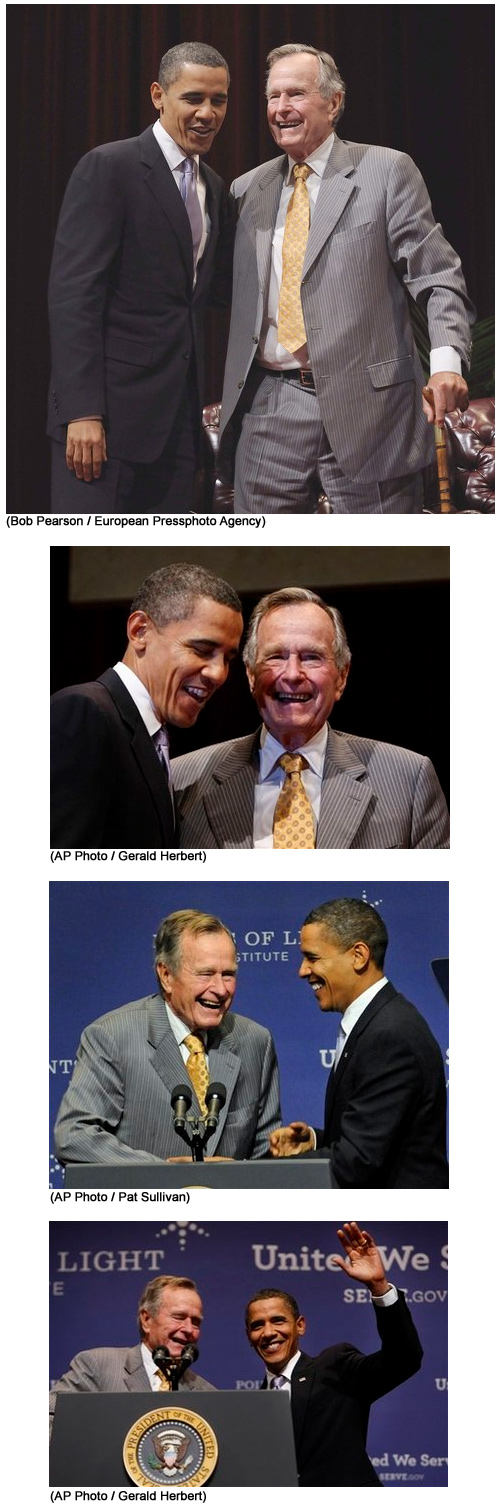
Obama Senior
Via: Los Angeles Times:
Reporting from College Station, Texas – In a glowing tribute to a Republican predecessor, President Obama on Friday praised President George H.W. Bush as an example of someone who eschewed “a life of comfort and privilege” and instead devoted himself to public service — inside government and out.
During an evening speech to honor the public service institute that Bush founded two decades ago, Obama called for cooperation between Republicans and Democrats. The former president, he said, proved that “the R or D next to your name is irrelevant” in challenging times.
“You might not always know it from watching the cable news shows or listening to folks on the radio,” Obama said, but “I think we’re standing in one of those moments.”
For his part, Bush reflected on Obama — the man who succeeded his son, President George W. Bush — as someone who at their initial meeting showed greater concern for Hurricane Katrina evacuees than for the television cameras.
“He came without fanfare,” Bush said of Obama’s 2005 visit to the region. “He was someone I could quickly see was genuinely concerned about helping others.”
They were joined onstage Friday in the Texas A&M University auditorium by Defense Secretary Robert M. Gates, who also served in the previous administration and was CIA director under the elder Bush.
The event presented a slightly odd situation, given that Obama’s administration has at times broadcast a rejection of policies and ideas under George W. Bush.
On Thursday, Obama had fielded tough questions in New Orleans about the federal response in the four years since Katrina. And he was not subtle in pointing to the failings of the younger Bush’s administration.
Friends of George H.W. Bush said that he has a genuine regard for Obama and that he came up with the idea six months ago of inviting the president to come to this college town to celebrate the 20th anniversary of the Points of Light Institute.
The former president is said to be unhappy with the Bush-bashing in Washington, but one former advisor said George H.W. Bush doesn’t hold it against Obama.
“Politics is politics,” said Ron Kaufman, a former White House political director. “But some things are bigger than that. He, like other Americans, would like to see the president be successful.”
Nevertheless, in the heart of Republican country, Obama inspired some protests and criticism.
Outside the auditorium Friday, a crowd of more than 100 chanted and waved signs, including one about the Obama administration’s spending and one about the national debt.
Inside, Bush had put together a polite and enthusiastic crowd.
The former president, who celebrated his 85th birthday in June with a parachute jump, walked gingerly with a cane. But he spoke in an unwavering voice of his admiration for Obama.
The evening was devoted to lauding the work of the Points of Light Institute, the name of which comes from a speech Bush gave envisioning the combined effect of individuals in public service.
Obama called on the audience of mostly college students to find time in their lives for service, even when it isn’t convenient or easy.
If the senior Bush could serve in combat missions overseas, Obama said, then “you can keep going when your service project gets tough.”
“He didn’t call for one blinding light shining from Washington,” Obama said. “He didn’t just call for a few bright lights from the biggest nonprofits. . . . He called for a vast galaxy of people and institutions working to solve problems in their own backyard.”
2009 Federal Deficit Surges to $1.42 Trillion
October 17th, 2009Via: AP:
What is $1.42 trillion? It’s more than the total national debt for the first 200 years of the Republic, more than the entire economy of India, almost as much as Canada’s, and more than $4,700 for every man, woman and child in the United States.
It’s the federal budget deficit for 2009, more than three times the most red ink ever amassed in a single year.
And, some economists warn, unless the government makes hard decisions to cut spending or raise taxes, it could be the seeds of another economic crisis.
Treasury figures released Friday showed that the government spent $46.6 billion more in September than it took in, a month that normally records a surplus. That boosted the shortfall for the full fiscal year ending Sept. 30 to $1.42 trillion. The previous year’s deficit was $459 billion.
As a percentage of U.S. economic output, it’s the biggest deficit since World War II.
“The rudderless U.S. fiscal policy is the biggest long-term risk to the U.S. economy,” says Kenneth Rogoff, a Harvard professor and former chief economist for the International Monetary Fund. “As we accumulate more and more debt, we leave ourselves very vulnerable.”
Forecasts of more red ink mean the federal government is heading toward spending 15 percent of its money by 2019 just to pay interest on the debt, up from 5 percent this fiscal year.
President Barack Obama has pledged to reduce the deficit once the Great Recession ends and the unemployment rate starts falling, but economists worry that the government lacks the will to make the hard political choices to get control of the imbalances.
Friday’s report showed that the government paid $190 billion in interest over the last 12 months on Treasury securities sold to finance the federal debt. Experts say this tab could quadruple in a decade as the size of the government’s total debt rises to $17.1 trillion by 2019.
Without significant budget cuts, that would crowd out government spending in such areas as transportation, law enforcement and education. Already, interest on the debt is the third-largest category of government spending, after the government’s popular entitlement programs, including Social Security and Medicare, and the military.
As the biggest borrower in the world, the government has been the prime beneficiary of today’s record low interest rates. The new budget report showed that interest payments fell by $62 billion this year even as the debt was soaring. Yields on three-month Treasury bills, sold every week by the Treasury to raise fresh cash to pay for maturing government debt, are now at 0.065 percent while six-month bills have fallen to 0.150 percent, the lowest ever in a half-century of selling these bills on a weekly basis.
The risk is that any significant increase in the rates at Treasury auctions could send the government’s interest expenses soaring. That could happen several ways — higher inflation could push the Federal Reserve to increase the short-term interest rates it controls, or the dollar could slump in value, or a combination of both.




