Power Out Again
October 17th, 2009The storm took out the power. I’m on battery backup now. Anyway, you know the story. No updates probably means that the power is out.
Goldman Exec Named First COO of SEC Enforcement
October 17th, 2009The money is so dirty now, the gains so ill-gotten, that the most diabolical of ALL Wall Street firms needs to create a PRIVATE exchange because the existing bogus securities laws (WorldCom, Enron, blah blah) are too cumbersome and time consuming!?
Watch this space; if you dare.
I was mid sip of coffee as I was skimming headlines in the feed reader. I’m still sputtering.
Appropriately, there’s a thunder storm passing over us right now. The thunderclaps are long, low and ominous.
Via: AP:
A Goldman Sachs executive has been named the first chief operating officer of the Securities and Exchange Commission’s enforcement division.
The market watchdog agency said Friday that Adam Storch, vice president in Goldman Sachs’ Business Intelligence Group, is assuming the new position of managing executive of the SEC division.
The move came as the SEC has been revamping its enforcement efforts following the agency’s failure to uncover Bernard Madoff’s massive fraud scheme for nearly two decades despite numerous red flags.
Storch, who will be responsible for project management and operations, will report to SEC Enforcement Director Robert Khuzami.
Along with the enforcement division’s deputy director, Storch also will supervise the SEC’s Office of Market Intelligence, with an eye to improving the monitoring, collection and analysis of the hundreds of thousands of tips and complaints the agency receives annually.
Before joining Goldman Sachs, Storch was a senior consultant at accounting firm Deloitte & Touche. He is a certified public accountant and certified fraud examiner, and has an MBA from New York University and bachelors of science in business administration from the State University of New York in Buffalo.
Storch has a strong background in technology systems and project management, Khuzami said in a statement. “He will help to make us more efficient and nimble, and permit us to put more of our investigators on the front lines to detect and stop fraud,” Khuzami said.
Khuzami, a former federal prosecutor who came to the SEC in March from Wall Street investment firm Deutsche Bank, says he has undertaken the most extensive restructuring of the enforcement division in at least 30 years.
One in Eight Girls Pregnant at Chicago High School
October 16th, 2009Via: CBS2Chicago:
It is a Chicago public school full of energy and spirit. It has about 800 girls, and 115 of them have something in common…
All those young ladies are moms or moms-to-be at Paul Robeson High School. It’s not a school for young mothers, it’s a neighborhood school. And all of the pregnancies have happened, despite prevention talk.
If you want to know why, the people closest to the situation say there’s no simple explanation.
Chicago Public Schools says it does not track the overall number of teen moms in the district. But Robeson Principal Gerald Morrow knows the count at his school in Englewood: 115 young ladies who are expecting.
Britain: Supranational Banking Organization May Be Needed
October 16th, 2009Funny how BIS isn’t mentioned.
Via: Reuters:
A global body with legal powers may be needed over time to enforce the world’s new financial rules, the Financial Services Authority (FSA) said on Wednesday.
The FSA’s newly appointed and first director of international affairs, Verena Ross, said the Financial Stability Board (FSB) was key to ensuring all gaps in regulation between securities, insurance and banking sectors were plugged.
Formerly known as the Financial Stability Forum, the FSB was expanded in April to include central bankers and finance ministry and regulatory officials from all Group of 20 (G20) countries.
The G20 has asked the body, chaired by Bank of Italy Governor Mario Draghi, to coordinate global efforts to introduce new financial rules in light of the sector’s worst crisis in 70 years.
“I would advocate to make sure the FSB have a strong secretariat to support their work,” Ross told a City and Financial Conference.
“The role of the FSB is crucial. We will need to make sure it is able to play its role forcefully… Success depends on real progress over the next six to 12 months,” she said.
But the board has no legal teeth and there are “real questions” about whether the world can continue with such informal arrangements in the longer term, Ross said.
There may be a case for exploring the need for a more formal global regulatory framework, such as a body with legal powers of enforcement like the World Trade Organisation, Ross added.
JAL, Asia’s Largest Airline, Near Bankruptcy
October 16th, 2009Via: Reuters:
Japan Airlines Corp shares slid 12 percent to a record low on Friday as investors suggested bankruptcy may be an option for Asia’s biggest airline by revenue, even as the government again pledged to support the troubled carrier.
“There’s increasing concern about the future of the company and whether it’s heading for a GM-style bankruptcy or not,” said Mitsushige Akino, chief fund manager at Ichiyoshi Investment Management.
The airline, plagued with high costs in a severe industry downturn, has asked creditors for 600 billion yen ($6.6 billion) in financial aid, including 300 billion yen in debt waivers and debt-for-equity swaps, as part of a restructuring plan, according to two sources familiar with the matter.
JAL shares fell to 100 yen, their lowest since they were re-listed in 2002. By the close, the stock was quoted at 101 yen, down more than 11 percent. The shares have lost a quarter of their value this week.
Civilians Unemployed – 15 Weeks & Over
October 16th, 2009Recovery.
Via: Federal Reserve Bank of St. Louis:
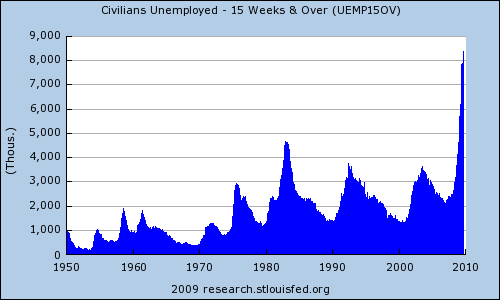
Long Term Unemployment
Drought: California Agriculture in Collapse
October 16th, 2009Via: AP:
As California prepares for its fourth year of drought, farmers are nervous in California’s San Joaquin Valley. The valley’s eight counties, if they were their own state, would be the top producing one in the nation. Nearly all the U.S. cantaloupes, garlic, almonds and processing tomatoes come from here. And so do nearly 400 other commodities — more than anywhere else.
The lack of water in the state’s reservoirs, coupled with the environmental collapse of the Sacramento-San Joaquin Delta where water from the state’s wet north is pumped south to irrigate fields, has restricted the amount of water some of the state’s most prolific farmers receive to as little as 10 percent of normal.
…
“You think we had a tough year this year?” said Marvin Meyers, an almond grower on Fresno County’s dry west side. “Wait ’til next year.”
Farmers and the advisory board of the California Department of Agriculture said the state’s $36 billion agriculture industry cannot afford another season of uncertainty. More packing houses they depend on to send their fruits, nuts and vegetables around the world will move to more reliable areas — across the border into Mexico they fear — if they cannot count on a reliable supply.
Another year of pumping salt-laden water from underground aquifers could kill their soil, they say. Board members warned that the Westlands Water District on the valley’s west side is the first to be hit by the crisis, but the water problems are spreading to the state’s other agricultural regions.
Some avocado growers in San Diego County are cutting trees back to stumps because the limited available water is too expensive.
“Where will the next shoe drop?” said board member Adan Ortega Jr.
Ireland: Top Insurer Tells 1,000 Doctors Not to Give Swine Flu Vaccine
October 16th, 2009Via: Independent:
An insurance company has warned 1,000 GPs not to administer the swine flu vaccine.
The HSE plans to enlist family doctors to give the swine flu vaccine to patients with pre-existing medical conditions.
But an insurance company which covers around 1,000 of the 2,200 to 2,500 GPs in the country advised them not to sign up for the work because of legal indemnity issues.
The HSE has given GPs until today to sign up to give the vaccine to 400,000 of their patients with certain medical conditions from next week.
Medisec Ireland, which covers around 1,000 GPs, told their members yesterday not to sign up until all indemnity issues were resolved.
GP sources said last night this may lead some doctors who have signed up to withdraw their participation in the programme.
In a letter to the doctors Medisec said it was unclear where a GP would legally stand if they exercised their discretion not to give the vaccine to their patients.
There are also unresolved legal issues around the doctors identifying and offering the vaccine to at-risk patients.
The company said the Irish Medical Organisation had been trying to negotiate an acceptable resolution to the serious medico/legal issues with the HSE, but had not been successful.
Other concerns relate to the cost of legal representation for doctors who may find themselves before their disciplinary body the Medical Council if they fail to give the vaccine to a patient.
They could also have to go before the same body for exercising their clinical judgment not to administer the vaccine to a patient of another doctor who had been referred to them.
Concern
The letter to GPs said that while the administration of the vaccine would be deemed normal work and covered by a doctor’s policy, the outstanding issues of concern might not fall into this category due to the amount of work involved and could lead to “adverse indemnity consequences”.
It added: “Accordingly, in the circumstances, we do not recommend our members to sign up for the programme until all issues have been resolved.”
The other company indemnifying doctors, the Medical Protection Society, is believed to have indicated GPs could go ahead with the vaccinations.
The HSE may have to extend today’s deadline for more clarification. It plans to publicise the rollout of the vaccine to at-risk patients tomorrow.
Sumitomo: Dollar May Drop to 50 Yen Next Year
October 16th, 2009Via: Bloomberg:
The dollar may drop to 50 yen next year and eventually lose its role as the global reserve currency, Sumitomo Mitsui Banking Corp.’s chief strategist said, citing trading patterns and a likely double dip in the U.S. economy.
“The U.S. economy will deteriorate into 2011 as the effects of excess consumption and the financial bubble linger,” said Daisuke Uno at Sumitomo Mitsui, a unit of Japan’s third- biggest bank. “The dollar’s fall won’t stop until there’s a change to the global currency system.”
The dollar last week dropped to the lowest in almost a year against the yen as record U.S. government borrowings and interest rates near zero sapped demand for the U.S. currency. The Dollar Index, which tracks the greenback against the currencies of six major U.S. trading partners, has fallen 15 percent from its peak this year to as low as 75.211 today, the lowest since August 2008.
The gauge is about five points away from its record low in March 2008, and the dollar is 2.5 percent away from a 14-year low against the yen.
“We can no longer stop the big wave of dollar weakness,” said Uno, who correctly predicted the dollar would fall under 100 yen and the Dow Jones Industrial Average would sink below 7,000 after the bankruptcy of Lehman Brothers Holdings Inc. last year. If the U.S. currency breaks through record levels, “there will be no downside limit, and even coordinated intervention won’t work,” he said.
China, India, Brazil and Russia this year called for a replacement to the dollar as the main reserve currency. Hossein Ghazavi, Iran’s deputy central bank chief, said on Sept. 13 the euro has overtaken the dollar as the main currency of Iran’s foreign reserves.
Elliott Wave
The greenback is heading for the trough of a super-cycle that started in August 1971, Uno said, referring to the Elliot Wave theory, which holds that market swings follow a predictable five-stage pattern of three steps forward, two steps back.
The dollar is now at wave five of the 40-year cycle, Uno said. It dropped to 92 yen during wave one that ended in March 1973. The dollar will target 50 yen during the current wave, based on multiplying 92 with 0.764, a number in the Fibonacci sequence, and subtracting from the 123.17 yen level seen in the second quarter of 2007, according to Uno.
The Elliot Wave was developed by accountant Ralph Nelson Elliott during the Great Depression. Wave sizes are often related by a series of numbers known as the Fibonacci sequence, pioneered by 13th century mathematician Leonardo Pisano, who discerned them from proportions found in nature.
Uno said after the dollar loses its reserve currency status, the U.S., Europe and Asia will form separate economic blocs. The International Monetary Fund’s special drawing rights may be used as a temporary measure, and global currency trading will shrink in the long run, he said.
Woman’s Life Ruined by Seasonal Flu Shot
October 16th, 2009Update: Hoax?
—End Update—
Via: WUSA9:
Many of you have been lining up to get the seasonal flu shot. But there is one Ashburn woman who wants you to hear her story before you do.
Desiree Jennings is trapped in her body. Intellectually she’s all there, but her muscles are fighting each other. She’s been diagnosed with dystonia, an extremely rare and debilitating neurological disease.
…
She says 10 days after getting a seasonal flu shot at a Reston grocery store in August, and on her second wedding anniversary, she got sick. First, she came down with flu like symptoms, then convulsions and blacking out.
She’s seen more than 60 doctors. She says all of them were stumped until Johns Hopkins diagnosed her with dystonia. She believes her seasonal flu shot triggered it.
Desiree says, “Nothing else explains such a fast moving neurological damage. The medical hospitals ruled out everything, CAT scans normal, blood normal, MRI normal. The only thing that explains it is the shot caused the neurologic damage.”
She says it is a strange disorder where muscles work against each other. She can’t walk forward, only backwards. She can run, but she can’t stop without help. She can whisper but has difficulty speaking. Noises can cause convulsions. Her resting heart rate is 90. When she runs her blood pressure dips to 58. She gets exhausted walking a few steps but she could run for hours.
Drugs such as valium and klonopin that make other people sleepy give her energy for hours.
Simple exercises become nearly impossible.
Desiree’s husband, Brendan, says, “It gets worse everyday. It’s heartbreaking to see.”
Desiree says the disease is irreversible. Once she loses an ability it doesn’t come back. She says there are only three ways you can get dystonia as an adult and they include head trauma, drug use, and poisoning. She says she has not experienced any of that.
There is no cure. One in a million are diagnosed with the disease. She says she just wants healthy people to talk to their doctors and weigh the risk.
While the Centers for Disease Control cannot comment directly on this case, they say they have no knowledge of a link between the seasonal flu shot and dystonia.




