Gold: Next Leg Up
October 13th, 2009WARNING: This is not a recommendation to buy, sell or hold any financial instrument.
UPDATE 5: USDX: Anatomy of a Failed Bounce Operation, One Minute Interval
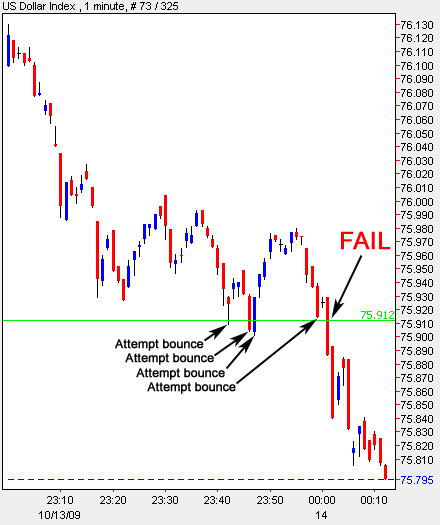
U.S. Dollar Index Bounce Fail
UPDATE 4: USDX PRINTS 75.805
UPDATE 3: USDX PRINTS 75.886
WEE!!!@$!$% Watch this…
UPDATE 2: USDX PRINTS 75.909
They’re definitely trying to bounce it, but it’s not working so far. Second try up now.
UPDATE 1: USDX MAKE OR BREAK
One would think that They’re going to try to bounce USDX at any moment, but gold is already up and out. 75.912 is the support on the USDX. Trading at 75.951 right now. I’m guessing gold knows something by breaking out first.
***Get Popcorn Ready***
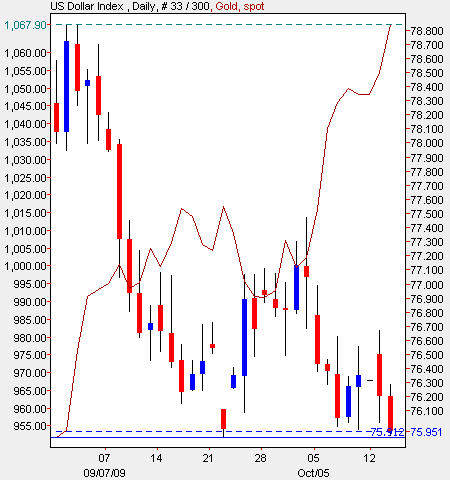
USDX vs. Gold Daily Interval
—End Update—
$1067.
FBI Doing Facial Recognition Scans on DMV Photo Records
October 13th, 2009Via: AP:
In its search for fugitives, the FBI has begun using facial-recognition technology on millions of motorists, comparing driver’s license photos with pictures of convicts in a high-tech analysis of chin widths and nose sizes.
The project in North Carolina has already helped nab at least one suspect. Agents are eager to look for more criminals and possibly to expand the effort nationwide. But privacy advocates worry that the method allows authorities to track people who have done nothing wrong.
“Everybody’s participating, essentially, in a virtual lineup by getting a driver’s license,” said Christopher Calabrese, an attorney who focuses on privacy issues at the American Civil Liberties Union.
FBI Building “Multi-Modal Biometrics” Database
October 13th, 2009Voice scans. You know, in case you use a phone that isn’t registered to you.
Via: ComputerWorld:
The Federal Bureau of Investigation is expanding beyond its traditional fingerprint-focused collection practices to develop a new biometrics system that will include DNA records, 3-D facial imaging, palm prints and voice scans, blended to create what’s known as “multi-modal biometrics.”
“The FBI today is announcing a rapid DNA initiative,” said Louis Grever, executive assistant director of the FBI’s science and technology branch, during his keynote presentation at the Biometric Consortium Conference in Tampa.
The FBI plans to begin migrating from its IAFIS database, established in the mid-1990s to hold its vast fingerprint data, to a next-generation system that’s expected to be in prototype early next year. This multi-modal NGI biometrics database system will hold DNA records and more.
Grever said that fingerprints and DNA appear to be the most mature and searchable biometrics possibilities, but the FBI is working to include iris-scan records among newer biometrics technologies to identify criminals and terrorists. The plan is to share this data with authorized U.S. and international investigative partners, as the agency does today.
The FBI’s current IAFIS database remains a workhouse; it processes about 200,000 daily transactions from its 370 million 10-fingerprint records, and it just crossed the 250 million transaction mark.
The next-generation FBI database system is under design by MorphoTrak and is expected to include DNA, iris scans, advanced 3-D facial imaging and voice scans among its multi-modal biometrics. Lower turnaround times for delivering information over wide-area networks are planned. The goal is to drop from a roughly two-hour response time for IAFIS urgent requests to less than 10 minutes.
Related: Scans Of Eyes, Fingerprints Help Army Find Insurgents
The Frankenfood Industry’s Strong Arm Tactics with Researchers
October 13th, 2009Via: GM Watch:
The increasingly fractious relationship between public sector researchers and the biotech seed industry has come into the spotlight in recent months. In July, several leading seed companies met with a group of entomologists, who earlier in the year had lodged a public complaint with the US Environmental Protection Agency (EPA) over restricted access to materials. In a letter to the EPA, the 26 public sector scientists complained that crop developers are curbing their rights to study commercial biotech crops. “No truly independent research can be legally conducted on many critical questions involving these crops [because of company-imposed restrictions],” they wrote.
In turn, the seed companies have expressed surprise at the outcry, claiming the issue is being overblown. And even though the July meeting, organized by the American Seed Trade Association in Alexandria, Virginia, did result in the writing of a set of principles for carrying out this research, the seed companies are under no compunction to follow them. “From the researchers’ perspective, the key for this meeting was opening up communication to discuss the problem,” says Ken Ostlie, an entomologist at the University of Minnesota in St. Paul, who signed the complaint. “It will be interesting to see how companies implement the principles they agreed upon.”
What is clear is that the seed industry is perceived as highly secretive and reluctant to share its products with scientists. This is fueling the view that companies have something to hide.
Who’s in control?
It’s no secret that the seed industry has the power to shape the information available on biotech crops, referred to variously as genetically engineered or genetically modified (GM) crops. Commercial entities developed nearly all of the crops on the US market, and their ownership of the proprietary technology allows them to decide who studies the crops and how. “Industry is completely driving the bus,” says Christian Krupke, an entomologist at Purdue University in West Lafayette, Indiana.
Company control starts with a simple grower’s contract. Anyone wishing to buy transgenic seeds has to sign what’s called a technology stewardship agreement that says, among many things, that the buyer cannot conduct research on the seed, nor give it to someone else for research. This means scientists can’t simply buy seeds for their studies, and farmers can’t slip them some on the side. Instead, scientists must get permission from the seed companies or risk a lawsuit. “You need permission from industry and you have to specify what you want to do with the plants,” says Bruce Tabashnik, an entomologist at the University of Arizona in Tucson.
Research Credit: efs
Russian Mafia/Government Crooks vs. Hedge Fund Crooks
October 13th, 2009Via: Guardian:
Thousands of Russians are watching a YouTube video that accuses their government and officials of high corruption.
A Russian version of a video by Hermitage Capital, the London-based hedge fund claiming to be victim of a $230m (£146m) scam, has attracted over 12,000 hits, and is the most viewed news clip on YouTube in Russia, the site shows. The English version has had almost 8,000 viewings.
William Browder, head of Hermitage Capital, hopes the video’s international impact will put pressure on the Russian authorities to listen to his claims of theft, gangsterism and government corruption.
“It’s a true Kafka-esque type of situation,” Browder says in the video. “It’s one thing to be victimised by a crime, it’s another thing to be blamed for the crime that you’re a victim of.”
Browder has been banned from entrance to the country and has removed his staff from the fund’s offices in Moscow after police raids. However, one lawyer working for Hermitage, a 37-year old father of two, is still in prison.
Hermitage alleges that its position as Russia’s largest foreign investor two years ago made the establishment nervous, leading to Browder being denied entry to the country. His petition for a new visa led to a string of threats that ended up with the police raiding Hermitage’s Moscow offices, seizing all its documentation.
The video contains reconstruction of the raids and also the transcript of a telephone call from a tax official which the company alleges contains blackmail threats.
The Russian interior ministry is still seeking to have Browder returned to Russia for questioning, Irina Dudukina, a ministry spokeswoman told Bloomberg News by phone today. The executive was placed on the ministry’s international wanted list on charges of tax evasion.
However, according to the fund, the criminals used a network of corrupt lawyers, police and judges to fake transactions and simulate that three profit-making Hermitage subsidiaries had turned a profit into losses – for which they demanded a tax rebate. The new owners of the stolen companies received Russia’s biggest ever rebate within two days, the video claims.
“The $230m which belonged to the Russian people had been stolen by the criminals in an organised conspiracy supported by corrupted officials in the higher reaches of the Russian state,” the video says. “The story sounds like a thriller but isn’t and it’s being repeated every day.”
Hermitage has several legal suits opened in Russia and plans to continue its battle: “We will overwhelm them with transparency. Evil tends to wither under the bright light of publicity,” Browder says.
Food Production ‘Must Rise 70%’ Over the Next 40 Years
October 13th, 2009Via: BBC:
Food production will have to increase by 70% over the next 40 years to feed the world’s growing population, the United Nations food agency predicts.
The Food and Agricultural Organisation says if more land is not used for food production now, 370 million people could be facing famine by 2050.
The world population is expected to increase from the current 6.7 billion to 9.1 billion by mid-century.
Climate change, involving floods and droughts, will affect food production.
The FAO said net investments of $83bn (£52.5bn) a year – an increase of 50% – had to be made in agriculture in developing countries if there was to be enough food by 2050.
Research Credit: R
Handgun Ammo Purchases in California: Driver’s License, Thumbprint and Sales Records for Police
October 12th, 2009Via: ABC News 10:
Before the midnight deadline, Gov. Schwarzenegger acted on 685 bills that were on his desk. He signed 456 and vetoed 229.
One of the bills that he signed was Assembly Bill 962. It requires handgun ammunition to be kept behind the counter where customers cannot access it without assistance. It also requires gun shop owners to thumbprint people who buy handgun ammunition, as well as record their identification and provide that information to police.
More:
Among other regulations, AB 962 would:
• Ban all mail-order and Internet sales of handgun ammunition.
• Prohibit the retail sale, the offer for sale or the display of handgun ammunition in a manner that allows ammunition to be accessible to a purchaser without assistance of a vendor or employee.
• Require that the delivery or transfer of ownership of handgun ammunition occur in a face-to-face transaction, with the deliverer or transferor being provided bona fide evidence of identity of the purchaser or other transferee.
That evidence of identity, which must be legibly recorded at the time of delivery, includes:
• The right thumbprint of the purchaser or transferee.
• The date of the sale or other transaction.
• The purchaser’s or transferee’s driver’s license or other identification number and the state in which it was issued.
• The brand, type and amount of ammunition sold or otherwise transferred.
• The purchaser’s or transferee’s signature.
• The name of the salesperson who processed the sale or other transaction.
• The purchaser’s or transferee’s full residential address and telephone number.
• The purchaser’s or transferee’s date of birth.
Soybeans, Corn Rise as Rains Stall U.S. Harvest, Limit Supplies
October 12th, 2009Via: Bloomberg:
Corn and soybeans rose on speculation that cold, wet Midwest weather will slow the harvest and reduce production in the U.S., the world’s largest grower and exporter of both crops.
Temperatures below freezing this weekend occurred north of a line from Amarillo, Texas, to Kansas City, Kansas, and east to Toledo, Ohio, ending the growing season for immature plants, said Dave Tolleris, president of WxRisk.com in Richmond, Virginia. Harvesting across the U.S. will be delayed by wet weather in next two weeks, Tolleris said.
“The harvest rates are very slow,” Jonathan Barratt, managing director at Commodity Broking Services Pty in Sydney, said by phone today. If the harvest turns out smaller than expected, then the market “will refocus and reprice,” he said.
Corn for December delivery rose 9.5 cents, or 2.6 percent, to $3.7175 a bushel on the Chicago Board of Trade at 1:35 p.m. London time, after gaining Oct. 9 to $3.73, the highest since Aug. 3. The most-active contract advanced 8.6 percent last week, the most this year.
Soybeans for November delivery rallied 17 cents, or 1.8 percent, to $9.81 a bushel in Chicago. It earlier reached $9.8325, the highest since Sept. 1. The most-active futures gained 8.9 percent last week, the most this year.
The U.S. corn and soybean harvests are lagging behind the pace of recent years after rain delayed planting in May and below-normal temperatures in July and August slowed crop development, government data show.
‘Field Losses’
“Harvest delays equal field losses at this point and this is not fully priced into futures yet,” said Mike Zuzolo, president of Global Analytics & Consulting LLC in Lafayette, Indiana.
About 10 percent of the U.S. corn crop was harvested as of Oct. 4, compared with the five-year average of 25 percent for the same time of the season, the U.S. Department of Agriculture said last week. About 15 percent of the soybeans had been collected, below the five-year average of 36 percent. The USDA will update harvest progress on Oct. 13 after the close of trading in Chicago.
The progress numbers may show “only a few percent gains” in the corn and soybean harvest, Zuzolo said. Corn may rise to $3.89 a bushel and soybeans may rally to $10.09 as harvest losses are priced into futures, he said.
Wheat for December delivery gained as much as 12 cents, or 2.6 percent, to $4.80 a bushel in Chicago, before trading at $4.7875 at 1:36 p.m. London time.
Corn is the biggest U.S. crop, valued at $47.4 billion in 2008, with soybeans in second place at $27.4 billion, government figures show.
Shooting of Prominent IMF Economist Baffles Police
October 12th, 2009“It had to be random?”
Is that the new “Probable Suicide”?
Via: WJLA:
Police are still looking for clues after a prominent economist was shot in the garage of his upscale home.
Ashoka Mody has been identified in an email to his fellow employees at the International Monetary Fund as the man shot Thursday night around 7:30 in his Bethesda garage in the 6800 block of Millwood Road
Mody is currently the assistant director in the European department and an expert in economic development and international finance.
He is also known in his Kenwood Park community as a good neighbor, and those who live near him are stunned that he would be the target of a gunman.
Police say the 54-year-old remains in critical condition after he was shot in his garage Thursday night, before he even had a chance to get out of his vehicle.
Mody’s wife told police of a masked man in dark clothing
It is unclear if anything was taken during the attack and police say they don’t know whether it was a random or targeted crime.
After the shooting, the usually quiet Bethesda neighborhood was filled with police and detectives scouring the lawn as they continue their hunt for a gunman.
“This is worrisome,” said a neighbor.
“It had to be random,” said Julia Sullivan. “They are the nicest family. I don’t know why anyone would want to hurt them so it’s terrifying.”
Michael Sullivan added, “If it was random, it could have been me.”
Detectives are still working to determine a motive for the shooting and police have only a vague description of the masked gunman, who fled on foot.
“We know he was last seen fleeing from this community toward Goldsboro Road,” Baur said. “We expect he escaped from the area.”
Police say there is no evidence to suggest robbery was the motive behind the shooting, but the investigation remains in its infancy.
They are asking anyone with information to call 301-279-8000 or the Major Crimes Division at 240-773-5070.
Austria: Early Snow Records Set to Be Broken
October 12th, 2009Via: Austrian Times:
Austria’s provincial capitals are expected to see their earliest snowfalls in history today (Mon) as Arctic air sweeps the country.
Josef Haselhofer from Vienna’s Central Agency for Meteorology and Geodynamics (ZAMG) said today (Mon) Arctic air would probably result in the first snow cover in provincial capitals before 20 October in history and said Innsbruck, Salzburg and St. Pölten were likely to see snow.
He said as much as 30 to 40 centimetres of snow was likely down to 1,200 metres and snow could fall as low as 400 metres later this week, adding it had already begun to fall in Vorarlberg. He also predicted low temperatures would be minus five degrees at higher elevations and zero degrees in the lowlands by Thursday morning.
Haselhofer warned of possible impassable snow drifts in some places and the danger of avalanches in low-lying areas.




