Facebook – Coke Zero Facial Profiler
October 15th, 2009Cancer in a can and Twitbook. The zombies will love this.
Via: Wikipedia:
Facial Profiler is a social experiment [1] created and launched in 2009 by Coca-Cola Zero. Taking the form of a Facebook app, Coke Zero’s Facial Profiler uses facial recognition technology to search a database of Facebook users (who have opted in to participate) to find people who look alike. [2] Once matched, users have the option to contact their look-alike. [3] Coke Zero claims the inspiration for Facial Profiler came from the drink itself. Marketing its drink as having real Coke taste and zero calories, Coke Zero based the creation of Facial Profiler on a simple premise: “If Coke Zero has Coke taste, isn’t it possible that someone out there has your face?” [4]
To ensure accurate results, the Facial Profiler’s initial phase involves the creation of a face database. [5] Faces are gathered from photos that users have personally uploaded and tagged to Facebook, stored photos uploaded from user hard drives and webcam photos taken via the app itself. [6] Once the database has gathered a statistically significant number of faces from both genders, various age groups and multiple ethnicities – results will be released to the public and matches will be delivered. Users are then notified via Facebook. [7]
Research Credit: JB
Benito Mussolini Was British Intelligence Asset
October 14th, 2009Via: Guardian:
History remembers Benito Mussolini as a founder member of the original Axis of Evil, the Italian dictator who ruled his country with fear and forged a disastrous alliance with Nazi Germany. But a previously unknown area of Il Duce’s CV has come to light: his brief career as a British agent.
Archived documents have revealed that Mussolini got his start in politics in 1917 with the help of a £100 weekly wage from MI5.
For the British intelligence agency, it must have seemed like a good investment. Mussolini, then a 34-year-old journalist, was not just willing to ensure Italy continued to fight alongside the allies in the first world war by publishing propaganda in his paper. He was also willing to send in the boys to “persuade” peace protesters to stay at home.
Mussolini’s payments were authorised by Sir Samuel Hoare, an MP and MI5’s man in Rome, who ran a staff of 100 British intelligence officers in Italy at the time.
Cambridge historian Peter Martland, who discovered details of the deal struck with the future dictator, said: “Britain’s least reliable ally in the war at the time was Italy after revolutionary Russia’s pullout from the conflict. Mussolini was paid £100 a week from the autumn of 1917 for at least a year to keep up the pro-war campaigning – equivalent to about £6,000 a week today.”
Hoare, later to become Lord Templewood, mentioned the recruitment in memoirs in 1954, but Martland stumbled on details of the payments for the first time while scouring Hoare’s papers.
As well as keeping the presses rolling at Il Popolo d’Italia, the newspaper he edited, Mussolini also told Hoare he would send Italian army veterans to beat up peace protesters in Milan, a dry run for his fascist blackshirt units.
“The last thing Britain wanted were pro-peace strikes bringing the factories in Milan to a halt. It was a lot of money to pay a man who was a journalist at the time, but compared to the £4m Britain was spending on the war every day, it was petty cash,” said Martland.
“I have no evidence to prove it, but I suspect that Mussolini, who was a noted womaniser, also spent a good deal of the money on his mistresses.”
After the armistice, Mussolini began his rise to power, assisted by electoral fraud and blackshirt violence, establishing a fascist dictorship by the mid-1920s.
His colonial ambitions in Africa brought him into contact with his old paymaster again in 1935. Now the British foreign secretary, Hoare signed the Hoare-Laval pact, which gave Italy control over Abyssinia.
“There is no reason to believe the two men were friends, although Hoare did have an enduring love affair with Italy,” said Martland, whose research is included in Christopher Andrew’s history of MI5, Defence of the Realm, which was published last week.
The unpopularity of the Hoare-Laval pact in Britain forced Hoare to resign. Mussolini, meanwhile, built on his new colonial clout to ally with Hitler, entering the second world war in 1940, this time to fight against the allies.
Deposed following the allied invasion of Italy in 1943, Mussolini was killed with his mistress, Clara Petacci, by Italian partisans while fleeing Italy in an attempt to reach Switzerland two years later.
Martland said: “Mussolini ended his life hung upside down in Milan, but history has not been kind to Hoare either, condemned as an appeaser of fascism alongside Neville Chamberlain.”
Sweden Loses its Internet Connection for an Hour
October 14th, 2009Via: Telegraph:
At 9:45pm local time on Monday 12 October, every Swedish website went down, and no emails to or from Swedish domains could be received. Around 900,000 domains were affected.
The problem was caused by an “incorrectly configured script” in an update of the .se domain, according to Pingdom, a Swedish web monitoring company.
Apparently a single missing full stop at the end of the code meant that the Domain Name Systems (DNS) failed to recognise .se as the “top-level” (country-wide) domain.
Research Credit: Lagavulin
Saudis Seek Payments for Any Drop in Oil Revenues
October 14th, 2009Maybe you need a laugh this morning.
Via: New York Times:
Saudi Arabia is trying to enlist other oil-producing countries to support a provocative idea: if wealthy countries reduce their oil consumption to combat global warming, they should pay compensation to oil producers.
The Job Market, in Charts
October 14th, 2009These charts are interesting, and as grim as they are, they can’t hold a candle to how grim it really is. These are using the official bogus data! Show us the line that includes the millions of people who have dropped out the bottom and aren’t counted anymore.
For anyone who thinks that this “recession” isn’t different, look at the, “Part Time for Economic Reasons” chart.
Via: New York Times:
You may have heard by now that the unemployment rate reached 9.8 percent in September. There are lots of other ways to gauge the health of the job market, however. Here are a few graphs that show how tough it is out there.
Research Credit: tochigi
Bleak U.S. Job Market Boosts Military Recruitment; All Recruitment Goals Met for First Time
October 14th, 2009Economic conscription.
Via: Reuters:
Aided by a bleak job market, the U.S. military met all of its recruitment goals in the past year for the first time since it became an all-volunteer force in 1973, the Pentagon said on Tuesday.
Military services have been stretched thin by conflicts in Afghanistan and Iraq, giving added weight to recruitment efforts as President Barack Obama considers sending another 40,000 U.S. troops to Afghanistan next year.
The United States already has 67,000 troops in Afghanistan and about 119,000 in Iraq.
Pentagon officials said recruitment gains were fueled by the deepest U.S. recession since the Great Depression and an unemployment rate nearing 10 percent.
“For the first time since the advent of the all-volunteer force, all of the military components, active and reserve, met their number as well as their quality goals,” said Bill Carr, deputy undersecretary of defense for military personnel policy.
The U.S. Army, Navy, Marine Corps and Air Force sent a total of about 169,000 active duty recruits to training in the 2009 fiscal year that ended on September 30, beating their 164,000-member goal, the Pentagon said.
National guard and reserve forces sent about 128,000 recruits to training, beating their goal.
Carr said rising private sector unemployment was a force behind the increase in military recruitment but was not the only factor that “allowed us to be, for much of the year, in a very favorable position.”
Guardian Censored, Can’t Identify the Reason Why
October 13th, 2009From Wikileaks, Trafigura Toxic dumping along the Ivory Coast:
Following press reportage about dumping off the coast of Africa, Waterson & Hicks, a UK law firm acting for Trafigura, a large London based oil and commodity trader, ordered and received this confidential report (the so-called “Minton report”) into toxic dumping practices by its client along and on the Ivory Coast. The report reveals a number of toxic dumping incidents and appears to be the report behind the extraordinary secret October 11, 2009 gagging of the Guardian newspaper. WikiLeaks believes the Guardian was gagged to prevent it reporting the following Parliamentry question:
Paul Farrelly (Newcastle-under-Lyme) – To ask the Secretary of State for Justice, what assessment he has made of the effectiveness of legislation to protect (a) whistleblowers and (b) press freedom following the injunctions obtained in the High Court by (i) Barclays and Freshfields solicitors on 19 March 2009 on the publication of internal Barclays reports documenting alleged tax avoidance schemes and (ii) Trafigura and Carter-Ruck solicitors on 11 September 2009 on the publication of the Minton report on the alleged dumping of toxic waste in the Ivory Coast, commissioned by Trafigura.[1]
Via: Guardian:
The Guardian has been prevented from reporting parliamentary proceedings on legal grounds which appear to call into question privileges guaranteeing free speech established under the 1688 Bill of Rights.
Today’s published Commons order papers contain a question to be answered by a minister later this week. The Guardian is prevented from identifying the MP who has asked the question, what the question is, which minister might answer it, or where the question is to be found.
The Guardian is also forbidden from telling its readers why the paper is prevented – for the first time in memory – from reporting parliament. Legal obstacles, which cannot be identified, involve proceedings, which cannot be mentioned, on behalf of a client who must remain secret.
The only fact the Guardian can report is that the case involves the London solicitors Carter-Ruck, who specialise in suing the media for clients, who include individuals or global corporations.
The Guardian has vowed urgently to go to court to overturn the gag on its reporting. The editor, Alan Rusbridger, said: “The media laws in this country increasingly place newspapers in a Kafkaesque world in which we cannot tell the public anything about information which is being suppressed, nor the proceedings which suppress it. It is doubly menacing when those restraints include the reporting of parliament itself.”
The media lawyer Geoffrey Robertson QC said Lord Denning ruled in the 1970s that “whatever comments are made in parliament” can be reported in newspapers without fear of contempt.
He said: “Four rebel MPs asked questions giving the identity of ‘Colonel B’, granted anonymity by a judge on grounds of ‘national security’. The DPP threatened the press might be prosecuted for contempt, but most published.”
The right to report parliament was the subject of many struggles in the 18th century, with the MP and journalist John Wilkes fighting every authority – up to the king – over the right to keep the public informed. After Wilkes’s battle, wrote the historian Robert Hargreaves, “it gradually became accepted that the public had a constitutional right to know what their elected representatives were up to”.
Interpol and U.N. Back ‘Global Policing Doctrine’
October 13th, 2009I was thinking, “Wow, this seems very familiar. Where have I seen something like this before?” HAHA. This is just too much.
Start em’ young with Justice League International:
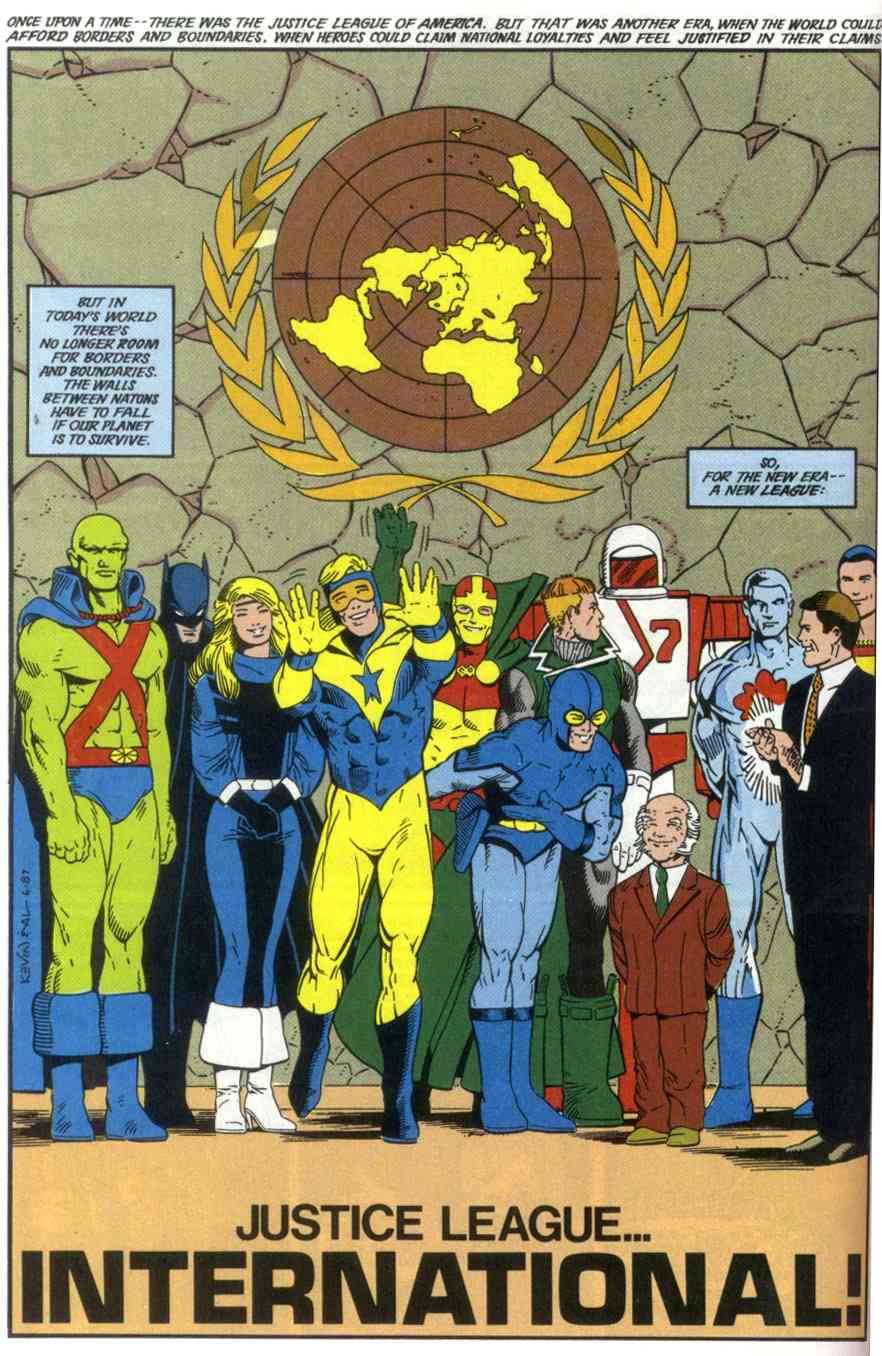
Justice League International
The text says:
Once upon a time—There was the Justice League of America. But that was another era, when the world could afford borders and boundaries, when heros could claim national loyalties and feel justified in their claims.
But in today’s world there’s no longer room for borders and boundaries. The walls between nations have to fall if our planet is to survive.
So, for a new era—A new League:
Justice League…
International!
In case you don’t recognize the logo on the wall, here’s the real one:
U.N. Logo
The Justice League International comic books were published in the 1980s and 1990s.
Via: New York Times:
Interpol and the United Nations are poised to become partners in fighting crime by jointly grooming a global police force that would be deployed as peacekeepers among rogue nations riven by war and organized crime, officials from both organizations say.
On Monday, justice and foreign ministers from more than 60 countries, including the United States and China, are gathering in Singapore for a meeting hosted by the two international organizations.
It is the first step toward creating what Interpol calls a “global policing doctrine” that would enable Interpol and the United Nations to improve the skills of police peacekeepers, largely by sharing a secure communications network and a vast electronic trove of criminal information, including DNA records, fingerprints, photographs and fugitive notices.
“We have a visionary model,” said Ronald K. Noble, secretary general of Interpol and the first American to head the international police organization, which is based in Lyon. More than 187 member nations finance the organization.
“The police will be trained and equipped differently with resources,” Mr. Noble said. “When they stop someone, they will be consulting global databases to determine who they are stopping.”
Modern peacekeeping has evolved dramatically since the blue-helmeted U.N. military force won a Nobel Peace Prize in 1988. Since 2005, the number of police officers within the total force of 95,400 peacekeepers has more than doubled from about 6,000 to 12,200 in 17 countries.
U.N. police are already battling kidnappings and drug crime in Haiti and illicit lumber trading in Liberia. The aim of the joint effort is to increase the ability to track the movement of criminals around the world by sharing resources and common standards, according to Mr. Noble. He is also pressing ahead with plans for special electronic passports for the agency’s staff of more than 600 Interpol investigators to speed border crossings.
The Norwegian Ministry of Foreign Affairs is contributing more than $2 million to finance the development of international global policing standards, according to Andrew Hughes, an Australian who currently heads the U.N.’s force of police officers.
The ambition is to create a series of networks to counter borderless organized criminal operations, Mr. Hughes said. Women, in particular, are being recruited, with a goal of reaching 20 percent of the U.N. force and the development of all-female units like the group of 140 peacekeepers from Bangladesh that is about to be deployed.
“We’re working with refugees,” Mr. Hughes said. “Many of the victims of atrocities are women, and they’ve had enough of men with guns and uniforms.”
He said that among the most critical tasks for a global police force were combating illegal arms and drug trafficking. His own officers in West Africa have watched the growth of cocaine smuggling by Colombian and Venezuelan drug cartels through weakened countries like Sierra Leone and Liberia to the lucrative consumer markets in Europe.
The United States remains the biggest market for cocaine, according to the U.N.’s annual report on drugs and crime. But in the past three years, South American cartels have moved more drugs to Europe using transit points like Guinea Bissau, where the president and the head of the military were killed in sophisticated bombing attacks in March. Each year, at least 50 tons of cocaine from Andean countries passes through West Africa to the streets of Europe, where the drugs are worth almost $2 billion, according to the U.N. report.
“Organized crime is a business that looks for opportunity to expand their market enterprise,” Mr. Hughes said. “When you have a breakdown in police and courts and corrections, organized crime is ripe. We also see the toxic effect of corruption, because they are able to corrupt officials, which makes it difficult to build a functioning society.”
In Afghanistan, where heroin and hashish trafficking is also a thorny issue, NATO announced plans this month to start training the local police — a move it has avoided in the past to concentrate on military responsibilities.
But Mr. Noble of Interpol says he takes a dim view of transforming warriors into beat cops, because the mind-sets are so different.
“We caution on making the delegation of civil police development tasks to military structures,” Mr. Noble said, citing the example of an attack that freed hundreds of Taliban from a prison in Kandahar, Afghanistan, last year. Although Interpol immediately asked for information about the missing prisoners, he said, “we were really shocked and dismayed to learn there were no fingerprints and photographs despite billions spent to train police there.”
With the meeting of justice ministers on Monday, which coincides with a general assembly of Interpol police members, the group is expected to debate the global police issue and to craft a declaration that would lead to an action plan for international police peacekeeping within 12 months.
Cryptogon Reader Affiliate Purchase (at Nitro-Pak)
October 13th, 2009Someone out there has made what amounts to an astonishing purchase at one of Cryptogon’s affiliates.
First of all, thank you. Second: Do you know about something specific that’s headed down the track?
Now, I’m sure this person knows who he or she is and the purchase that I’m referring to in this post. If you’re that person and feel like relating any information that might be of assistance to people out in Cryptogon land, I’d like to hear from you.
If you would like to check in, please identify yourself by stating the Cryptogon affiliate in question and the dollar amount of your order. I’m only asking you to provide those details so I know that you’re the one who made the purchase. Feel free to use a throw away email (gmail, yahoo, etc) if you like. Anything that you tell me would be kept between us by default (and whichever intelligence agencies are monitoring the emails). My public key is here, just in case. I understand if you don’t want to talk about this to me or anyone else. I’m just curious.
To everyone else, I’ll give this person a day or so to respond, or not, then I’ll update the Support list as usual.
I hope this doesn’t sound too woowoo. Don’t think that it’s a personal submarine or a 300 foot high jumbotron HDTV, etc. Once I tell you, you’ll probably wonder what all the fuss was about. But there aren’t many people thinking like this person. That’s why I’m curious to know if he or she has any information to share.
UPDATE: The Reader Emailed Me
The affiliate order in question was with Nitro-Pak. The order was for $7,989 worth of supplies. Cryptogon received a commission of $798.90.
I’ll just post the email I received, minus the Cryptogon reader’s name and email address, of course.
This speaks for itself:
Kevin,
reference: order to Nitro-Pak in the amount of $7,989.00.
I am answering your question out of respect for you, and the fact that you asked, not because I have some vital information to pass along.
No, I don’t know anything in the offing, as in being privy to some great secret. The information upon which I base my decisions is all publicly available. However, like everyone else, I am selective in what I pay attention to, and whose judgments and commentary I listen to and consider.
David Icke had a nice metaphor about how far outside the city limits of conventional viewpoints various people choose to pitch their tents. In each case of a person “well out there”, he will recognize that the people closer in to town are sadly naive. But there will be others who have pitched tents even further out. And the man says, “Those guys further out have gone crazy. The situation is not as wild as they say.”
I can testify to having repeatedly packed up my campsite and shifted yet further out. Folks that at first I felt were too wild now seem to make a lot of sense to me. The guys that make the most sense to me are waving all kinds of red flags and foreseeing big events soon. And really, as I keep reminding myself: we are already way into the collapse of our civilization. Stupendous bankruptcies and equivalent operations have already happened. Deficits beyond human comprehension are calmly admitted by the authorities. Our public institutions are corrupted beyond redemption. I don’t need to list this stuff for Cryptogon readers.
Now, as to the order I placed, my subjective experience is that it just developed totally naturally. I started with the fear that the wealth stored in my retirement plan was almost certainly doomed to destruction. Even with the degree of flexibility built into the plan — and there really is some — there was no investment into which I could divert the funds that seemed a credible place.
A few years back I did very well with the portion in foreign based mutual funds. Last couple of years, I was very disproportionately into PIMCO bond funds, and that has at least not gone down.
But of late, it is hard to place any faith in theoretically paper, but really totally digital wealth, being stored and managed by Wall Street firms. I pulled a substantial amount out of the account. Time to get local and get real. Let’s think about food.
I remembered you were an affiliate of Nitro-Pak, so I simply started there. And after perusing their offerings, and having some substantial funds to invest, there was this perfectly wonderful jump start on comprehensive crisis preparedness.
One of my sons, college aged, is way further out there in passionate preparedness. He participates actively on web sites dedicated to survival, and such matters. At first he was skeptical about the order I was about to place, and if only for family peace, I held off placing the order until he had vetted it by comparing the contents and costs with other offerings from other suppliers. He gave it his seal of approval. It really is a very good deal in terms of the contents, quality, coverage, and cost. And this contains not just food, but many other thoughtful additions. It is really comprehensive.
So if you did not have much in the line of crisis preparedness, but could pry loose some substantial money, this provides a great, quick jump start on the preparation process.
Nitro-Pak is very responsive. I immediately started getting emails with confirmation details. Very impressive response. We just received the bulk of the shipment. Some special sized items are being shipped separately, and one item is back ordered. The shipment arrived in pristine condition. I recommend these guys.
As for this message, you can use whatever you want from it, but I do not want you to give out my name or email address.
Warmest regards,
[Sender’s Name Kept Private]
Australia: Ban Screens of All Kinds for Children Under Two
October 13th, 2009Via: Telegraph:
Children under the age of two should be banned from watching television, according to guidelines prepared for the Australian government.
The guidelines warn that exposure to television at such an early age can delay language development, affect the ability of a child to concentrate and lead to obesity.
The recommendations also suggest that children aged two to five should watch no more than one hour of television a day.
The recommended viewing limits vary wildly from the actual amount of television and DVDs viewed by Australian children.
Australian statistics show that four-month-old infants watch an of average 44 minutes of television each day and that children under the age of four with pay television at home spend at least three hours a day in front of the screen.
The draft guidelines, which have been designed for childcare centres but also offer advice for parents, are intended to help curb the spread of obesity. Six to eight per cent of Australian schoolchildren are currently listed as obese and an additional one in five, while not obese, is overweight.
“Based on recent research, it is recommended that children younger than two years of age should not spend any time watching television or using other electronic media (DVDs, computer and other electronic games),” said a draft copy of the guidelines obtained by The Australian newspaper.
“Screen time … may reduce the amount of time they have for active play, social contact with others and chances for language development.
“(It may) affect the development of a full range of eye movement (and) … reduce the length of time they can stay focused.”
The government has refused to comment on the Get Up and Grow report for healthy eating and exercise in early childhood, devised by Melbourne’s Royal Children’s Hospital, saying only that the guidelines were still being finalised.




