Squalene: The Swine Flu Vaccine’s Dirty Little Secret Exposed
August 4th, 2009Via: Mercola:
Will There Be Immune Adjuvants in Swine Flu Vaccines?
The U.S. government has contracts with several drug companies to develop and produce swine flu vaccines. At least two of those companies, Novartis and GlaxoSmithKline, are using an adjuvant in their H1N1 vaccines.
The adjuvant? Squalene.
According to Meryl Nass, M.D., an authority on the anthrax vaccine,
“A novel feature of the two H1N1 vaccines being developed by companies Novartis and GlaxoSmithKline is the addition of squalene-containing adjuvants to boost immunogenicity and dramatically reduce the amount of viral antigen needed. This translates to much faster production of desired vaccine quantities.”[v]
Novartis’s proprietary squalene adjuvant for their H1N1 vaccine is MF59. Glaxo’s is ASO3. MF59 has yet to be approved by the FDA for use in any U.S. vaccine, despite its history of use in other countries.
Per Dr. Nass, there are only three vaccines in existence using an approved squalene adjuvant. None of the three are approved for use in the U.S.
What Squalene Does to Rats
Oil-based vaccination adjuvants like squalene have been proved to generate concentrated, unremitting immune responses over long periods of time.[vi]
A 2000 study published in the American Journal of Pathology demonstrated a single injection of the adjuvant squalene into rats triggered “chronic, immune-mediated joint-specific inflammation,” also known as rheumatoid arthritis.[vii]
The researchers concluded the study raised questions about the role of adjuvants in chronic inflammatory diseases.
What Squalene Does to Humans
Your immune system recognizes squalene as an oil molecule native to your body. It is found throughout your nervous system and brain. In fact, you can consume squalene in olive oil and not only will your immune system recognize it, you will also reap the benefits of its antioxidant properties.
The difference between “good” and “bad” squalene is the route by which it enters your body. Injection is an abnormal route of entry which incites your immune system to attack all the squalene in your body, not just the vaccine adjuvant.
Your immune system will attempt to destroy the molecule wherever it finds it, including in places where it occurs naturally, and where it is vital to the health of your nervous system.[viii]
Gulf War veterans with Gulf War Syndrome (GWS) received anthrax vaccines which contained squalene.[ix] MF59 (the Novartis squalene adjuvant) was an unapproved ingredient in experimental anthrax vaccines and has since been linked to the devastating autoimmune diseases suffered by countless Gulf War vets.[x]
The Department of Defense made every attempt to deny that squalene was indeed an added contaminant in the anthrax vaccine administered to Persian Gulf war military personnel – deployed and non-deployed – as well as participants in the more recent Anthrax Vaccine Immunization Program (AVIP).
However, the FDA discovered the presence of squalene in certain lots of AVIP product. A test was developed to detect anti-squalene antibodies in GWS patients, and a clear link was established between the contaminated product and all the GWS sufferers who had been injected with the vaccine containing squalene.
A study conducted at Tulane Medical School and published in the February 2000 issue of Experimental Molecular Pathology included these stunning statistics:
“ … the substantial majority (95%) of overtly ill deployed GWS patients had antibodies to squalene. All (100%) GWS patients immunized for service in Desert Shield/Desert Storm who did not deploy, but had the same signs and symptoms as those who did deploy, had antibodies to squalene.
In contrast, none (0%) of the deployed Persian Gulf veterans not showing signs and symptoms of GWS have antibodies to squalene. Neither patients with idiopathic autoimmune disease nor healthy controls had detectable serum antibodies to squalene. The majority of symptomatic GWS patients had serum antibodies to squalene.”[xi]
According to Dr. Viera Scheibner, Ph.D., a former principle research scientist for the government of Australia:
“… this adjuvant [squalene] contributed to the cascade of reactions called “Gulf War Syndrome,” documented in the soldiers involved in the Gulf War.
The symptoms they developed included arthritis, fibromyalgia, lymphadenopathy, rashes, photosensitive rashes, malar rashes, chronic fatigue, chronic headaches, abnormal body hair loss, non-healing skin lesions, aphthous ulcers, dizziness, weakness, memory loss, seizures, mood changes, neuropsychiatric problems, anti-thyroid effects, anaemia, elevated ESR (erythrocyte sedimentation rate), systemic lupus erythematosus, multiple sclerosis, ALS (amyotrophic lateral sclerosis), Raynaud’s phenomenon, Sjorgren’s syndrome, chronic diarrhoea, night sweats and low-grade fevers.”[xii]
Research Credit: IL
Goldman Sachs Employees Told Not to Make Big Purchases
August 4th, 2009NSFW Audio:
Via: Reuters:
Goldman Sachs Group Inc Chief Executive Lloyd Blankfein told employees to avoid making high profile purchases, the New York Post said, citing sources.
Blankfein, who first asked employees to avoid large purchases late last year, has stepped up his campaign in recent weeks, a source told the paper.
“This is a sensitive time for us, and wants to make sure that we’re not being seen living high on the hog,” the paper quoted an anonymous Goldman executive as saying.
Goldman has faced a torrent of unwanted publicity recently including an unflattering story in Rolling Stone magazine, which accused the bank of having a key role in various market bubbles stretching back to the 1920s.
A Goldman spokeswoman declined to comment to the paper.
Goldman could not be immediately reached for comment by Reuters after regular U.S. business hours.
Last week New York Attorney General Andrew Cuomo, in a report into compensation paid by banks, said employee pay “has become unmoored from the banks’ financial performance.
Dollar: USDX Rangebound
August 4th, 2009WARNING: This is not a recommendation to buy, sell or hold any financial instrument.
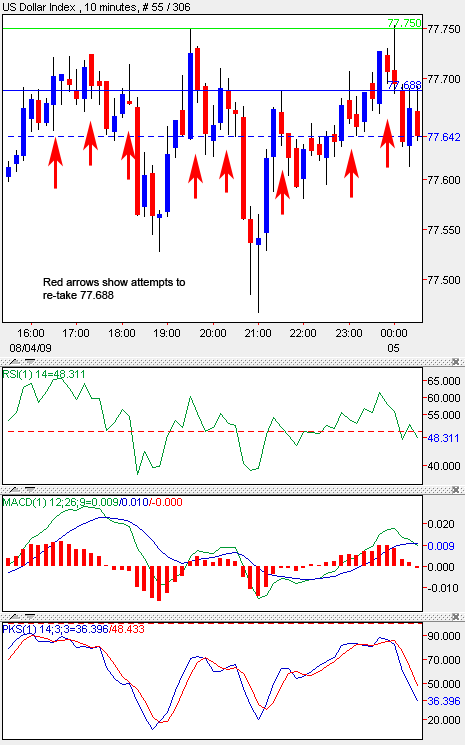
When an important support is taken out, there can be a period of limbo where the asset is drawn back around the support. I don’t know why this happens, but it’s a eerie thing to watch. The USDX has been doing that for the past 20 hours.
The range is 77.750 to 77.451. Most of the action is below 77.688.
Massive intervention is probably underway. Dollar bulls are attempting to jumpstart a rally by cranking it over 77.688. Several attempts have failed in the past seven hours. The bears have just been stomping it out. This is bloody knuckles stuff.
Scientists Fear a Revolt by Killer Robots
August 4th, 2009Via: Times Online:
At the conference, held behind closed doors in Monterey Bay, California, leading researchers warned that mankind might lose control over computer-based systems that carry out a growing share of society’s workload, from waging war to chatting on the phone, and have already reached a level of indestructibility comparable with a cockroach.
“These are powerful technologies that could be used in good ways or scary ways,” warned Eric Horvitz, principal researcher at Microsoft who organised the conference on behalf of the Association for the Advancement of Artificial Intelligence.
According to Alan Winfield, a professor at the University of the West of England, scientists are spending too much time developing artificial intelligence and too little on robot safety.
“We’re rapidly approaching the time when new robots should undergo tests, similar to ethical and clinical trials for new drugs, before they can be introduced,” he said.
The scientists who presented their findings at the International Joint Conference for Artificial Intelligence in Pasadena, California, last month fear that nightmare scenarios, which have until now been limited to science fiction films, such as the Terminator series, The Matrix, 2001: A Space Odyssey and Minority Report, could come true.
Robotic unmanned predator drones, for example, which can seek out and kill human targets, have already moved out of the movie theatres and into the theatre of war in Afghanistan and Iraq. While at present controlled by human operators, they are moving towards more autonomous control.
They could also soon be found on the streets. Samsung, the South Korean electronics company, has developed autonomous sentry robots to serve as armed border guards. They have “shoot-to-kill” capability.
Noel Sharkey, professor of artificial intelligence and robotics at Sheffield University, warned that such robots could soon be used for policing, for example during riots such as those seen in London at the recent G20 summit. “Is this a good thing?” he asked.
Research Credit: ltcolonelnemo
U.S. Antidepressant Use Doubled Between 1996 and 2005
August 4th, 2009Must read: Drug Companies & Doctors: A Story of Corruption.
Via: Reuters:
Use of antidepressant drugs in the United States doubled between 1996 and 2005, probably because of a mix of factors, researchers reported on Monday.
About 6 percent of people were prescribed an antidepressant in 1996 — 13 million people. This rose to more than 10 percent or 27 million people by 2005, the researchers found.
“Significant increases in antidepressant use were evident across all sociodemographic groups examined, except African Americans,” Dr. Mark Olfson of Columbia University in New York and Steven Marcus of the University of Pennsylvania in Philadelphia wrote in the Archives of General Psychiatry.
“Not only are more U.S. residents being treated with antidepressants, but also those who are being treated are receiving more antidepressant prescriptions,” they added.
More than 164 million prescriptions were written in 2008 for antidepressants, totaling $9.6 billion in U.S. sales, according to IMS Health.
Drugs that affect the brain chemical serotonin like GlaxoSmithKline’s Paxil, known generically as paroxetine, and Eli Lilly and Co’s Prozac, known generically as fluoxetine, are the most commonly prescribed class of antidepressant. But the study found the effect in all classes of the drugs.
Olfson and Marcus looked at the Medical Expenditure Panel Surveys done by the U.S. Agency for Healthcare Research and Quality, involving more than 50,000 people in 1996 and 2005.
“During this period, individuals treated with antidepressants became more likely to also receive treatment with antipsychotic medications and less likely to undergo psychotherapy,” they wrote.
Research Credit: VC
Federal Tax Revenues Plummeting
August 4th, 2009Via: AP:
The recession is starving the government of tax revenue, just as the president and Congress are piling a major expansion of health care and other programs on the nation’s plate and struggling to find money to pay the tab.
The numbers could hardly be more stark: Tax receipts are on pace to drop 18 percent this year, the biggest single-year decline since the Great Depression, while the federal deficit balloons to a record $1.8 trillion.
Other figures in an Associated Press analysis underscore the recession’s impact: Individual income tax receipts are down 22 percent from a year ago. Corporate income taxes are down 57 percent. Social Security tax receipts could drop for only the second time since 1940, and Medicare taxes are on pace to drop for only the third time ever.
The last time the government’s revenues were this bleak, the year was 1932 in the midst of the Depression.
“Our tax system is already inadequate to support the promises our government has made,” said Eugene Steuerle, a former Treasury Department official in the Reagan administration who is now vice president of the Peter G. Peterson Foundation.
“This just adds to the problem.”
While much of Washington is focused on how to pay for new programs such as overhauling health care — at a cost of $1 trillion over the next decade — existing programs are feeling the pinch, too.
Social Security is in danger of running out of money earlier than the government projected just a few month ago. Highway, mass transit and airport projects are at risk because fuel and industry taxes are declining.
The national debt already exceeds $11 trillion. And bills just completed by the House would boost domestic agencies’ spending by 11 percent in 2010 and military spending by 4 percent.
British Government Installing CCTV Cameras Inside Private Homes
August 3rd, 2009Via: Wired:
As an ex-Brit, I’m well aware of the authorities’ love of surveillance and snooping, but even I, a pessimistic cynic, am amazed by the governments latest plan: to install Orwell’s telescreens in 20,000 homes.
£400 million ($668 million) will be spend on installing and monitoring CCTV cameras in the homes of private citizens. Why? To make sure the kids are doing their homework, going to bed early and eating their vegetables. The scheme has, astonishingly, already been running in 2,000 family homes. The government’s “children’s secretary” Ed Balls is behind the plan, which is aimed at problem, antisocial families. The idea is that, if a child has a more stable home life, he or she will be less likely to stray into crime and drugs.
It gets worse. The government is also maintaining a private army, incredibly not called “Thought Police”, which will “be sent round to carry out home checks,” according to the Sunday Express. And in a scheme which firmly cements the nation’s reputation as a “nanny state”, the kids and their families will be forced to sign “behavior contracts” which will “set out parents’ duties to ensure children behave and do their homework.”
And remember, this is the left-wing government. The Shadow Home Secretary Chris Grayling, batting for the conservatives, thinks these plans are “too little, and too late,” implying that even more obtrusive work needs to be done. Rumors that a new detention center, named Room 101, is being constructed inside the Ministry of Love are unconfirmed.
Drug Companies & Doctors: A Story of Corruption
August 3rd, 2009Via: New York Review of Books:
Since drug companies don’t have direct access to human subjects, they need to outsource their clinical trials to medical schools, where researchers use patients from teaching hospitals and clinics, or to private research companies (CROs), which organize office-based physicians to enroll their patients. Although CROs are usually faster, sponsors often prefer using medical schools, in part because the research is taken more seriously, but mainly because it gives them access to highly influential faculty physicians—referred to by the industry as “thought-leaders” or “key opinion leaders” (KOLs). These are the people who write textbooks and medical journal papers, issue practice guidelines (treatment recommendations), sit on FDA and other governmental advisory panels, head professional societies, and speak at the innumerable meetings and dinners that take place every year to teach clinicians about prescription drugs. Having KOLs like Dr. Biederman on the payroll is worth every penny spent.
A few decades ago, medical schools did not have extensive financial dealings with industry, and faculty investigators who carried out industry-sponsored research generally did not have other ties to their sponsors. But schools now have their own manifold deals with industry and are hardly in a moral position to object to their faculty behaving in the same way. A recent survey found that about two thirds of academic medical centers hold equity interest in companies that sponsor research within the same institution.[6] A study of medical school department chairs found that two thirds received departmental income from drug companies and three fifths received personal income.[7]
Research Credit: efs
The Deep Politics of Hollywood: Close Encounters with the Pentagon
August 3rd, 2009I wish I’d taken a screenshot from the scene in the 2007 Transformers where John Turturro is shown against a wall and the sign to the left of the frame says something like, “322 days since last accident.” HAHA. I almost upchucked the lamb chop I ate for dinner that night.
I hit REWIND and then I paused it. A couple of things went through my mind. First of all, I didn’t want to tell you guys that I watched Transformers. (I like any SciFi, even nonsense SciFi.) Additionally, I don’t want to be seen as someone who cuts Easter Eggs out of movies. I mean, after all, appearances need to be maintained! (I’ve probably done it on Cryptogon somewhere and forgotten about it. I should have just taken the screenshot.)
After I returned the DVD, I wondered how many maniacs posted that 322 shot.
I couldn’t find even one site that mentioned it.
That was a bit of ramble, but when you understand that there are no coincidences with the set design, and that everything was put there on purpose, and that U.S. Military “advisers” were present during filming… Like I said, that lamb chop nearly came up. The military isn’t just going to let any joker run his film crew around F-117s and F-22s. The light from atop the pyramid must shine brightly on Michael Bay.
Via: Information Clearing House:
For 60 years space aliens have left their mark on the Hollywood box-office in some of the most popular movies of all time, from The Day the Earth Stood Still (1951), E.T: The Extraterrestrial (1982) and Independence Day (1996), to the highly lucrative Monsters vs. Aliens (2009). The new Transformers sequel, Revenge of the Fallen (2009), is also poised for box-office glory this summer with its big-budget blend of eye-popping special effects, fan-fiction and UFO mythology. The most interesting aspects of the Transformers films, however, are evident not so much in celluloid form as they are behind the scenes – in a production process built around the close relationship between Hollywood, the United States military and a variety of government agencies. While the dryer details of this relationship have been relatively well documented, the curious tale of government involvement in Hollywood’s UFO movies represents a forgotten chapter in the history of American cinema.
DOLLAR: USDX INTRADAY DOWNSIDE BREACH 77.688
August 3rd, 2009WARNING: This is not a recommendation to buy, sell or hold any financial instrument.
Buckle up. A lot of stuff could break on the way down to 71-72.
While I’m expecting it to wreck hard, a part of me is sitting here, looking at it and thinking, “They’re not really going to let this happen, are They?”
As of now, it sure looks that way.
If you don’t know what I’m talking about, see: Dollar Finally Breaking Down from July 20th.
Via: Reuters:
U.S. gold futures rose to their highest level in nearly two months on Monday due to a combination of a weaker dollar, physical demand and fresh buying from investment funds amid a Wall Street rally.




