Merck Makes Phony Peer-Review Journal
May 4th, 2009Via: Bioethics.net:
It’s a safe guess that somewhere at Merck today someone is going through the meeting minutes of the day that the hair-brained scheme for the Australasian Journal of Bone and Joint Medicine was launched, and that everyone who was in the room is now going to be fired.
The Scientist has reported that, yes, it’s true, Merck cooked up a phony, but real sounding, peer reviewed journal and published favorably looking data for its products in them. Merck paid Elsevier to publish such a tome, which neither appears in MEDLINE or has a website, according to The Scientist.
What’s wrong with this is so obvious it doesn’t have to be argued for. What’s sad is that I’m sure many a primary care physician was given literature from Merck that said, “As published in Australasian Journal of Bone and Joint Medicine, Fosamax outperforms all other medications….” Said doctor, or even the average researcher wouldn’t know that the journal is bogus. In fact, knowing that the journal is published by Elsevier gives it credibility!
Research Credit: ltcolonelnemo
China Has ‘Canceled U.S. Credit Card’
May 4th, 2009Via: AFP:
China, wary of the troubled US economy, has already “canceled America’s credit card” by cutting down purchases of debt, a US congressman said Thursday.
China has the world’s largest foreign reserves, believed to be mostly in dollars, along with around 800 billion dollars in US Treasury bonds, more than any other country.
But Treasury Department data shows that investors in China have sharply curtailed their purchases of bonds in January and February.
Representative Mark Kirk, a member of the House Appropriations Committee and co-chair of a group of lawmakers promoting relations with Beijing, said China had “very legitimate” concerns about its investments.
“It would appear, quietly and with deference and politeness, that China has canceled America’s credit card,” Kirk told the Committee of 100, a Chinese-American group.
“I’m not sure too many people on Capitol Hill realize that this is now happening,” he said.
The Republican lawmaker said that China was justified in concerns about returns from finance giants Fannie Mae and Freddie Mac, which were bailed out by the US government due to the financial crisis.
Kirk said he was the first member of Congress to tour the Bureau of Public Debt, which trades bonds, and was alarmed at how much debt was being bought by the US Federal Reserve due to absence of foreign investors.
“There will come a time where the lack of Chinese participation may have a significant impact,” Kirk said.
“We should track that, because up until last month they were the number one provider of currency to the United States and now they’re gone.”
With China’s economy also hit by the global economic crisis, Premier Wen Jiabao has openly voiced concern about the status of his country’s investments in the United States.
China has also floated replacing the dollar as the key international currency with a basket of units bringing in the euro, sterling and yen.
Bond Insurer Can’t Pay
May 2nd, 2009Via: Reuters:
Sellers of protection on debt issued by bond insurer Syncora Holdings will need to make payments to counterparties after the company suspended claims payments, the International Swaps and Derivatives Association said on Friday.
Syncora, formerly known as SCA, suspended payments at the direction of the New York Insurance Department to allow it to replenish its finances and turn a policyholders deficit of $2.4 billion into a state-required minimum surplus of $65 million, a company spokesman said on Friday.
The company is the first U.S. bond insurer to suspend claims payments as it struggles to reduce losses on about $8.6 billion of residential mortgage-backed securities it insured.
The notional value of credit default swaps written on the debt of Syncora is about $18 billion, but the net value is about $1 billion, according to data from Depository Trust & Clearing Corp, which clears more than 90 percent of the market.
Credit default swaps are used to protect against the risk of a corporate, sovereign or other borrower defaulting on their debt, or to speculate on their credit quality.
The ISDA acts as administrator for a committee of dealers and investors who decide whether an event would trigger a company’s CDS.
Syncora, which has guaranteed about $140 billion of debt, mostly municipal and structured finance, is facing a May 29 deadline to meet minimum capital requirements or be taken over by New York’s insurance regulators.
A spokesman for the office of Insurance Superintendent Eric Dinallo declined to comment. The NYID could act sooner than the deadline, said the Syncora spokesman.
Senator Proposes Free Flu Shots for All Americans
May 2nd, 2009Via: Reuters:
A Democratic U.S. senator proposed on Friday setting up a free nationwide voluntary flu vaccination program to fend off future outbreaks of dangerous strains.
With the United States on alert for more cases of the new H1N1 swine flu virus, Iowa Senator Tom Harkin said the government should include funding for free vaccines for all Americans in the supplemental spending bill now moving through Congress.
“The harsh reality is that we have repeatedly experienced devastating flu pandemics,” Harkin said in a statement.
“Strictly as a matter of prudent prevention, it is desirable to maximize the number of Americans who are vaccinated each year,” Harkin said. President Barack Obama has requested $1.5 billion from Congress to address the ongoing swine flu outbreak.
…
Harkin, who chairs the Senate appropriations subcommittee on health, said his bill would help build vaccine-manufacturing capacity and prevent production capacity from becoming idle.
“By offering annual free vaccines to all 304 million people in the United States, our vaccine-production capacity will be up and running and ready to shift, when necessary, to mass production of vaccines to fight a future outbreak or pandemic,” Harkin’s statement said.
He said intended to incorporate the measure into broader health reform legislation that Democrats want to pass later this year. [sic]
Research Credit: j crash
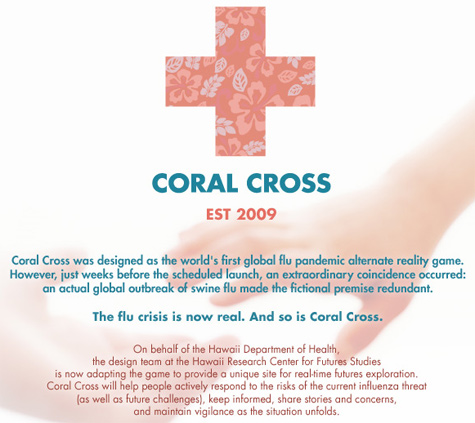
Coral Cross: The World’s First Global Flu Pandemic Alternate Reality Game; But Just Weeks Before The Scheduled Launch, An Extraordinary Coincidence Occurred…
May 2nd, 2009“The flu crisis in now real. And so is Coral Cross.”
Via: Alternate Reality Gaming Network:
Dystopic literature often turns to the threat of pandemics for inspiration. From Albert Camus’ La Peste to Stephen King’s The Stand, authors create global pandemics in their stories to confront issues raised by a threat to human survival that strikes at the very fabric of our society. In order to open a dialogue about Hawaii’s pandemic preparedness and allocation priorities, the U.S. Centers for Disease Control and Prevention is funding an alternate reality game starting in mid-May at CoralCross.org.
As part of a larger public engagement initiative that includes community meetings and a live TV panel, the Hawaii State Department of Heath has contracted with the Hawaii Research Center for Future Studies to produce Coral Cross, a “playable scenario” on the island of Oahu. According to Judy Kern at the Communications Office of the Hawaii State Department of Health, the goal of the ARG is to “help encourage public dialogue and elicit input for decision-makers on Hawaii’s pandemic priorities.”
The game is scheduled to launch during the second half of May, with each day representing one month of game time. While anyone can play, the game’s core audience will be located in Hawaii, particularly the island of Oahu. As Stuart Candy, researcher at the Hawaii Research Center for Futures Studies, explains,
First, we can make use of the limited geography — a captive audience, if you like — by using more real-life elements to augment the storytelling. Second, as a member of our design team observed, the fact that we’re tackling a global topic, pandemic flu, with a local tilt, not only gives it an interesting flavour, but it also helps the scenario. Instead of trying to evoke every last thing about how the world could transform as a result of a deadly disease sweeping across it, the island acts as a sort of microcosm in which, no matter where they’re from, people will be able to see what’s at stake more clearly and concretely, in particular how lives and communities are affected.
By restricting the geographic field of gameplay to a limited area, Coral Cross will hopefully be able to address the impact pandemics will have on local communities and social structures while providing a truly immersive experience for the participants.
For a number of years, the Hawaii Research Center for Futures Studies has been facilitating public discussions of future scenarios through “experiential futures.” And as a former Game Master for the Institute For the Future’s forecasting game Superstruct, Stuart Candy received first-hand exposure to the potential of the genre for community forecasting. With serious games like World Without Oil, Superstruct, After Shock, Ruby’s Bequest, and Coral Cross engaging the community in meaningful dialogue, Jane McGonigal’s dream of seeing a game designer win the Nobel Peace Prize is becoming increasingly likely.
Anyone interested in Coral Cross can submit their email address to CoralCross.org in order to receive notification when the game begins in May.
Research Credit: j crash
And Now… Lithium in Water ‘Curbs Suicide’
May 2nd, 2009Via: BBC:
Drinking water which contains the element lithium may reduce the risk of suicide, a Japanese study suggests.
Researchers examined levels of lithium in drinking water and suicide rates in the prefecture of Oita, which has a population of more than one million.
The suicide rate was significantly lower in those areas with the highest levels of the element, they wrote in the British Journal of Psychiatry.
High doses of lithium are already used to treat serious mood disorders.
But the team from the universities of Oita and Hiroshima found that even relatively low levels appeared to have a positive impact of suicide rates.
Levels ranged from 0.7 to 59 micrograms per litre. The researchers speculated that while these levels were low, there may be a cumulative protective effect on the brain from years of drinking this tap water.
Initial Oil Target
May 2nd, 2009WARNING: This is not a recommendation to buy, sell or hold any financial instrument.
DISCLOSURE: I’m long oil.

West Texas Intermediate Crude Oil, weekly interval
Flying Pigs, Tamiflu and Factory Farms
May 2nd, 2009Via: Global Research:
Flying Pigs, Tamiflu and Factory Farms
by F. William Engdahl
If we are to believe what our trusted international media report, the world is on the brink of a global pandemic outbreak of a new deadly strain of flu, H1N1 as it has been labelled, or more popularly, Swine Flu. As the story goes, the outbreak of the deadly flu was first discovered in Mexico. According to press reports, after several days, headlines reported as many as perhaps 150 deaths in Mexico were believed caused by this virulent people-killing pig virus that has spread to humans and now is allegedly being further spread from human to human. Cases were being reported hourly from Canada to Spain and beyond. The only thing wrong with this story is that it is largely based on lies, hype and coverup of possible real causes of Mexican deaths.
One website, revealingly named Swine Flu Vaccine, reports the alarming news, ‘One out of every five residents of Mexico’s most populous city wore masks to protect themselves against the virus as Mexico City seems to be the epicenter of the outbreak. As many as 103 deaths have been attributed to the swine flu so far with many more feared to be on the horizon. The health department of Mexico said an additional 1,614 reported cases have been documented.’ We are told that the H1N1 ‘shares genetic material from human, avian and swine influenza viruses.’1
Airports around the world have installed passenger temperature scans to identify anyone with above normal body temperature as possible suspect for swine flu. Travel to Mexico has collapsed. Sales of flu drugs, above all Tamiflu from Roche Inc., have exploded in days. People have stopped buying pork fearing certain death. The World Health Organization has declared ‘a public health emergency of international concern,’ defined by them as ‘an occurrence or imminent threat of illness or health conditions caused by bioterrorism, epidemic or pandemic disease, or highly fatal infectious agents or toxins that pose serious risk to a significant number of people.’2
What are the symptoms of this purported Swine Flu? That’s not at all clear according to virologists and public health experts. They say Swine Flu symptoms are relatively general and nonspecific. ‘So many different things can cause these symptoms. it is a dilemma,’ says one doctor interviewed by CNN. ‘There is not a perfect test right now to let a doctor know that a person has the Swine Flu.’ It has been noted that most individuals with Swine Flu had an early onset of fever. Also it was common to see dizziness, body aches and vomiting in addition to the common sneezing, headache and other cold symptoms. These are symptoms so general as to say nothing.
The US Government’s Center for Disease Control (CDC) in Atlanta states on its official website, ‘Swine Influenza (swine flu) is a respiratory disease of pigs caused by type A influenza viruses that causes regular outbreaks in pigs. People do not normally get swine flu, but human infections can and do happen. Swine flu viruses have been reported to spread from person-to-person, but in the past, this transmission was limited and not sustained beyond three people.’ Nonetheless they add, ‘CDC has determined that this swine influenza A (H1N1) virus is contagious and is spreading from human to human. However, at this time, it is not known how easily the virus spreads between people.’3
How many media that have grabbed on the headline ‘suspected case of Swine Flu’ in recent days bother to double check with the local health authorities to ask some basic questions? For example, the number of confirmed cases of H1N1 and their location? The number of deaths confirmed to have resulted from H1N1? Dates of both? Number of suspected cases and of suspected deaths related to the Swine Flu disease?
Some known facts
According to Biosurveillance, itself part of Veratect, a US Pentagon and Government-linked epidemic reporting center, on April 6, 2009 local health officials declared a health alert due to a respiratory disease outbreak in La Gloria, Perote Municipality, Veracruz State, Mexico.
They reported, ‘Sources characterized the event as a ‘strange’ outbreak of acute respiratory infection, which led to bronchial pneumonia in some pediatric cases. According to a local resident, symptoms included fever, severe cough, and large amounts of phlegm. Health officials recorded 400 cases that sought medical treatment in the last week in La Gloria, which has a population of 3,000; officials indicated that 60% of the town’s population (approximately 1,800 cases) has been affected. No precise timeframe was provided, but sources reported that a local official had been seeking health assistance for the town since February.’ What they later say is ‘strange’ is not the form of the illness but the time of year as most flu cases occur in Mexico in the period October to February.
The report went on to note, ‘Residents claimed that three pediatric cases, all under two years of age, died from the outbreak. However, health officials stated that there was no direct link between the pediatric deaths and the outbreak; they stated the three fatal cases were “isolated” and “not related” to each other.’
Then, most revealingly, the aspect of the story which has been largely ignored by major media, they reported, ‘Residents believed the outbreak had been caused by contamination from pig breeding farms located in the area. They believed that the farms, operated by Granjas Carroll, polluted the atmosphere and local water bodies, which in turn led to the disease outbreak. According to residents, the company denied responsibility for the outbreak and attributed the cases to “flu.” However, a municipal health official stated that preliminary investigations indicated that the disease vector was a type of fly that reproduces in pig waste and that the outbreak was linked to the pig farms.’4
Since the dawn of American ‘agribusiness,’ a project initiated with funding by the Rockefeller Foundation in the 1950s to turn farming into a pure profit maximization business, US pig or hog production has been transformed into a highly efficient, mass production industrialized enterprise from birth to slaughter. Pigs are caged in what are called Factory Farms, industrial concentrations which are run with the efficiency of a Dachau or Bergen-Belsen concentration camp. They are all conceived by artificial insemination and once born, are regularly injected with antibiotics, not because of illnesses which abound in the hyper-crowded growing pens, but in order to make them grow and add weight faster. Turn around time to slaughter is a profit factor of highest priority. The entire operation is vertically integrated from conception to slaughter to transport distribution to supermarket.
Granjas Carroll de Mexico (GCM) happens to be such a Factory Farm concentration facility for hogs. In 2008 they produced almost one million factory hogs, 950,000 according to their own statistics. GCM is a joint venture operation owned 50% by the world’s largest pig producing industrial company, Smithfield Foods of Virginia.5 The pigs are grown in a tiny rural area of Mexico, a member of the North American Free Trade Agreement, and primarily trucked across the border to supermarkets in the USA, under the Smithfields’ family of labels. Most American consumers have no idea where the meat was raised.
Now the story becomes interesting.
Manure Lagoons and other playing fields
The Times of London interviewed the mother of 4-year-old Edgar Hernandez of La Gloria in Veracruz, the location of the giant Smithfield Foods hog production facility. Their local reporter notes, ‘Edgar Hernández plays among the dogs and goats that roam through the streets, seemingly unaware that the swine flu he contracted a few weeks ago — the first known case — has almost brought his country to a standstill and put the rest of the world on alert. ‘I feel great,’ the five-year-old boy said. ‘But I had a headache and a sore throat and a fever for a while. I had to lay down in bed.’’
The reporters add, ‘It was confirmed on Monday (April 27 2009-w.e.) that Edgar was the first known sufferer of swine flu, a revelation that has put La Gloria and its surrounding factory pig farms and ‘manure lagoons’ at the centre of a global race to find how this new and deadly strain of swine flu emerged.’ 6
That’s quite interesting. They speak of ‘La Gloria and its surrounding factory pig farms and ‘manure lagoons.’ Presumably the manure lagoons around the LaGloria factory pig farm of Smithfield Foods are the waste dumping place for the feces and urine waste from at least 950,000 pigs a year that pass through the facility. The Smithfield’s Mexico joint venture, Norson, states that alone they slaughter 2,300 pigs daily. That’s a lot. It gives an idea of the volumes of pig waste involved in the concentration facility at La Gloria.
Significantly, according to the Times reporters, ‘residents of La Gloria have been complaining since March that the odour from Granjas Carroll’s pig waste was causing severe respiratory infections. They held a demonstration this month at which they carried signs of pigs crossed with an X and marked with the word peligro (danger).’7 There have been calls to exhume the bodies of the children who died of pneumonia so that they could be tested. The state legislature of Veracruz has demanded that Smithfield’s Granjas Carroll release documents about its waste-handling practices. Smithfield Foods reportedly declined to comment on the request, saying that it would ‘not respond to rumours.’8
A research compilation by Ed Harris reported, ‘According to residents, the company denied responsibility for the outbreak and attributed the cases to ‘flu.’ However, a municipal health official stated that preliminary investigations indicated that the disease vector was a type of fly that reproduces in pig waste and that the outbreak was linked to the pig farms.’9 That would imply that the entire Swine Flu scare might have originated from the PR spin doctors of the world’s largest industrial pig factory farm operation, Smithfield Foods.
The Vera Cruz-based newspaper La Marcha blames Smithfield’s Granjos Carroll for the outbreak, highlighting inadequate treatment of massive quantities of animal waste from hog production.10
Understandably the company is perhaps more than a bit uncomfortable with the sudden attention. The company, which supplies the McDonald’s and Subway fast-food chains, was fined $12.3 million in the United States 1997 for violating the Clean Water Act. Perhaps they are in a remote tiny Mexican rural area enjoying a relatively lax regulatory climate where they need not worry about being cited for violations of any Clean Water Act.
Factory Farms as toxic concentrations
At the very least the driving force for giant industrial agribusiness outsourcing of facilities to third world sites such as Veracruz, Mexico has more to do with further cost reduction and lack of health and safety scrutiny than it does with improving the health and safety quality of the food end product. It has been widely documented and subject of US Congressional reports that large-scale indoor animal production facilities such as that of Granjos Carroll are notorious breeding grounds for toxic pathogens.
A recent report by the US Pew Foundation in cooperation with the Johns Hopkins School of Public Health notes, ‘the method of producing food animals in the United States has changed from the extensive system of small and medium-sized farms owned by a single family to a system of large, intensive operations where the animals are housed in large numbers in enclosed structures that resemble industrial buildings more than they do a traditional barn. That change has happened primarily out of view of consumers but has come at a cost to the environment and a negative impact on public health, rural communities, and the health and well-being of the animals themselves.’ 11
The Pew study notes, ‘The diversified, independent, family-owned farms of 40 years ago that produced a variety of crops and a few animals are disappearing as an economic entity, replaced by much larger, and often highly leveraged, farm factories. The animals that many of these farms produce are owned by the meat packing companies from the time they are born or hatched right through their arrival at the processing plant and from there to market.’ 12
The study emphasizes that application of ‘untreated animal waste on cropland can contribute to excessive nutrient loading, contaminate surface waters, and stimulate bacteria and algal growth and subsequent reductions in dissolved oxygen concentrations in surface waters.’13
That is where the real investigation ought to begin, with the health and sanitary dangers of the industrial factory pig farms like the one at Perote in Veracruz. The media spread of panic-mongering reports of every person in the world who happens to contract ‘symptoms’ which vaguely resemble flu or even Swine Flu and the statements to date of authorities such as WHO or CDC are far from conducive to a rational scientific investigation..
Tamiflu and Rummy
In October 2005 the Pentagon ordered vaccination of all US military personnel worldwide against what it called Avian Flu, H5N1. Scare stories filled world media. Then, Defense Secretary Donald Rumsfeld announced he had budgeted more than $1 billion to stockpile the drug Oseltamivir, sold under the name Tamiflu. President Bush called on Congress to appropriate another $2 billion for Tamiflu stocks.
What Rumsfeld neglected to report at the time was a colossal conflict of interest. Prior to coming to Washington in January 2001, Rumsfeld had been chairman of a California pharmaceutical company, Gilead Sciences. Gilead Sciences held exclusive world patent rights to Tamiflu, a drug it had developed and whose world marketing rights were sold to the Swiss pharma giant, Roche. Rumsfeld was reportedly the largest stock holder in Gilead which got 10% of every Tamiflu dose Roche sold. 14 When it leaked out, the Pentagon issued a curt statement to the effect that Secretary Rumsfeld had decided not to sell but to retain his stock in Gilead, claiming that to sell would have indicated something to hide.’ That agonizing decision won him reported added millions as the Gilead share price soared more than 700% in weeks.
Tamiflu is no mild candy to be taken lightly. It has heavy side effects. It contains matter that could have potentially deadly consequences for a person’s breathing and often reportedly leads to nausea, dizziness and other flu-like symptoms.
Since the outbreak of Swine Flu Panic (not Swine Flu but Swine Flu Panic) sales of Tamiflu, as well as any and every possible drug marketed as flu-related, have exploded. Wall Street firms have rushed to issue ‘buy’ recommendations for the company. ‘Gimme a shot Doc, I don’t care what it is…I don’t wanna die…’
Panic and fear of death was used by the Bush Administration skilfully to promote the Avian Flu fraud. With ominous echoes of the current Swine Flu scare, Avian Flu was traced back to huge chicken factory farms in Thailand and other parts of Asia whose products were shipped across the world. Instead of a serious investigation into the sanitary conditions of those chicken factory farms, the Bush Administration and WHO blamed ‘free-roaming chickens’ on small family farms, a move that had devastating economic consequences to the farmers whose chickens were being raised in the most sanitary natural conditions. Tyson Foods of Arkansas and CG Group of Thailand reportedly smiled all the way to the bank.
Now it remains to be seen if the Obama Administration will use the scare around so-called Swine Flu to repeat the same scenario, this time with ‘flying pigs’ instead of flying birds. Already Mexican authorities have reported that the number of deaths confirmed from so-called Swine Flu is 7, not the 150 or more bandied in the media, and that most other suspected cases were ordinary flu or influenza.
(To be continued)
F. William Engdahl is author of Seeds of Destruction: The Hidden Agenda of Genetic Manipulation (Global Rersearch, 2007, see below) and A Century of War: Anglo-American Oil Politics and the New World Order (Pluto Press). His new book, Full Spectrum Dominance: Totalitarian Democracy in the New World Order (Third Millennium Press) is due out end of May. He may be contacted through his website: www.engdahl.oilgeopolitics.net.
Notes
1 Health Advisory, accessed in http://www.swine-flu-vaccine.info/.
2 Ibid.
3 Centers for Disease Control, Swine Influenza and You, accessed in
http://www.cdc.gov/swineflu/swineflu_you.htm.
4 Biosurveillance, Swine Flu in Mexico- Timeline of Events, April 24, 2009, accessed in
http://biosurveillance.typepad.com/biosurveillance/2009/04/swine-flu-in-mexico-timeline-of-events.html.
5 Smithfield Foods website, accessed in
http://www.smithfieldfoods.com/our_company/our_family/Norson.aspx.
6] Ruth Maclean in La Gloria and Chris Ayres in Mexico City, I had a headache and fever’ says boy who survived, London Times, April 28, 2009.
7] Ibid.
8 Ibid.
9 Ed Harris, Bloggers Examine Environmental Role in Mexico Swine Flu Outbreak, April 27, 2009, accessed in
http://www.planetthoughts.org/?pg=pt/Whole&qid=2870.
10 Ibid.
11 The Pew Commission on Industrial Farm Animal Production, Putting Meat on the Table: Industrial Farm
Animal Production in America, accessed in http://www.ncifap.org/_images/PCIFAPFin.pdf.
12 Ibid.
13 Ibid.
14 F. William Engdahl, Is Avian Flu another Pentagon Hoax?, GlobalResearch, October 30, 2005.
The CIA’s $1,000 a Day Specialists on Waterboarding, Interrogations
May 1st, 2009Via: ABC News:
According to current and former government officials, the CIA’s secret waterboarding program was designed and assured to be safe by two well-paid psychologists now working out of an unmarked office building in Spokane, Washington.
Bruce Jessen and Jim Mitchell, former military officers, together founded Mitchell Jessen and Associates.
Both men declined to speak to ABC News citing non-disclosure agreements with the CIA. But sources say Jessen and Mitchell together designed and implemented the CIA’s interrogation program.
…
“It’s clear that these psychologists had an important role in developing what became the CIA’s torture program,” said Jameel Jaffer, an attorney with the American Civil Liberties Union.
…
Former U.S. officials say the two men were essentially the architects of the CIA’s 10-step interrogation plan that culminated in waterboarding.
Associates say the two made good money doing it, boasting of being paid a $1,000 a day by the CIA to oversee the use of the techniques on top al Qaeda suspects at CIA secret sites.
“The whole intense interrogation concept that we hear about, is essentially their concepts,” according to Col. Steven Kleinman, an Air Force interrogator.
Both Mitchell and Jessen were previously involved in the U.S. military program to train pilots how to survive behind enemy lines and resist brutal tactics if captured.
Driver Dies After Suspected Dutch Royal Attack
May 1st, 2009Via: Reuters:
A Dutchman who tried to drive his car into a bus carrying Queen Beatrix at a royal parade died from his injuries on Friday.
A military policeman hit by the vehicle as it ploughed through a crowd also died, taking the toll among onlookers to six.
Mourners laid flowers at the monument in the city of Apeldoorn which the man’s car hit after narrowly missing the open-top bus carrying Beatrix and her family on Thursday.
The motive of the 38-year-old driver, identified by local media as Karst Tates, was unclear. No weapons or explosives were found when police searched his house and there were no signs that others were involved in planning the attack.
Authorities plan an investigation into the security measures surrounding the parade, the Justice and Interior ministries said in a statement on Friday.
The public prosecutor said Tates died overnight. He had been charged with an attempted attack on the royal family and had told police he had deliberately targeted the royals.
The prosecutor said Tates came from Huissen, a small town about 40 km (25 miles) south of Apeldoorn.
Newspapers cited his neighbours as saying he was a withdrawn man who lived alone. He had lost his job at a security firm and was due to move house, the AD paper reported.
The military policeman died from his injuries on Friday, the Defence Ministry said. Eight people are still in hospital, with one woman in a critical condition following the attack on the Queen’s Day national holiday.




