Vaccine Nation
August 19th, 2008For most people, vaccinating themselves and their children seems like a good idea. Vaccines are safe, effective and are supposed to protect us against dangerous infectious diseases — Right?
Wrong!
What you don’t know can harm you or kill you!
In this groundbreaking film, you will:
* See the truth about the dangers of vaccines and their direct relationship to autoimmune diseases, infections, allergies and a massive increase of developmental learning and behavioral disorders in children, such as Autism.
* Discover the truth about the history of vaccines and how they have NEVER been proven to be safe and effective for anyone.
* Witness the legacy of governmental deception and cover-ups associated with vaccines.
* Learn about the corruption within the scientific community and how vaccine studies are seriously flawed.
* You’ll also follow heart-wrenching, real life stories of the parents and children devastated by the effects of vaccines.
Official Site: Vaccine Nation
Research Credit: Wide Eye Cinema
She’s Not Real
August 19th, 2008Interesting, from a PSYOP perspective.
Via: Times:
Extraordinarily lifelike characters are to begin appearing in films and computer games thanks to a new type of animation technology.
Emily – the woman in the above animation – was produced using a new modelling technology that enables the most minute details of a facial expression to be captured and recreated.
She is considered to be one of the first animations to have overleapt a long-standing barrier known as ‘uncanny valley’ – which refers to the perception that animation looks less realistic as it approaches human likeness.
Researchers at a Californian company which makes computer-generated imagery for Hollywood films started with a video of an employee talking. They then broke down down the facial movements down into dozens of smaller movements, each of which was given a ‘control system’.
…
The team at Image Metrics – which produced the animation for the Grand Theft Auto computer game – then recreated the gestures, movement by movement, in a model. The aim was to overcome the traditional difficulties of animating a human face, for instance that the skin looks too shiny, or that the movements are too symmetrical.
“Ninety per cent of the work is convincing people that the eyes are real,” Mike Starkenburg, chief operating officer of Image Metrics, said.
“The subtlety of the timing of eye movements is a big one. People also have a natural asymmetry – for instance, in the muscles in the side of their face. Those types of imperfections aren’t that significant but they are what makes people look real.”
Previous methods for animating faces have involved putting dots on a face and observing the way the dots move, but Image Metrics analyses facial movements at the level of individual pixels in a video, meaning that the subtlest variations – such as the way the skin creases around the eyes, can be tracked.
Cryptogon Readers Send Contributions
August 19th, 2008Thank you.
Eileen $40
Eileen $40 (Farmlet)
TB $20
SA $25
DT $10
DR NZ$100
NATO to Back Georgia
August 18th, 2008Via: Reuters:
NATO ministers will pledge support for Georgia and reiterate a promise of future membership on Tuesday while criticising Russian intervention in the country and urging Moscow to respect a peace deal, a spokeswoman said.
Washington called an emergency meeting of the 26 NATO foreign ministers to review ties with Moscow and discuss help to Georgia, a former part of the Soviet Union which won its pledge of eventual alliance membership at an April summit in Bucharest.
…
A NATO spokeswoman played down reports of divisions among NATO allies on the response to Russia, saying ministers would deliver “a very clear message of solidarity to Georgia”.
“We will reaffirm the commitment in Bucharest and the meeting is also expected to approve a package of measures to support Georgia,” Carmen Romero said.
NATO states were expected to agree to send experts to assess damage to Georgia’s military infrastructure, including radar installations damaged by Russian action, she said.
Romero said there was expected to be a “strong message” to Russia calling for implementation of a ceasefire, its commitment to withdraw troops and an international peace mechanism.
“I think the allies are going to be firm that this was a violation of Georgia’s territorial integrity,” she said.
…
However analysts say isolating Moscow does not seem to be a viable option for Bush as Russia is just too important. If ties were to deteriorate to Cold War level, a lot is at stake, from U.N. cooperation on curbing Iran and North Korea’s nuclear ambitions to U.S. access to Asia and Afghanistan.
Russia is also a key energy supplier that some big European NATO members like France and Germany are loath to antagonise.
Russia was incensed by NATO’s promise of membership to Georgia. This would take NATO right up to Russia’s southern border and many analysts believe that and a similar promise of membership for Ukraine was behind this month’s fighting.
“American Officials Said”: Russia Deployed Several SS-21 Missile Launchers and Supply Vehicles to South Ossetia
August 18th, 2008This story is actually several days old. I first saw it on Democracy Now, but I couldn’t find any confirmation of it. I held off on posting this.
Can we get any confirmation of this from sources besides the U.S. Government?
“American officials said,” doesn’t cut it.
Via: New York Times:
Even as Russia pledged to begin withdrawing its forces from neighboring Georgia on Monday, American officials said the Russian military had been moving launchers for short-range ballistic missiles into South Ossetia, a step that appeared intended to tighten its hold on the breakaway territory.
The Russian military deployed several SS-21 missile launchers and supply vehicles to South Ossetia on Friday, according to American officials familiar with intelligence reports. From the new launching positions north of Tskhinvali, the South Ossetian capital, the missiles can reach much of Georgia, including Tbilisi, the capital.
…
Russia’s efforts to strengthen its military position in the region have important political and military implications. American officials have demanded that Russian troops pull back from their positions inside Georgia and that the Russian military presence in the enclaves of South Ossetia and Abkhazia be limited to the Russian peacekeeping force that was there before the conflict erupted earlier this month. Ultimately, American officials say, the Russian peacekeepers themselves should be replaced by a neutral, international peacekeeping force.
But instead of thinning out their forces in South Ossetia, the Russians appear to have been consolidating their presence there by deploying SS-21 missile launchers and, American officials say, by installing surface-to-air missiles near their military headquarters in Tskhinvali. Such moves appear to buttress assertions last week by Russia’s foreign minister, Sergey V. Lavrov, that South Ossetia and Abkhazia are to be separated from Georgia.
Spanish Government Cuts Short Holiday as Economy Collapses
August 17th, 2008Oh yeah, the joy is spreading to Europe.
Via: Telegraph:
Jose Luis Rodriguez Zapatero, the Spanish prime minister, sought to address the “stagnation and slowdown” of the economy when he announced a package of 24 measures designed to lessen their effect.
Spain is among the European countries that, like Britain, have been hardest hit by the kock on effects of the economic downturn and credit crunch in the United States.
Mr Zapatero made the rare move of convening his cabinet during August, when Spaniards traditionally take their annual leave and Madridrelos escape the stifling summer heat of the capital. He called the meeting to approve a raft of measures that include the elimination of inheritance tax and the injection of finance into state housing projects.
The move came a day after figures showed that second quarter growth dropped to 0.1 per cent, its lowest level since 1993 when Spain emerged from its last recession and housing crisis.
“We face a situation of economic stagnation and a steep slowdown,” Mr Zapatero said after chairing the cabinet meeting and after cutting short his family holiday in the remote Doñana national park. “The government is working to make sure that the economy recovers as soon as possible.”
The cabinet approved the provision of a 20 billion euro (£15.9 billion) finance package in a bid to stimulate the economy and avoid a looming recession.
The package also aims to simplify environmental plans for public works and cuts red tape for small and medium-sized businesses. It will also boost railroad infrastructure, launch a partial privatisation of the airport system and allow longer opening hours for retailers.
The Spanish government’s new measures are in addition to an 18 billion euro spending plan announced in April aimed at reviving the economy.
But the conservative opposition have accused Zapatero, who was re-elected to a second term in March, of being too slow to take action on the economy and branded the government’s extraordinary cabinet meeting as nothing more than a publicity stunt.
More: Spain’s Year End Unemployment Could Top 10.4% Forcast
Neo’s Passport in the Matrix Expired on 9/11/2001
August 17th, 2008Neo’s Passport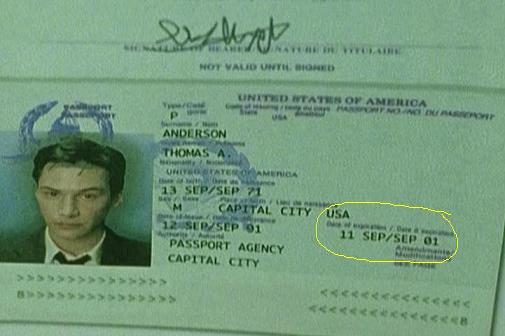
Via: IMDB:
Some personal information can be seen on Thomas Anderson’s “criminal record” that Agent Smith glances at when he interrogates Neo: The last update to the file was July 22, 1998 Neo’s date of birth is “March 11, 1962” Neo’s place of birth is “Lower Downtown, Capitol City” Neo’s mother’s maiden name is “Michelle McCahey” Neo’s father’s name is “John Anderson” Neo attended “Central West Junior High” and “Owen Paterson High” (named after the film’s production designer). Seconds later a photocopy of his passport can be seen. There the place of his birth is CAPITAL CITY USA, his date of birth is the 13th of September 1971, the passport was issued on the 12th of September 1991 and will expire on the 11th of September 2001.
Russian Pullback to Begin Monday
August 17th, 2008Via: AP:
Russian troops will begin pulling back Monday from their positions throughout Georgia toward the country’s separatist-held region of South Ossetia, the Kremlin said Sunday.
Western pressure has been increasing on Moscow to withdraw its forces under a cease-fire deal signed by Russian President Dmitry Medvedev and Georgian President Mikhail Saakashvili. The United States and France have already accused Russia of defying the truce between the ex-Soviet neighbors, as Russian tanks and troops roamed freely across a wide swath of Georgian territory.
The EU-backed cease-fire agreement calls for Georgian and Russian troops to withdraw to the positions they held before fighting broke out Aug. 7.
Medvedev told French President Nicolas Sarkozy in a telephone conversation Sunday that Russian army troops will retreat toward the de facto Georgia-South Ossetia border on Monday, according to a Kremlin statement.
The troops will head toward a border between Georgia and South Ossetia that was delineated in a 1999 peacekeeping agreement signed by all parties, the Kremlin said. The statement did not say that the troops will return to Russia.
In Other News: Russia Considering Arming Its Baltic Fleet with Nuclear Warheads
The Average Briton Is Being Recorded 3,000 Times Per Week
August 17th, 2008Via: Telegraph:
With every telephone call, swipe of a card and click of a mouse, information is being recorded, compiled and stored about Britain’s citizens.
An investigation by The Sunday Telegraph has now uncovered just how much personal data is being collected about individuals by the Government, law enforcement agencies and private companies each day.
In one week, the average person living in Britain has 3,254 pieces of personal information stored about him or her, most of which is kept in databases for years and in some cases indefinitely.
The data include details about shopping habits, mobile phone use, emails, locations during the day, journeys and internet searches.
In many cases this information is kept by companies such as banks and shops, but in certain circumstances they can be asked to hand it over to a range of legal authorities.
Britain’s information watchdog, the Information Commissioner’s Office, has called for tighter regulation of the amount of data held about citizens and urged the public to restrict the information they allow organisations to hold on them.
This newspaper’s findings come days after the Government published plans to grant local authorities and other public bodies access to the email and internet records of millions. Phone companies already retain data about their customers and give it to 650 public bodies on request.
“The Dollar Is Strengthening Because the U.S. Is Leading the Economies of Other Countries Over a Cliff”
August 17th, 2008Via: GreenFaucet:
The dollar is strengthening because the US is leading the economies of other countries over a cliff. Both in terms of easy monetary policies and the continued vendor financing arrangement where we buy their goods financed by their buying our treasuries and keeping our interest rates artificially low. Their currencies are now reflecting their deteriorating fundamentals. To be sure, the long commodities/ short US dollar trade was very crowded and is also playing a part as it unwinds.
…
Meredith Whitney, the Oppenheimer banking sector analyst who dared to separate herself from the comfort of her community herd and boldly predicted the financial disaster a year ago, thinks that, according to a Fortune article where she is the feature cover story, investors should still avoid banking stocks because they will be forced to report even bigger credit losses in the future. The article reads, “Whitney is convinced the economy is about to slip into an ‘early 1980s style’ recession that will devastate the 10% of the population that became overextended during the housing boom.”
Now who do you trust? Someone who has been dead on in predicting this mess from the beginning, or someone from the pack of pathological pollayanas who mindlessly continues to call one false bottom after the other? You know who I’m talking about. Whitney warns, “What’s ahead is much more severe than what we’ve seen so far.” Furthermore, according to Whitney, the banks need to more drastically reduce headcount (from a reduction of 7% so far to 25%–see my commentary “Escape From New York”) and “get real” about how their valuing their mortgage-related debt. Banks are only under-estimating housing price declines. They see drops limited to 20-25% where Whitney sees declines around 40%.
If all of that weren’t enough, the coup de grace for the consumer is a new credit law (well-intentioned as it may be) that will go into effect this fall that will, as the Fortune article citing Whitney’s view writes, “force banks to reduce the amount of credit they extend to consumers.” This of course will force consumers to cut back even further on spending. Whitney says that this is “basically going to amount to a pay cut for the average American consumer.”
Research Credit: efs