Are Gold Prices Failing to Reflect Shortages of Gold Bullion? No.
August 17th, 2008WARNING: This is not a recommendation to buy, sell or hold any financial instrument.
There are some stories floating around saying that the U.S. Mint has suspended sales of American Eagle gold coins. I haven’t posted these stories because, as I write this, the U.S. Mint continues to take orders for the coins. The U.S. Mint has suspended sales of the coins in the past, and the website clearly indicated that fact.
However, people keep submitting this information to me, so let’s look at some statements from a GATA story from yesterday:
…through their agents the bullion banks the Western central banks, desperate to prop up a corrupt and tottering financial system, have put gold so much on sale that even the U.S. Mint can’t find any now. The price reported from the commodities markets is a fiction — a scary one, perhaps, but a fiction no less.
Don’t get me wrong here, because I love a conspiracy as much as the next guy (and dealing with ‘conspiracies’ is part of my full time work on this site), but the statement above makes no sense.
Go to BullionVault.com and look at the real time prices displayed on the front page. BullionVault features a large, private gold bullion market that is always open for trading. BullionVault trades only allocated, Good Delivery gold bullion. All trades require payment in full. There is no credit, margin, leverage, lending, etc.
If, “The price reported from the commodities markets is a fiction,” surely the prices in a totally non-leveraged physical bullion market would reflect the discrepancy, right?
Kitco shows the spot market close (it’s the weekend now) at bid/ask 786.00/788.00.
BullionVault’s live price (trades 24/7) in the Zurich facility is bid/ask 785.42/788.32. Zurich has the most liquidity and the smallest spreads. The spread is wider during weekend trading.
Every transaction on BullionVault represents a transfer of ownership of physical gold bullion from one party to another. The prices are set by market participants who are willing to sell the physical gold that they already own.
What might we conclude from this?
There is no shortage of gold because the allocated market on BullionVault is indicating order flow with prices that are right in line with spot prices. If there was actually a shortage of gold, prices on allocated gold would be higher.
Note: I am a BullionVault client and affiliate.
Dollar Rally
August 16th, 2008WARNING: This is not a recommendation to buy, sell or hold any financial instrument.
On August 8th, with regard to the U.S. Dollar Index and dollar bears, I wrote:
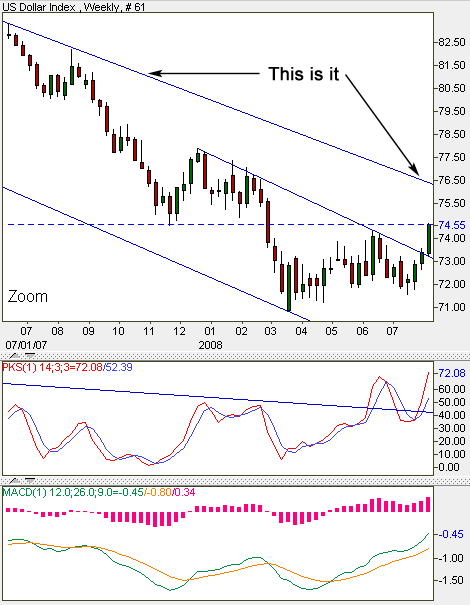
U.S. Dollar Index, Weekly Interval
We need to keep a close eye on this now because it has the potential to turn very ugly. I encourage everyone to draw their own lines in the sand.
Here’s mine:
I’m not staying short the dollar if we get a weekly green candle close above that upper channel line.
Welcome to very ugly.
Why is the dollar gapping up?
Fiat paper confetti wealth is trying to flee from asset to asset, currency to currency, continent to continent as the whole damn show unwinds. We’ve seen recent, post real estate collapse bubbles in the grains, metals, oil, euros and now, as ridiculous as it sounds, the juice appears to be going back into U.S. Dollars.
From a technical perspective, it appears that a watershed event has occurred on the dollar. I’ve never referred to a monthly interval chart before on Cryptogon, but I’m going to here. The chart below shows us over two years of activity on the U.S. Dollar Index, with each candle representing an entire month.

U.S. Dollar Index, monthly interval
While the August candle obviously hasn’t closed yet, there are a number of factors worth mentioning.
The parabolic SAR has been bearish since 2006. It just flipped to bullish on the August candle.
The upper channel line, that has contained all of the action since 2006, has been breached to the upside.
The stochastic, in extreme oversold territory for years, is pulling up and away. Note the trend line over the stochastic.
Not only is the MACD histogram slope positive, there is a cross up for the first time in years.
Finally, RSI has broken up and out.
I told you guys where the edge of my tolerance was for holding out bearish… I executed my stop in a mechanical, dispassionate manner.
I closed my UDN position, ate the loss and took out a hedge (against my NZD and physical gold) with UUP. Since then the move has just kept going. Please, PLEASE understand that UUP is going to pull back as this move consolidates. I went into it as a hedge, so if it pulls back, it means my other positions will increase, and vice versa.
If you’re looking to speculate here, be very careful because you could get whipsawed. I’d wait for the daily stochastic to pull back and buy a cross up anywhere below 60. My goal is to just stay as flat as possible through this period of chaos. As such, I just pulled the trigger fast on the chase.
How much of my gold have I sold throughout this… massacre?
Not one gram. The fact that I’m having to hedge my physical gold position with a bullish dollar vehicle is prima facie evidence that this economic system is capable of fabricating its own absurd reality—a reality that I can’t comprehend in any logical way. At some point, I have no idea when, the grand illusion will unwind. History teaches us that that these Ponzi schemes always do.
Subprime Pain Sweeps the World
August 16th, 2008Via: Business Day:
MORE than 100 local councils, charities, churches, hospitals and nursing homes across Australia are sitting on a $2 billion black hole after buying subprime investments structured by Wall Street banks during the bull market but which are now potentially worthless.
Melbourne’s Metropolitan Ambulance Service and local councils are among those facing losses of hundreds of millions of dollars in the subprime meltdown because of bad debt they bought through a global investment bank.
A document leaked to BusinessDay revealed that Lehman Brothers is managing tens of millions of dollars in funds for Victoria’s community, education and health sectors, much of it invested in high-risk financial instruments now potentially worthless.
Other Victorian entities with millions in subprime exposure are not-for-profit defence personnel insurer Defence Health, which has $39 million managed by Lehman Brothers, and $17 million for the Victoria Teachers Credit Union.
BusinessDay has identified more than 150 government, private and charitable institutions that bought complex financial instruments such as collateralised debt obligations (CDOs). There have been few buyers for CDOs and similar structured finance products since the subprime meltdown this time last year that sent global financial markets into a tailspin.
These toxic investments will wreck the finances of many local government and charitable organisations for years.
Twenty-three local councils are preparing a class action lawsuit against Wall Street bank Lehman Brothers to recover their losses.
Among those that bought the products are four universities, dozens of super funds, ambulance services, the St Vincent de Paul Society, the Starlight Children’s Foundation, the Boystown charity for underprivileged children, and the Anglican, Baptist, Uniting and Catholic churches.
Related: “We Americans Were Very Clever”
Research Credit: IL
Ikea Looking to Sell Solar Panels
August 16th, 2008Via: CleanTech:
The furniture giant plans to invest €50 million in cleantech startups, with the goal of eventually selling solar panels, smart meters and other technology in its stores.
Sweden’s Ikea may need to super-size its shopping carts. The furniture retailer unveiled an investment group today to put €50 million into cleantech startups over the next five years, with the eventual goal of seeing solar panels and other clean technologies on sale in its stores or used by Ikea suppliers.
Ikea GreenTech plans to focus on five areas — solar panels, alternative light sources, product materials, energy efficiency, and water saving and purification. The group said the investments will be made in companies that offer commercial prospects within a four to five year horizon.
“We’re already talking to companies,” Johan Stenebo, managing director of Ikea GreenTech, told the Cleantech Group. He said Ikea is likely to make its first investments this year. “That’s certainly our aim to make happen.”
Stenebo said the cleantech products will follow the same guidelines as the company’s other products.
“Really low prices, and they should be of very good quality. That’s the only thing we look at, we would never look at anything else, we would discard anything else that doesn’t fall into those boundaries,” he said. “Whether it’s home furnishings or it’s greentech products.”
Over the next two years, Ikea plans to work with five or six companies, with a target of bringing the first products to market within three to four years, helping the startups reduce their prices and develop better products.
Ikea expects to invest in five to 10 companies overall, keeping the portfolio relatively small so it spend a lot of time with the startups.
“We will be very active on the boards of these companies,” he said. “I think we can contribute somewhat in terms of commercializing the product they are developing, and then, obviously, distributing the product as well.”
Related: All Electric Vehicles and the Concept of Enough
Russia Seizes Arsenal of U.S. Weapons in Georgia
August 15th, 2008I’m squinting as I follow this situation. I almost don’t want to look.
Via: Dow Jones:
Russian forces have seized a “large arsenal” of U.S.-made weapons in the western Georgian city of Senaki including hundreds of assault rifles, a military spokesman said Friday.
“In Senaki, we seized a large arsenal of weapons including 664 U.S.-made M-16 rifles” and a number of M-40 sniper rifles, General Anatoly Nogovitsyn told a news conference in Moscow. “There were 1,728 weapons total.”
RICE: ALL RUSSIAN TROOPS IN GEORGIA “MUST LEAVE IMMEDIATELY”
August 15th, 2008Via: Dow Jones:
All Russian forces and irregular units with them must leave Georgia immediately, U.S. Secretary of State Condoleezza Rice said in the Georgian capital Tbilisi Friday.
Speaking at a joint press conference with Georgian President Mikhail Saakashvili after he had signed a ceasefire deal, Rice said: “With the signing of this accord, all Russian troops, and any paramilitary and irregular troops that entered with them must leave immediately.”
Pub Goers Trade Home Grown Produce for Beer
August 15th, 2008Mmm hmm.
Via: Money:
Credit crunch pinched residents of one Norfolk village have been taking advantage of an inventive means to save the pennies without cutting back on nights out. Thanks to the resourcefulness of their local pub, ‘The Pigs’, they can now barter fresh produce in return for pints of beer.
The pub, in Edgefield near Holt, is one of the few to see business boom since the start of the credit crunch as it encourages locals to trade their home grown produce in return for alcohol.
The sign outside the pub reads: ‘If you grow, breed, shoot or steal anything that may look at home on our menu, then bring it in and let’s do a deal.’ True to their word they’ll negotiate on anything, agreeing a barter price based on the size, quantity and quality of the produce presented.
Green fingered residents have been trading fruit and vegetables for pub meals and drinks, while others have swapped freshly laid eggs and fish or meat they’ve caught themselves for a pint.
Pub manager and brain child of the popular scheme, Cloe Wasey, enthused “We find the home-grown stuff is often much better than what we can get from the suppliers. When we get the good stuff, and it gets on to the specials board, it’s brilliant.”
Continuing: “We’ve been doing it for almost two years now but the success of it has only just recently started to boom with the credit crunch setting in. People need to find different ways to go out and this helps.”
So far the pub have traded pints in return for locally shot rabbit, pheasants and pigeons as well as fruit grown on local trees and potatoes freshly dug from punters’ gardens. They’ve also honored some more unusual requests with one customer bringing in eight pairs of pigs testicles to trade.
Taking this traditional approach to business has been hugely beneficial for both the owners of The Pigs pub and the residents of Edgefield. However, as consumers continue to tighten their belts without wanting to compromise on their way of life, only time will tell whether other establishments follow their lead and return to a more rustic way of doing business.
Thumb Print for Ammo Sales in California
August 15th, 2008Via: SacBee:
A Sacramento man pleaded guilty Tuesday to possession of ammunition by a felon after buying bullets from a local sporting goods store.
Ramon Michael Clark, 31, entered his guilty plea in federal court before U.S. District Judge John A. Mendez, according to a news release by the office of U.S. Attorney McGregor Scott.
Clark’s illegal activity came to light as a result of a pilot program requiring merchants to collect identifying information from people buying ammunition.
Clark bought 50 rounds of .25 caliber ammunition from Big 5 Sporting Goods on Mack Road in February.
Clark was required to submit his driver’s license and a thumbprint to complete the sale in compliance with a recently enacted ordinance, the release states.
Research Credit: ltcolonelnemo
Home Sellers Suffering Huge Losses
August 15th, 2008Via: CNN:
More homeowners than ever are selling at a loss, propelling the real estate market deeper into crisis.
In the 12 months that ended June 30, nearly 25% of all homes sold nationwide fetched less than sellers originally paid, according to real estate Web site Zillow.com.
While the nation’s double-digit decline in home prices has been well documented, the new report underscores the economic force of those price declines. Homeowners are walking away with much less in their pocket when they sell. And that affects more than the real estate market.
“It’s stunning what’s happening out there,” said Stan Humphries, Zillow’s vice president of data and analytics, who looked at statistics that date back to 1996. “The numbers are the worst we’ve seen and it’s not just the magnitude of the problem but the scope – so many markets are affected.”
ECB Slammed as Europe Crumbles
August 15th, 2008Europe tied itself to the mast of the doomed United States Ship of Fools; Germany more than any of the rest. Who’s leading the way down in Europe? Germany.
Blaming the ECB is convenient because it avoids questioning the absurd assumptions of neo liberalism and fractional reserve banking.
Via: Telegraph:
The economies of Germany, France and Italy all contracted in the first quarter and may now be in full recession, shattering assumptions that Europe would prove able to shrug off the effects of the credit crunch.
The picture is darkening so fast in Spain that Prime Minister Jose Luis Zapatero cancelled holidays and called his cabinet back to Madrid yesterday for the first emergency session of its kind since the Franco dictatorship. The crisis meeting agreed to a €20bn (£16bn) blitz on public works, tax cuts, and a mortgage rescue to halt the downward spiral.
Growth has turned negative in Ireland, Denmark, Latvia, and Estonia, while grinding to a halt in Sweden and The Netherlands. Iceland contracted by a staggering 3.7pc. The grim data from Eurostat follows a recession warning in Britain, and shock news that the Japanese economy had shrunk 0.6pc in the second quarter.
Almost the entire bloc of rich Organisation for Economic Co-operation and Development (OECD) countries – still two thirds of the world economy – are now in the grip of a major downturn. The oil shock over the early summer appears to have had a dramatic effect on the heavy industries of Japan and Germany.
The eurozone as a whole shrank by 0.2pc, the first contraction since the launch of the single currency a decade ago. Germany led the slide with a fall of 0.5pc. France and Italy fell 0.3pc. The delayed effects of the strong euro, tight credit, and slowing exports have now kicked in with a vengeance.
“This is an alarm warning for the economy,” said the Confederation of German Industry (BDI).
The European Central Bank and its president Jean-Claude Trichet appear to have misjudged the severity of the downturn, and may have made a serious error by raising interest rates a quarter point to 4.25pc last month.
By then it was already clear that property markets were slumping across much of the region. “What is shocking is the speed of the collapse in Germany,” said Albert Edwards, global strategist at Société Générale. “I think there has been a lot of hubris at the ECB. They took a derisory attitude towards the US, saying the Federal Reserve was too aggressive in cutting rates. Now they are reaping the bitter reward of their policy,” he said.
The ultra-hawkish Bundesbank’s Axel Weber gave no hint yesterday that the ECB is softening, suggesting that the bank sees a deliberate crunch as the only means to pre-empt a 1970s-style wage-price spiral. “The confidence expressed by some observers that weaker economic growth will lead to a damping of inflation pressures is in my opinion premature,” he said.
Research Credit: efs




