Canada Apologizes for Atrocities Committed Against Aboriginal Children
June 12th, 2008Via: Reuters:
Canada, addressing one of the darkest chapters in its history, formally apologised on Wednesday for forcing 150,000 aboriginal children into grim residential schools, where many say they were sexually and physically abused.
Prime Minister Stephen Harper told a Parliamentary chamber packed with legislators and aboriginal representatives that there could be no excuses for what happened at the church-run schools, which mainly operated from the 1870s to the 1970s.
“The government of Canada sincerely apologises and asks the forgiveness of the aboriginal peoples of this country for failing them so profoundly. We are sorry,” Harper said in a 15-minute address, at one point fighting back tears.
Native leaders said they hoped the apology would lead to a new era of reconciliation between Canadians and the often marginalised aboriginal population, which routinely suffers from poor living conditions and high unemployment.
The residential schools were initially set up to educate native children but later became part of a government campaign to assimilate aboriginals and eradicate their culture — “to kill the Indian in the child”, as some put it at the time.
“There is no place in Canada for the attitudes that inspired the Indian residential schools system to ever again prevail,” Harper said.
Contemporary accounts suggest up to half the children in some institutions died of tuberculosis and other diseases.
Many survivors say they were abused mentally, physically and sexually. Children were beaten for speaking their own languages and told they would be damned unless they converted to Christianity.
Related: UNREPENTANT: Kevin Annett and Canada’s Genocide
Top Secret British Government Document Left on Train
June 12th, 2008It’s right out of Yes Minister.
Via: Guardian:
Highly classified intelligence documents relating to two of the most sensitive issues involving Britain’s security interests – al-Qaida in Pakistan and the situation in Iraq – have been found on a train near London, it was disclosed last night.
The documents, including one marked Top Secret, are believed to be detailed and up-to-date assessments by Whitehall’s Joint Intelligence Committee (JIC).
They were found on Tuesday and handed to the BBC’s security correspondent, Frank Gardner, who reported the loss. The BBC said the documents were left on the train by a senior intelligence officer.
A Cabinet Office spokesman said last night that the documents’ high security classification meant they would have had a limited circulation. “There has been a security breach, the Metropolitan police are carrying out an investigation.”
A Scotland Yard spokesperson said its counter terrorism squad would be heading the investigation. “We can confirm that we are making inquiries in connection with the loss of the documents.”
Gardner said the documents were left in an orange cardboard envelope on a train from London Waterloo to Surrey by a “very senior intelligence official” working in the Cabinet Office. A police search was launched when it was realised that they were missing, as officials were concerned at the possibility of such sensitive papers getting into the wrong hands, he said.
The envelope was picked up by a fellow passenger, who found a seven-page document inside setting out the latest government assessment on the Islamist terror network al-Qaida, along with a “top secret and in some cases damning” assessment of Iraq’s security forces, said Gardner.
The al-Qaida document, commissioned jointly by the Foreign Office and the Home Office, was classified “UK top secret”, he said. Each page was numbered and marked: “For UK, US, Canadian and Australian eyes only.” The document on Iraq was commissioned by the Ministry of Defence. Gardner said: “This was a clear breach of government rules. They should be sealed in a briefcase if taken out.”
The BBC said the two reports were JIC assessments. A British intelligence assessment of the strength of al-Qaida in Pakistan would be sensitive and potentially damaging if read either by hostile interests or the Pakistan government. An assessment of the efficiency of the Iraqi security forces could be embarrassing if seen by the Iraqi government or insurgents.
The intelligence officer had permission to take the documents out of the office as long as sufficient security was provided, meaning a locked box, Whitehall officials said.
The fact that the investigation is in the hands of the police rather than MI5 suggests the documents were lost or mislaid and the official had not been targeted. The officer was still at work, Whitehall sources said. The loss is the latest in a string of recent data security lapses.
Oil Symmetrical Triangle Intraday
June 11th, 2008WARNING: This is not a recommendation to buy, sell or hold any financial instrument.
Really quick, watch that symmetrical triangle forming on the intraday charts. Translation: Breakout higher from previous range possible. It could go sharply higher on this formation.
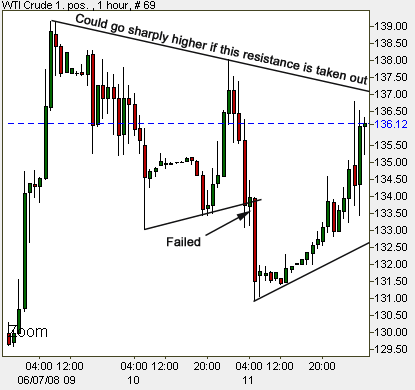
West Texas Intermediate Crude, 1 Hour Interval
Spanish Shoppers Stockpile Food and Fuel as Protests Cut Off Supplies
June 11th, 2008Via: Reuters:
Spanish drivers and shoppers stockpiled fuel and food on Tuesday, fearing shortages after lorry drivers blocked deliveries across the country for a second day of an indefinite protest at the high price of fuel.
Cars queued at petrol stations — 40 percent of which had run out of fuel in the worst affected area of Catalonia — and supplies of fresh food began to run low in some markets, Spanish media reported.
Police motorbike riders escorted fuel tankers to some petrol stations to break picket lines and prevent attacks, after some strikers slashed lorry tires on Monday.
“I heard all the petrol stations were running out of fuel so I came to fill up, otherwise I worried I won’t be able to get to work tomorrow,” said a Madrid driver who gave his name as Raul.
Oil company Cepsa said 45 percent of its deliveries had failed to get through to stations due to strikers blocking their path at fuel deposits, although Spain’s biggest oil firm Repsol said deliveries were getting through with “relative normality.”
Half the normal number of tankers picked up fuel at deposits on Monday, distribution firm CLH said, though the spokesman added that many oil companies had taken on extra supplies in previous days in anticipation of the strike.
Truckers caused traffic chaos in Madrid by slowing almost all roads into the capital, while others blockaded wholesale food markets.
Authorities opened toll booths to ease traffic chaos around the capital, media reported and Barcelona’s city council said it was preparing a plan to ensure supplies of food, fuel and health supplies got through.
What the Internet Is Doing to Our Brains
June 11th, 2008This one hits very close to home.
Via: The Atlantic:
“Dave, stop. Stop, will you? Stop, Dave. Will you stop, Dave?” So the supercomputer HAL pleads with the implacable astronaut Dave Bowman in a famous and weirdly poignant scene toward the end of Stanley Kubrick’s 2001: A Space Odyssey. Bowman, having nearly been sent to a deep-space death by the malfunctioning machine, is calmly, coldly disconnecting the memory circuits that control its artificial brain. “Dave, my mind is going,” HAL says, forlornly. “I can feel it. I can feel it.”
I can feel it, too. Over the past few years I’ve had an uncomfortable sense that someone, or something, has been tinkering with my brain, remapping the neural circuitry, reprogramming the memory. My mind isn’t going—so far as I can tell—but it’s changing. I’m not thinking the way I used to think. I can feel it most strongly when I’m reading. Immersing myself in a book or a lengthy article used to be easy. My mind would get caught up in the narrative or the turns of the argument, and I’d spend hours strolling through long stretches of prose. That’s rarely the case anymore. Now my concentration often starts to drift after two or three pages. I get fidgety, lose the thread, begin looking for something else to do. I feel as if I’m always dragging my wayward brain back to the text. The deep reading that used to come naturally has become a struggle.
I think I know what’s going on. For more than a decade now, I’ve been spending a lot of time online, searching and surfing and sometimes adding to the great databases of the Internet. The Web has been a godsend to me as a writer. Research that once required days in the stacks or periodical rooms of libraries can now be done in minutes. A few Google searches, some quick clicks on hyperlinks, and I’ve got the telltale fact or pithy quote I was after. Even when I’m not working, I’m as likely as not to be foraging in the Web’s info-thickets—reading and writing e-mails, scanning headlines and blog posts, watching videos and listening to podcasts, or just tripping from link to link to link. (Unlike footnotes, to which they’re sometimes likened, hyperlinks don’t merely point to related works; they propel you toward them.)
For me, as for others, the Net is becoming a universal medium, the conduit for most of the information that flows through my eyes and ears and into my mind. The advantages of having immediate access to such an incredibly rich store of information are many, and they’ve been widely described and duly applauded. “The perfect recall of silicon memory,” Wired’s Clive Thompson has written, “can be an enormous boon to thinking.” But that boon comes at a price. As the media theorist Marshall McLuhan pointed out in the 1960s, media are not just passive channels of information. They supply the stuff of thought, but they also shape the process of thought. And what the Net seems to be doing is chipping away my capacity for concentration and contemplation. My mind now expects to take in information the way the Net distributes it: in a swiftly moving stream of particles. Once I was a scuba diver in the sea of words. Now I zip along the surface like a guy on a Jet Ski.
Research Credit: idleworm.com
Fatal Misconception: The Struggle to Control World Population
June 11th, 2008Via: ieet.org:
Connelly decisively confronts the historical baggage of reproductive rights by detailing the confluence of social Darwinists, Malthusians, racist eugenicists, public health advocates and feminists who coalesced around the century-long effort to control world population.
Like Betsy Hartman’s pioneering critique Reproductive Rights and Wrongs: The Global Politics of Population Control, Connelly’s principal narrative is the tension between those who focused on women’s empowerment through birth control and those who wanted to control the fertility of populations with financial incentives and coercion. “The great tragedy of population control, the fatal misconception,” Connelly says, “was to think that one could know other people’s interests better than they knew it themselves.”
The narrative starts in the 19th century with the rising concern in the UK and US about the higher fertility rates of the developing world, sure to produce a flood of non-Anglos across borders and the decline of Anglo hegemony. Racial eugenicists emerged in many countries, determined to increase the birth rate of worthy whites in the affluent North and to control the fertility of the rest.
Connelly describes the rise of the global population control movement, from Delhi and Beijing to London, Geneva and New York, with astonishing breadth. In his account, population control reached its final act in the 1970s and 1980s when Club of Rome pessimism about the “population bomb” coincided with massive sterilisations in India and the imposition of the one-child regime in China. By the mid-1980s population control had been tarnished politically by these excesses, while dramatic declines of fertility worldwide had demonstrated that government coercion has only a marginal influence on childbearing compared with improving women’s education and employment prospects.
Although the book details the ubiquitous influence of racialism and coercive eugenics, it avoids the conspiratorial mindset often used to tar all family planning. The often-vilified Margaret Sanger is examined as a tragic and heroic figure, a passionate activist using every ally at hand to further the cause of women’s empowerment through birth control, then finding herself in league with racialists and patriarchal authoritarian Malthusians. By structuring the story around central figures such as Sanger, Annie Besant and William Draper, Connelly helps the reader weather a mind-numbing parade of characters, organisations and acronyms.
Research Credit: PD
EMERGENCY: MULTIPLE FACTORS POINTING TO LOWER CROP YIELDS
June 11th, 2008Remember this one from several months back?
World’s Largest Maker of Crop Nutrients: Famines May Occur Without Record Harvests
Flash forward to today. We see problems with next year’s crops all over the world.
Via: New York Times:
In a year when global harvests need to be excellent to ease the threat of pervasive food shortages, evidence is mounting that they will be average at best. Some farmers are starting to fear disaster.
American corn and soybean farmers are suffering from too much rain, while Australian wheat farmers have been plagued by drought.
“The planting has gotten off to a poor start,” said Bill Nelson, a Wachovia grains analyst. “The anxiety level is increasing.”
Randy Kron, whose family has been farming in the southwestern corner of Indiana for 135 years, should have corn more than a foot tall by now. But all spring it has seemed as if there were a faucet in the sky. The rain is regular, remorseless.
Some of Mr. Kron’s fields are too soggy to plant. Some of the corn he managed to get in has drowned, forcing him to replant. The seeds that survived are barely two inches high.
At a moment when the country’s corn should be flourishing, one plant in 10 has not even emerged from the ground, the Agriculture Department said Monday. Because corn planted late is more sensitive to heat damage in high summer, every day’s delay practically guarantees a lower yield at harvest.
“This is pushing my nerves to the limit,” Mr. Kron said one recent morning, the sky as dark as the unplanted earth.
Last winter, as the full scope of the global food crisis became clear, commodity prices doubled or tripled, provoking grumbling in America, riots in two dozen countries and the specter of greatly increased malnutrition.
As the world clamors for more corn, wheat, soybeans and rice, farmers are trying to meet the challenge. Millions of acres are coming back into production in Europe. In Asia, planting two or three crops in a single year is becoming more common.
American farmers are planting 324 million acres this year, up 4 million acres from 2007. Too much of the best land is waterlogged, however. Indiana and Illinois have been the worst hit, although Iowa, Wisconsin and Minnesota were inundated last weekend.
Bob Biehl, whose farm is near St. Louis, has managed to plant only 140 of the 650 acres he wanted to devote to corn. Some farmers in his area “haven’t even been able to take the tractor out of the shed,” he said.
United States soybean plantings are running 16 percent behind last year. Rice is tardy in Arkansas, which produces nearly half the country’s crop. “We’re certainly not going to have as good a crop as we had hoped,” said Harvey Howington of the Arkansas Rice Growers Association. “I don’t think this is good news for anybody.”
Harvests ebb and flow, of course. But with supplies of most of the key commodities at their lowest levels in decades, there is little room for error this year. American farmers are among the world’s top producers, supplying 60 percent of the corn that moves across international borders in a typical year, as well as a third of the soybeans, a quarter of the wheat and a tenth of the rice.
“If we have bad crops, it’s going to be a wild ride,” said the Agriculture Department’s chief economist, Joseph Glauber. “There’s just no cushion.”
As every farmer knows, trouble can come at any point before the harvest is complete. Danny and Karen Smith get up in the middle of the night at their wheat farm in Milton, Kan., whenever they hear thunder.
In a few weeks, the wheat they planted last fall will be ripe. A bad storm or, worse, a tornado could destroy it. Last year, the Smiths lost nearly all their wheat to a late freeze compounded by too much rain.
This year, the weather has been perfect: cool and moist. “See how plump these berries are?” Mr. Smith said, standing in the middle of one of his fields. “This will feed a lot of people.”
The world wheat harvest is forecast to rise more than 8 percent this year, because of better weather and more acreage under cultivation. But even this bright spot is tentative. Australia was expected to emerge from a two-year drought, but that prediction is looking somewhat doubtful.
With the exception of southwestern Australia and a small corner of southeastern Australia, little rain has fallen in recent months. Many wheat farmers have been unable to plant at all, said Bob Iffla, the chairman of the country’s Wheat Growers Association.
As a result, the harvest is likely to be below average: 5 million to 15 million tons of wheat available for export, compared with 17 million or 18 million tons in an average year.
China also faces trouble: the agriculture ministry issued an urgent notice to wheat and rice farmers in southern China on Sunday, telling them to harvest as much of their crop as possible immediately in the face of unseasonable torrential rains expected to rake the region for the next 10 days.
In the American corn belt, the issue has also been getting the rain to stop. After heavy rains and flooding last weekend, the price of corn on the commodity markets rose Monday to a record $6.57 a bushel.
“We can’t snap our fingers and make high yields,” said Emerson D. Nafziger, a professor of agronomic extension at the University of Illinois. “We still depend on the weather.”
A universal saying among farmers is that high prices never last, because they encourage production that fills the demand and drives down the prices. The current crisis is testing that theory. With costs soaring for fertilizer and diesel, the expenses of farming are so high that the urge to plant more is battling, in some places, with the temptation to plant nothing.
Prajoub Suksapsri in Ayutthaya, Thailand, is among the farmers going all-out this year. For the first time in two decades of farming, Mr. Prajoub is preparing to plant a second crop of rice on his land, which usually does not have irrigation.
He and his neighbors have risked their savings to set up a system to pump water into their fields. If rice prices stay high, Mr. Prajoub could make the biggest profit he has seen in years from his two-acre farm. But if prices fall, he could face heavy losses.
“Sometimes I lie awake at night, worrying about it,” he said, watching his new Honda generator chug steadily, running the pumps. The landlord for the fields that he rents is charging him more than triple the usual amount just for the right to plant an extra harvest.
“He is sucking my blood,” Mr. Prajoub said.
Helen Gabriel’s farm in south-central Luzon Island in the Philippines also measures two acres and lacks irrigation. Faced with soaring costs for diesel, fertilizer, rice seed and insecticide, she has made a different decision from Mr. Prajoub.
“We will have no crop this year,” Mrs. Gabriel said as she waited in a three-hour line for the right to buy 4.4 pounds of government-subsidized rice.
World stockpiles of rice are likely to shrink slightly this year, excluding Chinese food security reserves that are not available for world trade, after already dwindling markedly in six of the last eight years, said Concepcion Calpe, a Food and Agriculture Organization rice specialist in Rome.
That estimate does not take into account the turmoil in Arkansas. Last year, the rice crop in Arkansas yielded a record 160 bushels an acre. This year, experts there say, 150 bushels will be an achievement.
“There’s no doubt about it, we’re not going to have the rice to export,” said Carl Frein of Farmers Marketing Service in Brinkley, Ark. “Poor countries like Haiti, I don’t know what they’re going to do.”
For all the apprehension this year, the growing season is still young, with plenty of time for the situation to improve — or for crops to fail.
“I’ve seen mediocre starts get a bit better, and mediocre starts get a whole lot worse,” said Mr. Nelson, the grains analyst.
Mr. Kron, the Indiana farmer, gave up on corn last week after managing to plant — and in some cases replant — only about half of his 1,200 acres.
Last year, his corn yielded 150 bushels an acre. This year, he will be happy to get 130 bushels. He has warned his processor, Azteca Milling, which makes flour for tortillas and chips, that he will be short.
Mr. Kron’s prospects are deteriorating. He was hoping to plant soybeans on some of his unused corn ground, but hundreds of those acres adjoin the swollen Wabash River. On Monday, the fields started flooding.
“I don’t know if this is the worst year we’ve ever had, but it’s moving up the list pretty quick,” the farmer said.
Lab Drives Car to 100 MPG
June 10th, 2008As the predictably lame article tells us: Clean energy is expensive.
Far more interesting than the story about the tricked out Prius is the annual budget of the National Renewable Energy Laboratory. I’ve already written this commentary:
The U.S. spends more on the war in Iraq in one day (about $300 million) than it does on the ANNUAL BUDGET for the primary government laboratory that is tasked with renewable energy and energy efficiency research and development. As absurd as that is, a recipient of a grant from this lab has developed a 40% efficient solar cell.
What if that lab had the funding equivalent of what the U.S. is spending on the war over a period of two or three days?
Clean energy is expensive, alright, gosh darn, mmm hmm.
Via: Rocky Mountain News:
If a car that gets 100 miles per gallon of gasoline sounds like a driver’s futile fantasy, think again.
Scientists at the National Renewable Energy Laboratory in Golden are testing a spruced-up Toyota Prius, a plug-in hybrid sedan complete with a solar panel attached to its oval roof and a bigger battery in the trunk to supply power in lieu of the gasoline-fueled engine.
The result: A spunky Prius that runs the initial 60 miles mostly on battery, adding up to a fuel mileage of 100 miles per gallon.
“The stored power in the battery does a great job of displacing petroleum,” said Tony Markel, a senior engineer at NREL who has been working on the 2006 model Prius for the past two years. “For most people, their daily commute is about 30 miles, so this car would run virtually on battery and only need to be recharged at night.”
Displacing petroleum is a desirable virtue today, as the nation battles global warming and skyrocketing fuel prices.
On Monday, Colorado’s average price for regular, unleaded gasoline hit a record high at $3.943 a gallon, nearly 70 cents higher than the $3.258 a year earlier.
But the spruced-up Prius doesn’t come cheap.
The lithium-ion battery, which can be recharged using a standard electrical outlet at home or even at the workplace, has a price tag of $40,000. And the solar panel on the roof cost $2,500.
All told, the car adds up to almost $70,000 – but as NREL says, it’s only a unique research model at this point.
U.S. Food Reserves Tapped Out
June 10th, 2008Via: Tri State Observer:
“According to the May 1, 2008 CCC inventory report there are only 24.1 million bushels of wheat in inventory, so after this sale there will be only 2.7 million bushels of wheat left the entire CCC inventory,” warned Matlack. “Our concern is not that we are using the remainder of our strategic grain reserves for humanitarian relief. AAM fully supports the action and all humanitarian food relief. Our concern is that the U.S. has nothing else in our emergency food pantry. There is no cheese, no butter, no dry milk powder, no grains or anything else left in reserve. The only thing left in the entire CCC inventory will be 2.7 million bushels of wheat which is about enough wheat to make ½ of a loaf of bread for each of the 300 million people in America.”
The CCC is a federal government-owned and operated entity that was created to stabilize, support, and protect farm income and prices. CCC is also supposed to maintain balanced and adequate supplies of agricultural commodities and aids in their orderly distribution.
“This lack of emergency preparedness is the fault of the 1996 farm bill which eliminated the government’s grain reserves as well as the Farmer Owned Reserve (FOR),” explained Matlack. “We had hoped to reinstate the FOR and a Strategic Energy Grain Reserve in the new farm bill, but the politics of food defeated our efforts. As farmers it is our calling and purpose in life to feed our families, our communities, our nation and a good part of the world, but we need better planning and coordination if we are to meet that purpose. AAM pledges to continue our work for better farm policy which includes an FOR and a Strategic Energy Grain Reserve.”
AAM’s support for the FOR program, which allows the grain to be stored on farms, is a key component to a safe grain reserve in that the supplies will be decentralized in the event of some unforeseen calamity which might befall the large grain storage terminals.
A Strategic Energy Grain Reserve is as crucial for the nation’s domestic energy needs as the Strategic Petroleum Reserve. AAM also supports full funding for the replenishment and expansion of Bill Emerson Humanitarian Trust.
Research Psychiatrists Fail to Report Earnings From Drug Companies
June 10th, 2008Follow the drug money.
Via: PlanetC1:
Call it a psycho conflict of interest affecting the health and lives of thousands of children, an Iowa senator has discovered 3 Harvard researchers earned millions of dollars in consulting fees from drug companies, for performing research and evangelizing antipsychotic drug use in children.
Charles Ernest “Chuck” Grassley, a senior United States Senator from Iowa, launched a congressional investigation to determine whether research psychiatrists were receiving drug money payments and failing to disclose that information to the federal government and university departments.
pharmaceutical medications antipsychoticsAccording to congressional investigators, researchers failed to report millions of dollars in income earned while consulting for various drug companies. According to news reports, these were well-known child psychiatrists practicing research out of Harvard University. Among the research doctors were psychiatrist, Dr. Joseph Biederman, of the psychiatry department at Harvard Medical School. Investigators believe the three psychiatrists may have violated federal rules created to vet out potential conflicts of interest in pharmaceutical research, some of which is financed by government grants.