Cryptogon Readers Send Contributions
June 7th, 2008JW sent $35 and AS sent $50. Thank you.
Oil: The Event
June 7th, 2008WARNING: This is not a recommendation to buy, sell or hold any financial instrument.
Before I begin, I want to emphasize that this market is for experts only. Unless you trade for a living, I wouldn’t go near this either way.
Oil has formed a bullish engulfing candle formation on the weekly chart. It has also broken out of its previous range and closed at a fresh record high. On their own, these are very bullish developments. While the weekly stochastic remains in extreme overbought territory, price levels trump oscillators. Oil strategies should favor long positions ABOVE about $135.20 as long as you remember the state of the weekly stochastic. Below $135.20, consider shorts again, with the premise being that a full oscillation down could be due. Shorts must be managed carefully, as they are countertrend and very vulnerable to squeezes/reversals like we saw today. Consider a straddle if it retries $135.
NEAR TERM: VERY VOLATILE, DO NOT EXPECT SMOOTH SAILING HIGHER ON OIL FROM HERE.
The oil story is being driven by several factors, however, the dollar is the most critical of these. Note below that the U.S. Dollar Index is still range bound. There are two supports directly ahead for the dollar, around 71.90 and 71.40 (see chart below).
INTERMEDIATE TERM: ABOVE $135, BULLISH; STRONG CORRECTION POSSIBLE BELOW $135.
The uptrend is very much intact. If the dollar does not find support between present levels and 71.40, oil will be headed higher. My strategic positioning on the dollar is bearish, regardless of the shorter term, countertrend cranks we’ve been seeing.
I rarely include fundamental analysis in my technical work, but today’s move on oil was so unusual that I went looking for an “event.” Extreme oil moves are usually driven by supply disruption events, but that wasn’t the case today. What single event was potentially behind the largest gap higher in oil prices—ever?
On June 5, 2008 at 5:38 p.m. the Wall Street Journal published a piece about the Ambac and MBIA credit rating downgrades (Cryptogon post here). While the news was circulating before this, I’m using this story as the benchmark. I’ve indicated the release of that news on four hour charts of West Texas Intermediate crude oil, spot gold and EUR/USD. I also indicated the news on the U.S. Dollar Index daily interval chart.
A lot of people are saying a lot of things about oil right now.
Nobody, as far as I’ve seen, has drawn an arrow on an intraday oil chart indicating what happened after something like one trillion dollars worth of debt was downgraded in one fell swoop. I emphasized the point by including several other dollar affected assets.
What do you see?
I see dollars trying to hide in many different places, all at once.
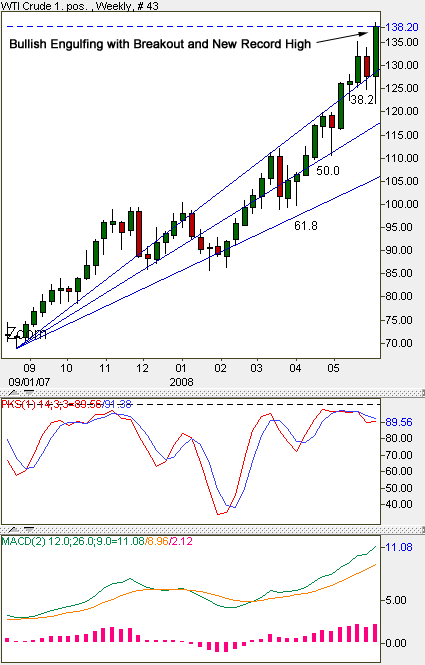
Weekly Interval West Texas Intermediate Crude Oil
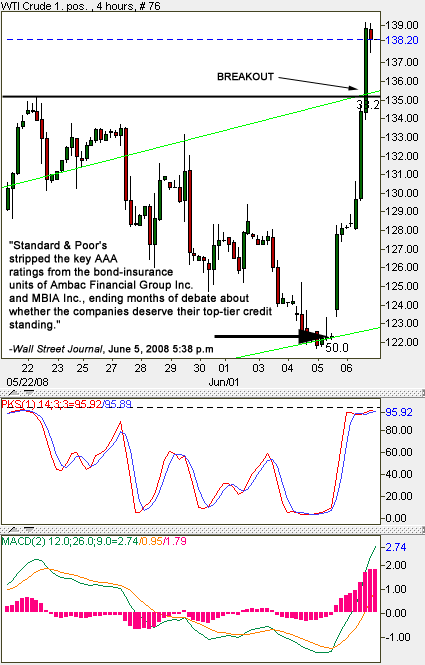
Four Hour Interval West Texas Intermediate Crude Oil
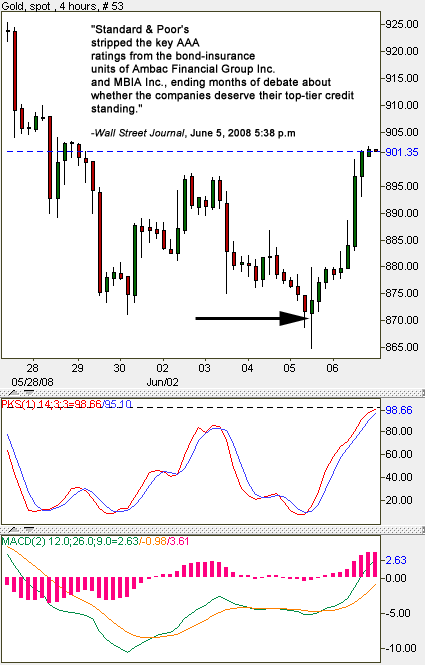
Four Hour Interval Spot Gold
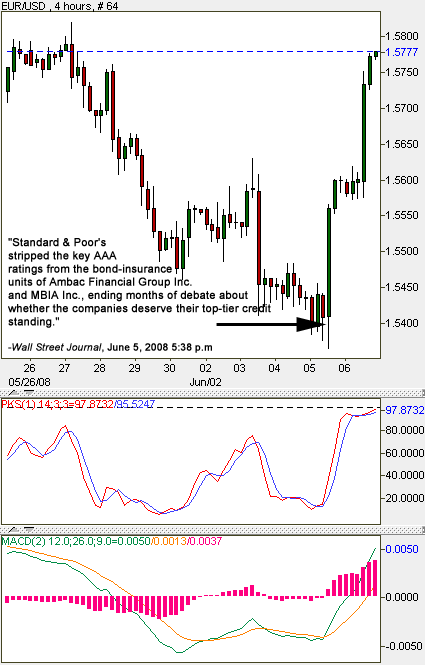
Four Hour Interval EUR/USD
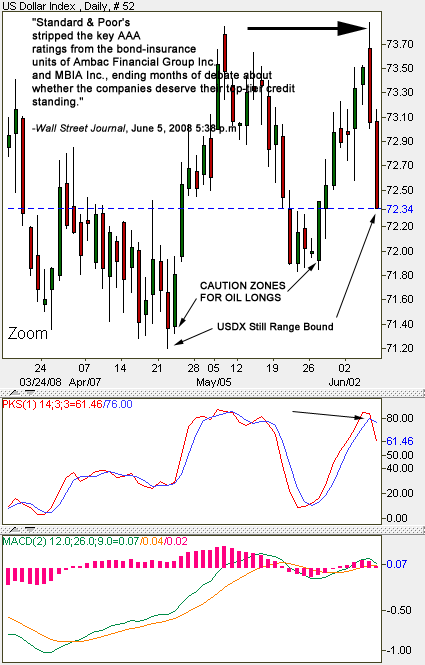
Daily Interval U.S. Dollar Index
OIL SURGES $11 to RECORD $138
June 7th, 2008This was an insane move. I’ll have some charts up next post.
Earlier, I wrote, “Gold, oil and the U.S. Dollar Index are all rangebound slop now. Know that your indicators contain more noise here.”
That was midway through the session. With this weekly candle in, the picture is substantially different now. We’ll look at the charts.
Via: CNN:
Oil prices shot up nearly $11 a barrel and settled Friday at a record $138.54 on geopolitical jitters, a dollar decline and a forecast that oil would hit $150 by July 4.
Friday’s spike in the July contract for light crude on the New York Mercantile Exchange marks the largest single-day increase in oil prices on record. The contract hit an intraday record of $139.12, breaking the previous trading record of $135.09.
“The bulls are running rampant and the bears have panicked,” said oil industry analyst Stephen Schork, editor of the Schork Report. “It’s pure hysteria, absolute panic,” he added.
The rally highlighted concerns that retail gas prices, which have surged near a nationwide average of $4 a gallon, will continue to crimp consumer spending and fuel inflation.
Stocks fell more than 400 points Friday due to the rally in crude prices and a report from the Labor Department that showed the unemployment rate rose to 5.5% in May from 5% in April, the biggest monthly jump in more than two decades. The economy lost 49,000 jobs, marking the fifth straight month of job losses.
Meanwhile, the dollar continued its slide versus the euro on the weak jobs report and comments Thursday that the European Central Bank could potentially raise interest rates. The dollar also tanked versus the yen.
Concerns about instability in the Middle East flared after hawkish comments from Israeli Deputy Prime Minister, Shaul Mofaz, about possible attacks on Iran.
Also contributing to the surge: Morgan Stanley (MS, Fortune 500) analyst Ole Slorer released a report saying that he expected a “short-term spike in oil prices,” as high as $150 a barrel by July 4.
Softening dollar
The dollar began its slide Thursday after European Central Bank president Jean-Claude Trichet said the bank might raise interest rates, which would strengthening the value of the euro. If the euro gains, oil becomes cheaper, European investors buy more oil, raising the price of oil in U.S. dollars, according to Phil Flynn, senior market analyst at Alaron Trading.
The “European Central Bank pulled the rug out from under us,” said Flynn.
Trichet’s comments came the day after Federal Reserve Chairman Ben Bernanke said he wanted to try to support the dollar to bring energy prices into check. “The two central banks are out of step with each other,” he said.
Global demand, especially for gas and distillates in emerging markets, supported the record build in crude prices.
However, the governments of a number of countries, such as India and Malaysia, have started lifting their government fuel subsidies, prompting gas prices to rise in those nations.
China Buying Time at $2.49 Per Gallon
June 6th, 2008In short: The Chinese government is massively subsidizing gasoline prices.
Via: Forbes:
Beijing is holding down many prices–including oil–with a cumbersome price-control scheme.
Consider the following: Since January 2007, global crude oil prices have risen by 109%; gasoline prices in the U.S. have risen by 77% (roughly apace); gasoline prices in China have risen only 9%.
Gasoline in the U.S. now sells for around $4 per gallon, but it sells for $2.49 per gallon in China. Beijing last raised domestic gasoline prices in November 2007, by 9%, and that was the first and only hike since January 2007, when crude was $87 per barrel. A recent rumor that China was about to lift its gasoline-price controls was quickly dismissed by Beijing.
China’s energy sector, regarded as “strategically vital,” is dominated by three giant state-owned enterprises. If Beijing wants anything in energy, it is control. But as China becomes more integrated into the global economy, global rules–not China’s rules–are increasingly intervening.
So here is where it gets really crazy. China National Offshore Oil Corporation, largely an exploration and development driller, sells its output at roughly the globally-set crude oil price to the state-owned refiners, primarily PetroChina and Sinopec. CNOOC’s earnings were up 56% in the first quarter of this year, in a global bull market for oil. No surprise.
Sinopec, conversely, with little drilling capability, buys crude at the global price and sells at the state-controlled retail price, taking a giant bath on every gallon of product they sell. During the first quarter of 2008, their earnings were down 81%. Ouch.
Then there is PetroChina, which has considerable domestic production but also must buy some oil at world prices and sell at the below-market state-set price. PetroChina’s earnings were down 56% in the first quarter.
Beijing will subsidize the domestic gasoline retailers, mostly Sinopec and PetroChina, about $40 billion this year for the price-cost squeeze just described. The oil bureaucrats in Beijing mean well, but what a tangle! How can global investors make any sense of this?
At some point, the domestic oil price in China must rise to the world price, but, at present, that would unacceptably lift inflation. So Beijing watches and waits with a price system that is not functioning. Beijing can afford this massive subsidy to China’s oil consumers with its current favorable budget situation.
But make no mistake: This hold-down of retail prices is a subsidy to energy consumers that is hidden in the government’s budget. The taxpayers are paying for these lower oil prices. They just don’t see it at the pump with the current inflation statistics.
Secret Plan to Keep U.S. Forces in Iraq Indefinitely
June 6th, 2008The U.S. will never leave Iraq voluntarily. A hasty retreat, Saigon style, because of imperial overextension? Maybe. But no orderly withdrawal. Don’t be fooled by this nonsense theater.
Doubt it? What part of Superbase don’t you understand? That’s what people in the business of exploitation and death call a “geostrategic asset.” States don’t give up control of geostrategic assets because a lot of people wear Lick Bush t-shirts and write letters to the editor.
—Now Democrats Don’t Want More Troops?
Via: Independent:
A secret deal being negotiated in Baghdad would perpetuate the American military occupation of Iraq indefinitely, regardless of the outcome of the US presidential election in November.
The terms of the impending deal, details of which have been leaked to The Independent, are likely to have an explosive political effect in Iraq. Iraqi officials fear that the accord, under which US troops would occupy permanent bases, conduct military operations, arrest Iraqis and enjoy immunity from Iraqi law, will destabilise Iraq’s position in the Middle East and lay the basis for unending conflict in their country.
But the accord also threatens to provoke a political crisis in the US. President Bush wants to push it through by the end of next month so he can declare a military victory and claim his 2003 invasion has been vindicated. But by perpetuating the US presence in Iraq, the long-term settlement would undercut pledges by the Democratic presidential nominee, Barack Obama, to withdraw US troops if he is elected president in November.
The timing of the agreement would also boost the Republican candidate, John McCain, who has claimed the United States is on the verge of victory in Iraq – a victory that he says Mr Obama would throw away by a premature military withdrawal.
America currently has 151,000 troops in Iraq and, even after projected withdrawals next month, troop levels will stand at more than 142,000 – 10 000 more than when the military “surge” began in January 2007. Under the terms of the new treaty, the Americans would retain the long-term use of more than 50 bases in Iraq. American negotiators are also demanding immunity from Iraqi law for US troops and contractors, and a free hand to carry out arrests and conduct military activities in Iraq without consulting the Baghdad government.
The precise nature of the American demands has been kept secret until now. The leaks are certain to generate an angry backlash in Iraq. “It is a terrible breach of our sovereignty,” said one Iraqi politician, adding that if the security deal was signed it would delegitimise the government in Baghdad which will be seen as an American pawn.
Research Credit: RL
U.S. Unemployment Up Sharply
June 6th, 2008It’s pointless to post government unemployment statistics, but even by their bogus numbers, it’s the biggest rise in more than two decades.
Via: Bloomberg:
The U.S. lost jobs in May for a fifth month and the unemployment rate rose by the most in more than two decades, signaling that the world’s largest economy is stalling.
Payrolls fell by 49,000 after a 28,000 drop in April, the Labor Department said today in Washington. The jobless rate increased by half a point to 5.5 percent, higher than every forecast in a Bloomberg News survey, partly because an influx of teenagers into the workforce exceeded jobs available.
Treasuries climbed and the dollar slid after the report indicated the economy will struggle to rebound from the weakest expansion in five years. Continental Airlines Inc. and UAL Corp.’s United Airlines are among companies announcing job cuts this week as businesses grapple with soaring energy costs and slowing demand.
MBIA, Ambac, $1 Trillion of Debt, Downgraded
June 6th, 2008Via: Bloomberg:
MBIA Inc. and Ambac Financial Group Inc., the world’s largest bond insurers, had their AAA financial strength rankings cut by Standard & Poor’s, taking with them the ratings on more than $1 trillion of securities they guaranteed.
The ratings were lowered two levels to AA, New York-based S&P said in a statement today. S&P said it would keep the ratings under review pending “clarification of ultimate potential losses as well as future business prospects, the outcome of strategic business decisions, and potential regulatory developments.”
Ambac, which pioneered municipal bond insurance in 1971, and MBIA, which followed three years later, are succumbing to a loss of confidence after straying into backing securities linked to subprime mortgages and home-equity loans that are now defaulting at record rates. The companies, which have raised $4.1 billion combined in the past six months to cover potential losses, said yesterday they were unlikely to meet demands for more capital.
“The rating agencies have been plain that capital ratios are a moving target, and with economic and spread conditions getting worse, these downgrades shouldn’t be a surprise,” said Matt Fabian, a managing director at Concord, Massachusetts-based researcher Municipal Market Advisors. “It’s the end of an era.”
The downgrades affect most of the $668 billion of debt insured by MBIA and the $551 billion of debt guaranteed by Ambac at the end of March. Unless the debt had an underlying rating of AAA without insurance its ranking was also lowered, according to Mimi Barker, a spokeswoman, for S&P.
Research Credit: JL
Oil Gaps on Dollar Craps
June 6th, 2008WARNING: This is not a recommendation to buy, sell or hold any financial instrument.
See what I mean about that dollar and oil?
I expected to see a bit more downside on oil, but, as I said, you need that dollar crank to play along. It did, for a while, as noted. If you covered in time, nice one. If you didn’t cover your winner, two axioms that must be front and center on countertrend cranks are: 1) Pigs get slaughtered and 2) Nobody ever went broke taking profit.
Gold, oil and the U.S. Dollar Index are all rangebound slop now. Know that your indicators contain more noise here.
I’m still unflinchingly short the dollar and have remained so throughout these BS crank rallies. I didn’t cover my UDN. I didn’t sell any gold. I don’t trade oil.
Via: Wall Street Journal:
Oil rose above $130 a barrel Friday in Asia, extending gains made in the previous session when the euro rose against the dollar in response to comments by the head of the European Central Bank.
Including gains in the previous floor session, that put oil more than $8 higher than at the middle of the week.
The dramatic reversal in what had been a weakening market came after ECB President Jean-Claude Trichet suggested the bank could raise interest rates and the euro climbed against the dollar. When interest rates rise in Europe, or fall in the U.S., the dollar tends to weaken against the euro. Many investors tend to buy commodities such as oil as a hedge against inflation when the dollar is falling.
Also, a weaker dollar makes oil less expensive to investors dealing in other currencies, and analysts believe the dollar’s protracted decline has been a major reason why oil prices have nearly doubled in the past year.
Meanwhile, the dollar held relatively steady against the yen, changing hands above ¥106 yen in Tokyo’s currency market. The euro was trading at levels near $1.56 after dropping back some from the day before.
Mr. Trichet spoke Thursday after the bank left a key interest rate unchanged amid concerns about inflation. While Mr. Trichet said a change in rates wasn’t a certainty, he said some of the bank’s governors favor an increase.
Light, sweet crude for July delivery rose $5.49 overnight — its biggest single-day price increase in the history of the New York Mercantile Exchange crude contract — to settle at $127.79 a barrel. Larger one-day percentage jumps have taken place in the past.
Late afternoon in Singapore, the contract was up $2.64 at $130.43 a barrel in electronic trading.
Earlier this week, Federal Reserve Chairman Ben Bernanke indicated that more interest rate cuts are unlikely in the U.S., sending the dollar higher and pushing oil prices lower.
Oil’s decline from the record $135.09 hit May 22, though, has come largely on concerns about demand, and the factors that slashed the prices by more than $10 are still present, analysts noted. They said they were uncertain whether Thursday’s trading could be the start of a new surge higher or just an exception. Recent data show high prices have led consumers to cut their gasoline consumption.
NZ Blackouts Coming: Absurd, Totally Unnecessary, Hold Politicians Accountable
June 6th, 2008Kiwis, what’s about to happen is ridiculous. Contact your MPs. Ask them why we don’t have net metering. Ask them why incentives for individuals to set up small scale generation are so pathetic. Ask them why more effort hasn’t gone into developing baseload capacity from geothermal and wave/tidal sources.
Turn them on to Charmaine Watts (Appropriate name):
A possible looming winter power shortage should encourage New Zealand to accelerate the adoption of small scale renewable electricity options, Sustainable Electricity Association New Zealand said today.
Chief executive Charmaine Watts said more people were feeling helpless each winter in the face of spiralling prices and the threat of power shortages.
“It’s high time the Government woke up and considered the advantages of small scale renewable electricity options if it is really serious about its target of generating 90 per cent of our power needs from renewable sources by 2025, she said in a lecture to mark World Environment Day.
Ms Watts is leading by example. Eight years ago her family decided to generate as much of their energy needs as possible. Using small scale wind and solar power and a wood burner, the Watts consume only 500 to 1000 kilowatt hours (kWh) a year compared with the average family consumption of between 8000-12,000kWh.
“It is possible, but the Government needs to do more to reduce the costs of adopting these technologies as happens in many other countries.”
She said overseas, small scale renewables were being embraced at the rate equivalent to the output of seven Clyde Dams a year thanks to active government policies.
If more power was generated where it was consumed it would mean fewer power stations being built, fewer fossil fuels being burnt, and fewer wind farms being erected.
“We would all have greater control over our power bills and be more confident our water will stay hot and our lights will stay on each winter. What’s more, we would be helping deal with climate change so it’s a clear win-win.”
They’re asleep at the wheel in that beehive, and when the lights go out, it’s going to be their fault.
I know, I know. “Start newzealand.cryptogon.com,” most of you groaning. I’ll try to contain myself.
Via: Stuff:
One of the country’s biggest gas-fired power stations has failed just days before electricity companies are expected to call a nationwide energy savings campaign because of the drought in the South Island.
On Wednesday night Contact Energy took its Otahuhu B gas-fired power station near Auckland offline to repair a fault, which may take four days. The 10-year-old station has a capacity of 400 megawatts.
National hydro lake storage is down to 53 per cent of average and is likely to fall further because Otahuhu is out of action. Low lake levels have driven wholesale electricity prices to record levels.
Big power company bosses are due to meet on Monday to decide if a public power savings campaign should start, possibly by the middle of the month. Without significant rain, it is possible “ripple control” hot water heating may be cut back by early July, sources said.
National’s energy spokesman Gerry Brownlee said Otahuhu’s failure should be the cue for Energy Minister David Parker to announce “the crisis measures he’s been trying so hard to avoid”.
The southern hydro lakes would be using water that would otherwise be held in reserve for winter.
“The situation is remarkably bad. Just to keep the lights on, New Zealanders are relying on a broken Cook Strait cable, an asbestos-riddled mothballed plant in New Plymouth, and a diesel-guzzling emergency generator at Whirinaki.”
U.S. Government’s Audited Financial Statement Shows $3.5 Trillion Deficit in 2005
June 6th, 2008Via: USA Today:
The federal government keeps two sets of books. The set the government promotes to the public has a healthier bottom line: a $318 billion deficit in 2005.
The set the government doesn’t talk about is the audited financial statement produced by the government’s accountants following standard accounting rules. It reports a more ominous financial picture: a $760 billion deficit for 2005. If Social Security and Medicare were included — as the board that sets accounting rules is considering — the federal deficit would have been $3.5 trillion.
Congress has written its own accounting rules — which would be illegal for a corporation to use because they ignore important costs such as the growing expense of retirement benefits for civil servants and military personnel.
Last year, the audited statement produced by the accountants said the government ran a deficit equal to $6,700 for every American household. The number given to the public put the deficit at $2,800 per household.
A growing number of Congress members and accounting experts say it’s time for Congress to start using the audited financial statement when it makes budget decisions. They say accurate accounting would force Congress to show more restraint before approving popular measures to boost spending or cut taxes.
“We’re a bottom-line culture, and we’ve been hiding the bottom line from the American people,” says Rep. Jim Cooper, D-Tenn., a former investment banker. “It’s not fair to them, and it’s delusional on our part.”
The House of Representatives supported Cooper’s proposal this year to ask the president to include the audited numbers in his budgets, but the Senate did not consider the measure.