Right Now, Feds Might be Looking Into Your Finances
March 14th, 2008Yeah, they need to steal money from you to bail out the crooks on Wall Street.
“Mr. Smith, we see here that you leaned left instead of right the last two out of five times you farted. We’ll need to seize your funds until you can provide us with an itemized, externally audited report of why that happened. Mmmkay? Enjoy the rest of your evening.”
Via: USA Today:
Each year, federal agents peek at the financial transactions of millions of Americans — without their knowledge.
The same type of information that raised suspicions about New York Gov. Eliot Spitzer is reviewed every day by authorities to find traces of money laundering, check fraud, identity theft or any crime that may involve a financial institution.
As concerns about fraud and terrorist financing grow, an increasing number of suspicious deposits, withdrawals and money transfers are being reported by banks and others to the federal government. Banks and credit unions as well as currency dealers and stores that cash checks reported a record 17.6 million transactions to the Financial Crimes Enforcement Network in 2006, according to a report from the network, a bureau of the U.S. Treasury Department.
“I don’t think Americans understand that their financial transactions are being reported and routinely examined,” said Barry Steinhardt of the American Civil Liberties Union.
The Treasury Department’s database now contains records of more than 100 million financial transactions going back to at least 1996, said network spokesman Steve Hudak.
Teams of agents from the FBI, IRS, Drug Enforcement Administration and other agencies regularly review newly filed financial reports and launch investigations. Federal and local authorities search the database to find information about people that can help ongoing probes. Treasury Department analysts study the reports to detect trends in fraud and issue reports alerting financial institutions.
“The government has access to untold volumes of records and can draw all sorts of conclusions about us, and many are going to be wrong,” Steinhardt said.
Bankers disagree. “For the typical bank customer, this means very little because there’s nothing they’re doing that’s likely to be viewed as out of the ordinary,” said Richard Riese, head of regulatory compliance for the American Bankers Association.
The reporting system dates to the early 1970s when federal agents sought to pinpoint drug dealers by looking for people making large cash deposits.
Financial institutions have long been required to report cash transactions over $10,000. Those reports — simple notices of a deposit or withdrawal — account for more than 90% of the records the enforcement network gets each year.
Far more controversial are secret “suspicious activity reports” filed by financial institutions and reviewed by teams of agents spread around the country. The investigation of Spitzer began when a bank spotted potentially suspicious transfers from several accounts and filed reports with the IRS, according to a federal official who spoke on condition of anonymity. The official did not want his name used because he’s not authorized to discuss the case publicly.
The number of suspicious activity reports soared from 413,000 in 2003 to 1 million in 2006, according to the enforcement network.
Federal law requires the reports to remain secret. They are written by officers at financial institutions who specialize in detecting suspicious activity, such as a series of large transactions.
BEAR STEARNS STOCK CUT IN HALF
March 14th, 2008Via: Reuters:
Bear Stearns Inc shares fell 50 percent on Friday, on news the bank’s liquidity position had deteriorated significantly in the last 24 hours, prompting it to secure financing from JPMorgan Chase and the Federal Reserve Bank of New York.
Shares fell to $28.59 on the New York Stock Exchange.
EMERGENCY: U.S. FEDERAL RESERVE, JPMORGAN TRYING TO PREVENT COLLAPSE OF BEAR STEARNS
March 14th, 2008Spot gold $1005. Dollar getting slammed again. Trading remains orderly.
—
That looked like it was going to get weird for a few minutes…
Do the riot police show up when Wall Street goes looking for handouts?
Via: AFP:
JPMorgan Chase on Friday said it was acting with the Federal Reserve Bank of New York to provide emergency secured funding to troubled US investment bank Bear Stearns for an initial period of up to 28 days.
The emergency funding will be available to Bear Stearns “as necessary,” JPMorgan Chase said in a statement.
The Fed, through its discount window, will provide financing to JPMorgan Chase. JPMorgan Chase said it did not believe this transaction exposes its shareholders to “any material risk.”
JPMorgan Chase said it was working closely with Bear Stearns on securing permanent financing or other alternatives for the bank, which has been battered by a global credit crunch and the US housing slump.
The Wall Street investment bank has sustained hundreds of millions of dollars in losses in the mortgage-related credit crisis that erupted in mid-2007.
Bear Stearns confirmed that it has agreed to a secured loan facility for up to 28 days with JPMorgan Chase. The company said it was in talks with JPMorgan about permanent financing or other alternatives.
The company said its liquidity position had “significantly deteriorated” in the last 24 hours.
“Bear Stearns has been the subject of a multitude of market rumors regarding our liquidity,” said Alan Schwartz, the company’s president and chief executive.
“We have tried to confront and dispel these rumors and parse fact from fiction. Nevertheless, amidst this market chatter, our liquidity position in the last 24 hours had significantly deteriorated,” he said.
“We took this important step to restore confidence in us in the marketplace, strengthen our liquidity and allow us to continue normal operations,” the Bear Stearns executive said.
The company added that it cannot make any assurance that strategic alternatives will be successfully completed.
FBI Made ‘Blanket’ Demands for Phone Records
March 14th, 2008Via: New York Times:
Senior officials of the Federal Bureau of Investigation repeatedly approved the use of “blanket” records demands to justify the improper collection of thousands of phone records, according to officials briefed on the practice.
The bureau appears to have used the blanket records demands at least 11 times in 2006 alone as a quick way to clean up mistakes made over several years after the Sept. 11, 2001, attacks, according to a letter provided to Congress by a lawyer for an F.B.I. agent who witnessed the missteps.
The F.B.I. has come under fire for its use of so-called national security letters to inappropriately gather records on Americans in terrorism investigations, but details have not previously been disclosed about its use of “blanket” warrants, a one-step operation used to justify the collection of hundreds of phone and e-mail records at a time.
Related: NSA’s Domestic Spying Grows As Agency Sweeps Up Data
House Agrees to Rare Secret Session on Spy Bill
March 14th, 2008The following passage is from, They Thought They Were Free: The Germans, 1933-45 by Milton Mayer:
“What happened here was the gradual habituation of the people, little by little, to being governed by surprise; to receiving decisions deliberated in secret; to believing that the situation was so complicated that the government had to act on information which the people could not understand, or so dangerous that, even if the people could not understand it, it could not be released because of national security. And their sense of identification with Hitler, their trust in him, made it easier to widen this gap and reassured those who would otherwise have worried about it.
“This separation of government from people, this widening of the gap, took place so gradually and so insensibly, each step disguised (perhaps not even intentionally) as a temporary emergency measure or associated with true patriotic allegiance or with real social purposes. And all the crises and reforms (real reforms, too) so occupied the people that they did not see the slow motion underneath, of the whole process of government growing remoter and remoter.
…
“To live in this process is absolutely not to be able to notice it—please try to believe me—unless one has a much greater degree of political awareness, acuity, than most of us had ever had occasion to develop. Each step was so small, so inconsequential, so well explained or, on occasion, ‘regretted,’ that, unless one were detached from the whole process from the beginning, unless one understood what the whole thing was in principle, what all these ‘little measures’ that no ‘patriotic German’ could resent must some day lead to, one no more saw it developing from day to day than a farmer in his field sees the corn growing. One day it is over his head.
Via: Reuters:
The House of Representatives abruptly postponed a vote on a spy bill on Thursday after Democrats agreed to a Republican request to hold a rare secret session to discuss classified security matters.
The vote was reset for Friday.
The bill would revamp a 1978 surveillance law and reject President George W. Bush’s demand that phone companies that participated in his warrantless domestic spy program begun after the September 11 attacks be immunized from lawsuits.
House Republican Whip Roy Blunt said he wants to privately inform colleagues how the Democratic measure could disrupt anti-terrorism efforts.
Blunt said several lawmakers with high-security clearance already had access to the information, but wanted to make sure all were aware of it.
“There are a significant number of elements of how the (1978) Foreign Intelligence Surveillance Act works and … specific examples of how their proposed changes would prevent it from working that I think can only be disclosed in a secret session,” Blunt said.
Several Democrats voiced skepticism, with some suggesting Republicans were merely trying to delay action on the bill that Bush has threatened to veto.
But Democrats ultimately agreed for the House to hold its first secret session since 1983 on Thursday night. The session was set to last an hour and begin after authorities cleared and secured the chamber.
IMF Tells States to Plan for the Worst; “Think the Unthinkable”
March 14th, 2008A handful of Wall Street firms created this mess, and guess who’s going to pay?
Mmm hmm.
Via: Financial Times:
IMF tells states to plan for the worst
By Krishna Guha in Washington
Published: March 13 2008 02:00 | Last updated: March 13 2008 02:00
Governments might have to intervene with taxpayers’ money to shore up the financial system and prevent a “downward credit spiral” from taking hold, the International Monetary Fund said yesterday.
John Lipsky, the IMF’s first deputy managing director, said: “We must keep all options on the table, including the potential use of public funds to safeguard the financial system.”
The statement by the senior IMF official marks the second radical policy intervention from the IMF this year. It had previously called on governments to consider using fiscal policy to offset the impact of the credit crisis on growth.
Mr Lipsky said: “I fully recognise an appropriate role for public sector intervention after market solutions have been exhausted.”
He urged policymakers to “think the unthinkable” and prepare now for what they would do if the worst case scenarios materialised and “low probability but high impact events” threatened to jeopardise global financial stability.
He warned of the risk that a “global financial decelerator” could take hold, in which rising defaults and margin calls from lenders triggered forced asset sales, driving down the value of collateral and forcing further forced sales.
The IMF deputy managing director’s comments make it clear that the fund is open in principle to the possibility of taxpayer-funded intervention in the market for mortgage securities as well as intervention to save individual banks from bankruptcy.
Mr Lipsky warned: “The risks of further escalation of this crisis are rising and decisive policy action will be needed.”
He said this crisis was different from recent past crises because both the financial markets and the banking system “have faltered simultaneously”. The first priority had to be to reverse the “spreading strains” in global financial markets and restore the functioning of the financial system in advanced economies.
Mr Lipsky said there should be no let up in the pressure on financial institutions to disclose losses but said pressure to deleverage “needs to be kept orderly”.
He also urged banks to recapitalise to avoid shrinking their balance sheet.
Stressing that this was a global problem – not one confined to the US – he said it would have to be addressed in a “global -context”.
Mr Lipsky said the “first line of defence” remained monetary policy and interest rates. But monetary policy was “hampered” by problems in the credit markets and “there is a risk of a broader and more intense tightening in credit conditions”.
This was why the IMF was making the case that “there is likely to be a role in some countries for stepped-up counter-cyclical macroeconomic policy measures to help support demand”. Fiscal policy was the “second line of defence”.
But Mr Lipsky said “macroeconomic policies may not be sufficient to cushion the blow if an extreme event occurs” – making it essential that policymakers prepared for the possible need to intervene.
Hundreds Line Up for Government Handouts, Meet Riot Police Instead
March 13th, 2008Via: Palm Beach Post:
A crowd of more than 500 people waiting for hours this morning for housing voucher applications were dispersed by police in riot gear at the Boca Raton Housing Authority when the applications ran out sooner than expected.
The action prompted complaints that officers used excessive tactics and housing authority officials were incompetent in their planning.
Two people were arrested and six to eight people hospitalized for exhaustion during the ordeal.
Hundreds of people, mostly mothers who had spent more than eight hours in line, were forced to leave the property at 2333 W. Glades Road by 30 Boca Raton Police officers, including SWAT team members, who walked toward the crowd in unison holding their police shields up about 10:30 a.m.
“Leave or face arrest,” police officers shouted at the crowd as they urged them out of the housing authority parking lot. People were made to leave the vicinity altogether, with officers forcing them to cross the street and move toward their cars.
The overwhelming turnout of people desperate for housing money came as little surprise to Suzanne Cabrera, president of the Housing Leadership Council of Palm Beach County.
“This is an indication that housing it’s still a huge problem,” Cabrera said this afternoon. “It’s a reflection of people’s concern for housing, their uncertainty. I got people today asking me: was this my last chance to get housing I can afford?”
Several other things, such as mortgage foreclosures and high gas prices, are contributing to that feeling of insecurity and desperation, she said.
So whenever word gets out that voucher applications are being handed out, which she said doesn’t happen very often, people get full of hope.
Research Credit: GT
Retail Sales Plunge by 0.6 Percent
March 13th, 2008Via: AP:
Consumers, battered by plunging home prices and a credit crunch, stayed away from the malls in February, pushing retail sales down by a larger-than-expected amount. It was another worrisome sign that the country could be falling into a recession.
The Commerce Department reported Thursday that retail sales fell by 0.6 percent last month, far worse than the small 0.2 percent increase that analysts had been expecting.
The weakness was widespread with sales of autos, furniture and appliances all down.
It marked the second time in the past three months that retail sales have taken a tumble. Sales had fallen by an even bigger 0.7 percent in December, the largest drop in six months, as the nation’s retailers suffered through a dismal holiday shopping season. Sales posted a modest 0.4 percent gain in January.
Consumer spending is closely watched because it accounts for two-thirds of total economic activity.
Gold for April Delivery: $1000
March 13th, 2008WARNING: This is not a recommendation to buy, sell or hold any financial instrument.
Equities are going to get whacked. What usually happens in these situations is that money comes out of the gold. Don’t be surprised if it pulls back.
Via: Reuters:
U.S. gold futures rallied to a record high of $1,000 an ounce on Thursday, fueled by a combination of a weakening dollar, strong investment demand and inflation fears due to rising crude oil prices.
At 8:27 a.m. EDT, the active contract for April delivery was up $17.30 or 1.7 percent at $997.70 an ounce. Just minutes earlier, it had hit an all-time high of $1,000 on the COMEX division of the New York Mercantile Exchange.
Gold: Remember the Messy Symmetrical Triangle?
March 13th, 2008WARNING: This is not a recommendation to buy, sell or hold any financial instrument.
I was just looking at the four and eight hour intervals on gold and my Magic 8 Ball, chicken entrails and tea leaves lead me to believe that we might have a bullish Symmetrical Triangle forming… Yeah, squint really hard, it might help you see it. * chortle * And right under that big, fat $1000. Squint some more and you might see a bullish Ascending Triangle.
—Gold: Intraday Intervals Forming Messy Symmetrical Triangle
Weeeeeeeee!
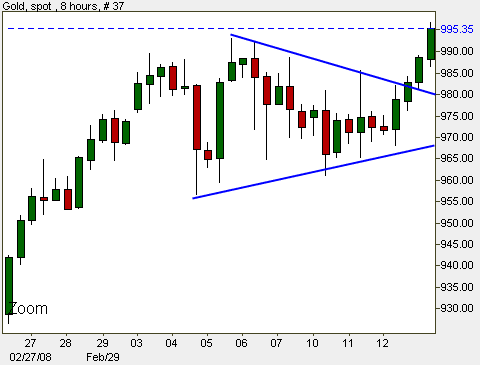
Gold, eight hour interval, symmetrical triangle breakout
Trying for a grand, again.