Cryptogon Readers Sign Up for Hosting with BlueHost
February 20th, 2008Thanks to the owners of doomers.us and gamegumbo.com for signing up for hosting with BlueHost. Cryptogon received $130.
Cryptogon Readers Send Contributions
February 20th, 2008Pookie $79.50
DT $10
JR $5
MW $20
Eileen $50
Thank you.
Pentagon: “Psychologically Devastating” Microwave Weapon Can Cause People to Hear Voices in Their Heads
February 20th, 2008Via: Wired:
Application of the microwave hearing technology could facilitate a private message transmission. It may be useful to provide a disruptive condition to a person not aware of the technology. Not only might it be disruptive to the sense of hearing, it could be psychologically devastating if one suddenly heard “voices within one’s head.”
…
Because the frequency of the sound heard is dependent on the pulse characteristics of the RF energy, it seems possible that this technology could be developed to the point where words could be transmitted to be heard like the spoken word, except hat it could only be heard within a person’s head. In one experiment, communication of the words from one to ten using “speech modulated” microwave energy was successfully demonstrated. Microphones next to the person experiencing the voice could not pick up the sound. Additional development of this would open up a wide range of possibilities.
…
This technology requires no extrapolation to estimate its usefulness. Microwave energy can be applied at a distance, and the appropriate technology can be adapted from existing radar units. Aiming devices likewise are available but for special circumstances which require extreme specificity, there may be a need for additional development. Extreme directional specificity would be required to transmit a message to a single hostage surrounded by his captors. Signals can be transmitted long distances (hundreds of meters) using current technology. Longer distances and more sophisticated signal types will require more bulky equipment, but it seems possible to transmit some of the signals at closer ranges using man-portable equipment.
Britain: Northern Rock Deal Could Cost £3,500 Per Person
February 20th, 2008Via: Telegraph:
The cost of the Northern Rock crisis has reached the equivalent of £3,500 for every taxpayer as experts warned that the nationalisation rescue of the bank was bound to fail.
Taxpayers’ exposure to the beleaguered bank has doubled since the beginning of the year and now stands at about £110 billion – more than the annual budget of the NHS and the equivalent of 27p on the basic rate of income tax.
Lamp Lit by Gravity Wins Greener Gadget Award
February 20th, 2008UPDATE: This lamp can’t work as described. Inventor admits it.
Via: Pure Energy Systems:
A Virginia Tech student has created a floor lamp powered by gravity.
Clay Moulton of Springfield, Va., who received his Master of Science in Architecture with a concentration in industrial design from the College of Architecture and Urban Studies in 2007, created the lamp as a part of this master’s thesis. The LED lamp, named Gravia, has just won second place in the Greener Gadgets Design Competition as part of the Greener Gadgets Conference in New York City.
The light output will be 600-800 lumens – roughly equal to a 40 watt incandescent bulb. Each drop of the gravity mechanism runs the light over a period of four hours.
To “turn on” the lamp, the user moves weights from the bottom to the top of the lamp. An hour-glass like mechanism is turned over and the weights are placed in the mass sled near the top of the lamp. The sled begins its gently glide back down and, within a few seconds, the LEDs come on and light the lamp, Moulton said. “It’s more complicated than flipping a switch but can be an acceptable, even enjoyable routine, like winding a beautiful clock or making good coffee,” he said.
Moulton estimates that Gravia’s mechanisms will last more than 200 years, if used eight hours a day, 365 days a year. “The LEDs, which are generally considered long-life devices, become short-life components in comparison to the drive mechanisms,” he said.
The acrylic lens will be altered by time in an attractive fashion, Moulton said. “The LEDs produce a slightly unnatural blue-ish light. As the acrylic ages, it becomes slightly yellowed and crazed through exposure to ultraviolet light,” he said. “The yellowing and crazing will tend to mitigate the unnatural blue hue of the LED light. Thus, Gravia will produce a more natural color of light with age.”
He predicted that the acrylic will begin to yellow within 10 to 15 years when Gravia is used in a home’s interior room.
Energy Conflicts and Differential Profits: Poor Performance of Oil Stocks Predicts Middle East Conflicts
February 19th, 2008Via: Alternative Information Center — Economy of the Occupation 10: Cheap Wars:
The key beneficiaries of this new, indirect link are the large oil companies. The geographic centre of this process is the Middle East. After the Vietnam War, the Middle East has become the hot spot of global conflict, with obvious corollaries for the price of oil. The relationship between these conflicts and the differential profits of the oil companies, however, has received little or no attention.
The reason for this neglect is not difficult to see. Most analyses of Middle-East conflict and oil are situated in the disciplinary intersection of ‘international relations’ and ‘international economics.’ Their basic reasoning boils down to a struggle among states over raw materials. On the one hand, there are the industrialized countries that need cheap oil in order to sustain their growth and expanded reproduction. On the other hand there are the countries of the Middle East , organized through OPEC, whose intention is to extract from the process as much rent as they can. This broad conflict is complicated by various factors: for example, inter-state rivalry—say between the United States and the Soviet Union (previously) and Europe and Asia (presently); religious and ethnic hostilities in the Middle East itself; or the interests of various sectors and capitalist fractions in the industrialized countries.
In this polemic of high politics and resource economics, few have bothered to break through the aggregate front, fewer have done empirical work, and almost no one has dealt with the question of how exactly accumulation by the oil companies fits into the picture. Figure 2 offers a glimpse into what is missing from the story. The chart shows the history of differential accumulation by the ‘Petro-Core’ of leading oil companies—specifically: BP, Chevron, Exxon, Mobil, Royal-Dutch/Shell and Texaco.[6]
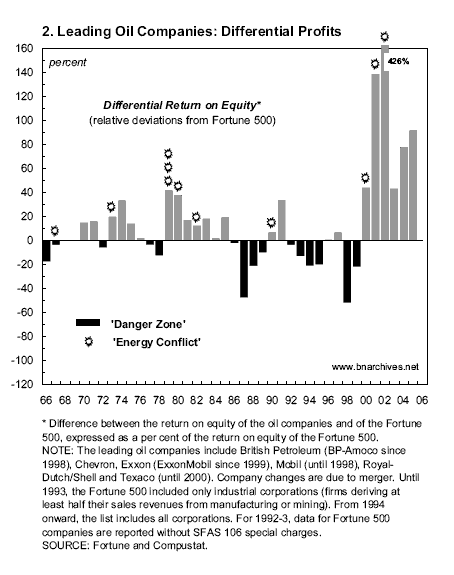
Each bar in the figure measures the difference between the rate of return on equity of these companies and the average rate of return on equity of the Fortune 500 benchmark (with the result expressed as a percent of the Fortune 500 average). The grey bars show years of differential accumulation; that is, years in which the leading oil companies beat the average with a higher rate of return. The black bars show periods of differential decumulation; that is, years in which the leading oil companies trailed the average. For reasons that will become apparent in a moment, these latter periods signal ‘danger’ in the Middle East . Finally, the explosion signs show ‘Energy Conflicts’—namely, conflicts that were related, directly or indirectly, to oil.[7] The figure exhibits three related patterns, all remarkable in their persistence:
First, every energy conflict in the Middle East was preceded by a danger zone, in which the oil companies suffered differential decumulation.
Second, every energy conflict was followed by a period during which the oil companies beat the average.
And, third, with only one exception in 1996-7, the oil companies never managed to beat the average without an Energy Conflict first taking place.
UN: Saboteurs May Have Cut Mideast Telecom Cables
February 19th, 2008“I wouldn’t be surprised, however, if the Them were to bring the Internet down as a false flag operation, blame Bin Laden, et al. and provide the pretext for the economic collapse that is, in reality, long over due. If the Internet comes down… it will indicate that the Them feel that there is nothing left to loot and that some hellish system of martial law is necessary in order to maintain control.”
“Anyone who tells you that this is some sort of fluke is a f*@$^!& idiot, and that’s being kind.”
Is the USS Bin Laden awaiting its next assignment in Davy Jones’ Locker?
Via: AFP:
Damage to several undersea telecom cables that caused outages across the Middle East and Asia could have been an act of sabotage, the International Telecommunication Union said on Monday.
“We do not want to preempt the results of ongoing investigations, but we do not rule out that a deliberate act of sabotage caused the damage to the undersea cables over two weeks ago,” the UN agency’s head of development, Sami al-Murshed, told AFP.
Five undersea cables were damaged in late January and early February leading to disruption to Internet and telephone services in parts of the Middle East and south Asia.
There has been speculation that the sheer number of cables being cut over such a short period was too much of a coincidence and that sabotage must have been involved.
India’s Flag telecom revealed on February 7 that the cut to the Falcon cable between the United Arab Emirates and Oman was caused by a ship’s anchor. But mystery shrouds what caused another four reported cuts.
“Some experts doubt the prevailing view that the cables were cut by accident, especially as the cables lie at great depths under the sea and are not passed over by ships,” Murshed said on the sidelines of a conference on cyber-crime held in Gulf state of Qatar.
The Falcon cable has since been repaired, along with the Flag Europe Asia (FEA) cable which was damaged off Egypt’s Mediterranean coast. The status of the remaining cable is still unclear.
U.S. Banks Borrow $50 Billion via New Fed Facility Against “Garbage Collateral Nobody Else Wants to Take”
February 19th, 2008Via: Financial Times:
US banks have been quietly borrowing massive amounts of money from the Federal Reserve in recent weeks by using a new measure the Fed introduced two months ago to help ease the credit crunch.
The use of the Fed’s Term Auction Facility, which allows banks to borrow at relatively attractive rates against a wider range of their assets than previously permitted, saw borrowing of nearly $50bn of one-month funds from the Fed by mid-February.
US officials say the trend shows that financial authorities have become far more adept at channelling liquidity into the banking system to alleviate financial stress, after failing to calm money markets last year.
However, the move has sparked unease among some analysts about the stress developing in opaque corners of the US banking system and the banks’ growing reliance on indirect forms of government support.
“The TAF … allows the banks to borrow money against all sort of dodgy collateral,” says Christopher Wood, analyst at CLSA. “The banks are increasingly giving the Fed the garbage collateral nobody else wants to take … [this] suggests a perilous condition for America’s banking system.”
California Judge Tries to Take Wikileaks Down: Hilarity Ensues
February 19th, 2008The imbecile judge cut one head off the monster and a thousand more sprang from the wound.
Despite forced takedown actions and DDOS attacks, Wikileaks is on the air: http://88.80.13.160. The server is located in Sweden.
(Of course, don’t expect the BBC to let you know that.)
Also, John Young, over at Cryptome, has provided a mirror of all the documents in question: Wikileaked Bank Julius Baer Documents 3MB zip
Funny note: After hunting down that IP address, I went to check Reddit and the Wikileaks IP was the number one story. I almost pissed myself laughing. So much for getting some “breaking news” out there on this issue.
Via: BBC:
A controversial website that allows whistle-blowers to anonymously post government and corporate documents has been taken offline in the US.
Wikileaks.org, as it is known, was cut off from the internet following a California court ruling, the site says.
The case was brought by a Swiss bank after “several hundred” documents were posted about its offshore activities.
Other versions of the pages, hosted in countries such as Belgium and India, can still be accessed.
However, the main site was taken offline after the court ordered that Dynadot, which controls the site’s domain name, should remove all traces of wikileaks from its servers.
The court also ordered that Dynadot should “prevent the domain name from resolving to the wikileaks.org website or any other website or server other than a blank park page, until further order of this Court.”
Other orders included that the domain name be locked “to prevent transfer of the domain name to a different domain registrar” to prevent changes being made to the site.
Wikileaks claimed that the order was “unconstitutional” and said that the site had been “forcibly censored”.
Web names
The case was brought by lawyers working for the Swiss banking group Julius Baer. It concerned several documents posted on the site which allegedly reveal that the bank was involved with money laundering and tax evasion.
The documents were allegedly posted by Rudolf Elmer, former vice president of the bank’s Cayman Island’s operation.
A spokesperson for Julius Baer said he could not comment on the case because of “pending legal proceedings”.
The BBC understands that Julius Baer asked for the documents to be removed because they could have an impact on a separate legal case ongoing in Switzerland.
The court hearing took place last week and Dynadot blocked access from Friday evening.
Wikileaks says it was not represented at the hearing because it was “given only hours notice” via e-mail.
A document signed by Judge Jeffery White, who presided over the case, ordered Dynadot to follow six court orders.
As well as removing all records of the site form its servers, the hosting and domain name firm was ordered to produce “all prior or previous administrative and account records and data for the wikileaks.org domain name and account”.
The order also demanded that details of the site’s registrant, contacts, payment records and “IP addresses and associated data used by any person…who accessed the account for the domain name” to be handed over.
Wikileaks allows users to post documents anonymously.
Information bank
The site was founded in 2006 by dissidents, journalists, mathematicians and technologists from the US, Taiwan, Europe, Australia and South Africa.
It so far claims to have published more than 1.2 million documents.
It provoked controversy when it first appeared on the net with many commentators questioning the motives of the people behind the site.
It recently made available a confidential briefing document relating to the collapse of the UK’s Northern Rock bank.
Lawyers working on behalf of the bank attempted to have the documents removed from the site. They can still be accessed.
Dynadot was contacted for this article but have so far not responded to requests for comment.
Largest Meat Recall in U.S. History
February 18th, 2008Which phrase is more bone chilling?
Downer cattle, or federal nutrition program?
Via: Reuters:
A California meatpacker accused of animal cruelty is making the largest U.S. meat recall on record — 143 million lbs, the U.S. Agriculture Department said on Sunday.
Most of the meat, raw and frozen beef products, probably has already been consumed, said USDA officials at a briefing. Some 37 million lbs were bought for school lunches and other federal nutrition programs. USDA said there was only a minor risk of illness from eating the beef.
Hallmark/Westland Meat Packing Co voluntarily recalled all of its beef produced since February 1, 2006. USDA said Hallmark violated rules against the slaughter of “downer cattle” — that is, animals too ill to walk.
“This is the largest beef recall in the history of the United States, unfortunately,” said Agriculture Undersecretary Richard Raymond.
Based in Chino, California, Hallmark/Westland has been closed since early February. Company officials were not immediately available for comment.
The Humane Society of the United States showed videotapes on January 30 showing workers at the plant using several abusive techniques to make animals stand up and pass a pre-slaughter inspection. These included ramming cattle with forklift blades and using a hose to simulate the feeling of drowning.
“A recall of this staggering scale proves that it’s past time for Congress and the USDA to strengthen our laws for the sake of people and animals,” said HSUS president Wayne Pacelle.
Raymond said the recall stemmed from slaughter of cattle that could not stand at the time of slaughter, although they passed inspection earlier. Packers are required to alert USDA veterinarians in those cases so they can decide if the animal can be slaughtered for food.