U.S. MINT FAILS TO RESTART SALES OF AMERICAN EAGLE GOLD COINS
October 1st, 2007WARNING: This is not a recommendation to buy, sell or hold any financial instrument.
When I initially mentioned that the U.S. Mint had stopped selling American Eagle gold coins, that represented such a weird situation that I turned a screen shot of the U.S. Mint’s web page into the banner image for Cryptogon, as you see above.
With the global economic situation becoming more precarious by the day, I thought I’d just follow up and check out the U.S. Mint’s American Eagle gold coin page again, to make sure that they restarted sales of the coins, as they “expected” to on September 27th.
The coins are STILL not available. The U.S. Mint has also failed to provide an estimate on when sales will resume.
Cryptogon readers of all income levels are using BullionVault to buy certified, professionally vaulted gold in a cost efficient and secure manner. Here are Cryptogon pages that mention BullionVault. Here is my affiliate link to BullionVault. If you have any questions, please feel free to contact me. I you wish to use encryption, my public key is here.
Via: U.S. Mint:
Due to the increasing market value of gold, the American Eagle Gold Uncirculated Coins are temporarily unavailable while pricing for this option can be adjusted; therefore, no orders can be taken at this time.
CITIGROUP CUTS PROFIT FORCAST BY 60%; SUBPRIME… YOU KNOW THE REST BY HEART
October 1st, 2007Via: Bloomberg:
Citigroup Inc., the biggest U.S. bank, said third-quarter profit fell about 60 percent because of “weak” credit markets and losses on leveraged loans and mortgage-backed securities.
The bank will write down $1.4 billion before taxes on leverage finance commitments, Citigroup said today in a statement. The New York-based bank lost $1.3 billion on subprime assets and about $600 million in fixed-income trading. Higher loan-loss reserves contributed to $2.6 billion in credit costs in the consumer-banking business.
Some Northern Rock Clients Buying Gold
October 1st, 2007“I really wonder if we are at a point where physical demand from people looking to diversify their portfolios could cause the thing to breakout higher. How many bank runs will the herd endure before it looks for alternatives?”
—Cryptogon, September 16th, 2007
Via: The Post:
Some beleaguered Northern Rock customers who withdrew their savings used the money to buy gold in search of old fashioned stability.
Dublin-based broker Gold and Silver Investments said that some of its British customers had switched funds from Northern Rock to gold as the price of the precious metal hit a 28-year high last week.
Mark O’Byrne said the demand for gold has been rising steadily but the falling dollar and record oil prices have driven up gold prices as investors turn to traditional investments.
‘‘The turbulence in financial markets is another factor,†O’Byrne said.
Research Credit: Pookie
UBS: UNEXPECTED LOSS CAUSED BY SUBPRIME WRITEDOWNS
October 1st, 2007Via: Bloomberg:
UBS AG, Europe’s biggest bank, had an unexpected third-quarter loss and plans to cut 1,500 jobs after writing down the value of fixed-income securities by more than 4 billion Swiss francs ($3.4 billion).
The pretax loss, the first reported by any of the world’s largest banks, totaled 600 million francs to 800 million francs, the Zurich-based company said today. Huw Jenkins, the head of the investment bank, will step down and become an adviser to Chief Executive Officer Marcel Rohner. Chief Financial Officer Clive Standish will retire. The shares fell.
Some Bank of England Gold Reserves Do Not Meet “London Good Delivery” Standards
October 1st, 2007Via: UK Channel4:
Some of Britain’s gold reserves held in the Bank of England are cracking up because they were poorly made.
The deterioration could temporarily cut the value of the country’s 320-tonne reserve, which is held by the Bank on behalf of the Treasury.
A Freedom of Information request by trade journal Metal Bulletin revealed that the cracks and fissures had appeared in some gold.
The bank is said to be in discussions to establish exactly how much of its hoard is involved, although it is only believed to be a small proportion.
The quality of gold in the UK is defined by the London Good Delivery (LGD) standards laid down by the London Bullion Market Association.
The affected bullion, originally imported in the 1930s and 1940s, falls below the proper LGD standard.
This is due to the poor refining processes used at the time, which is thought to be the cause of the deterioration.
A Bank of England spokesman insisted the problem was only superficial and not an issue of the gold’s purity. But the affected gold would attract a lower price were it to be sold now and the bank would have to re-refine it to bring it up to standard.
“This is not about purity, this is about physical appearance,” the spokesman said.
Gold is held by the Bank of England as an insurance policy in case of turmoil in the world’s money markets. The complete British reserve is currently worth around £4 billion.
UK: Homeowners Face Payment Shock
September 29th, 2007Via: Financial Times:
Homeowners with patchy credit histories are set to face a 26 per cent jump in their monthly mortgage payments due to the global credit squeeze, according to a new report.
Standard & Poor’s, the ratings agency, said that 80,000 UK borrowers who are due to come to the end of existing mortgage deals now face a huge “payment shock” because subprime mortgage lenders have been pushing up interest rates and tightening lending criteria in recent weeks.
Many subprime mortgage lenders such as GMAC and Kensington are now asking borrowers to put down a larger deposit of 25 per cent – rather than the 10 per cent which was required just a few weeks ago.
In its report S&P believes the global credit squeeze – which has seen lenders struggle to raise funding and securitise mortgage assets into the capital markets – will make it much harder for borrowers to re-mortgage on similar terms.
Tougher rules are set to prevent subprime customers with poor credit records from remortgaging because lenders may refuse to offer them a new deal when they come to the end of their current rate leaving them stuck on expensive standard variable rates.
This will mean borrowers’ monthly payments will rise sharply which could in turn lead to greater home repossessions and more borrowers falling into arrears.
More: ARM Resets in the U.S.
Congressman: State Department Official Threatened Investigators
September 29th, 2007Via: McClatchy:
Aides to State Department Inspector General Howard Krongard threatened two investigators with retaliation this week if they cooperate with a congressional probe into Krongard’s office, the chairman of a House of Representatives panel and other U.S. officials said Friday.
The allegations are the latest in a growing uproar surrounding Krongard. Current and former officials in his office charge that he impeded investigations into alleged arms smuggling by employees of the private security firm Blackwater and into faulty construction of the new U.S. Embassy in Baghdad.
Krongard has denied the charges and is due to appear before the House Oversight and Government Reform Committee next month.
In a statement e-mailed to reporters Friday, his office said it was cooperating with investigators.
“The Office of the Inspector General has cooperated with and will continue to cooperate with the House Oversight and Government Reform Committee’s investigation,” the statement said. “Furthermore, the OIG will continue to make any OIG employee available to speak with the committee, if they choose.”
Officials at the State Department and other agencies said support for Krongard appeared to be slipping and that it remained uncertain whether he could keep his job. They spoke on condition of anonymity, because Secretary of State Condoleezza Rice hasn’t made a final decision in the matter.
The probe into Krongard’s office is being led by Rep. Henry Waxman, D-Calif., the chairman of the House oversight committee.
The two investigators said they were threatened with retaliation — perhaps including losing their jobs — if they cooperated, Waxman said in a letter to Krongard.
According to the letter, Krongard’s congressional liaison told one of the two, Special Agent Ronald A. Militana, “Howard can fire you. It would affect your ability to get another job.”
Interesting: John Kokal
CIA Jet Used for “Rendering” Suspects Crashes with Four Tons of Cocaine on Board
September 29th, 2007Just another day at the office.
Full text follows.
Via: McClatchy:
U.S. authorities are assisting the Mexican government in the investigation of an American business jet that crashed near Cancun this week with four tons of cocaine on board, officials said Thursday.
One of the men listed as the registered owners of the plane, Joao Luiz Malago, said in a telephone interview from Brazil that his Florida-based company sold the aircraft for $2 million on Sept. 16 to a Lakeland, Fla., man and his partner, who Malago believed was from Miami.
Malago said he feared the man was dead because he hasn’t been picking up the phone.
Officials at the U.S. Embassy in Mexico had no information on any American citizens being killed or arrested in connection with the aircraft, a 1975 model Gulfstream II.
“We’re in the process of a judicial investigation that the Mexican government is conducting and we are providing information,” said an embassy official, who wasn’t authorized to speak on the record. “Part of that investigation is to find out more about where this plane came from and who had it before.”
Some news reports have linked the plane to the transport of terrorist suspects to the U.S. detention center at Guantanamo Bay, Cuba, but those reports cite logs that indicate only that the plane flew twice between Washington, D.C., and Guantanamo and once between Oxford, Conn., and Guantanamo. No terrorist suspects are known to have been transferred to Guantanamo directly from the United States.
The jet, carrying the tail number N987SA, changed hands twice in recent weeks. But how it ended up in the hands of suspected drug traffickers remains a mystery.
The Mexican attorney general’s office said the blue and white Gulfstream II crashed on Monday in a remote jungle area on the Yucatan Peninsula. Authorities seized 132 bags of cocaine weighing four tons. Two men were arrested and jailed on drug trafficking charges in Merida, officials said. They declined to identify the men, however.
The aircraft was sold on Aug. 30 to Donna Blue Aircraft, owned by two Brazilians: Malago and his partner Eduardo Dias Guimaraes. In separate telephone interviews from different parts of Brazil, both men said they’d sold the aircraft to two Florida men on Sept. 16.
“We are not the owners of the plane,” said Guimaraes, reached in Goiania in central Brazil.
He deferred most questions to his partner, Malago, who said from Sao Paulo that Donna Blue purchased the aircraft in July from a company that had owned it for 10 years, and then flipped it quickly to two Florida businessmen who paid for it in full.
McClatchy is withholding the names of the alleged new owners of the plane because they couldn’t be reached for confirmation.
The Gulfstream was awaiting documentation when it departed on Sept. 18 at 5:10 pm from Fort Lauderdale Executive Airport to Toluca, outside Mexico City, Malago said. He said he learned of Monday’s crash after receiving a call from an insurance company, but had been unable to reach the new owner by phone and feared he was dead.
He said he knew nothing of the plane’s history or what use it had been put to previously. He said he’d been a pilot for 25 years and had bought and sold planes throughout Latin America. “Generally you don’t know the history of the plane,” he said.
At the time of the Guantanamo flights, the plane’s operation was managed by Air Rutter International, a California-based air charter service, but was owned by someone else. Air Rutter’s owner, Bill Cripe, refused to identify that owner, except to say he was a reputable businessman. Cripe also said he didn’t know about any flights to Guantanamo.
More: Drugs on Crashed Plane Belonged to Mexico’s Biggest Dealer
The four tons of cocaine found aboard a U.S.-registered business jet that crashed in Mexico’s Yucatan Peninsula on Monday belonged to Joaquin “El Chapo” Guzman, this country’s most notorious drug trafficker, Mexican authorities said Friday.
The business jet that was transporting the dope to Mexico from Colombia was purchased just a week before the crash by a U.S. pilot with a history of legal and financial problems in Florida, interviews and official records indicate, but whether the pilot still owned the plane at the time of its crash is unknown.
The complex sale of the Gulfstream II jet and its end in the Mexican jungle highlight the increasingly complicated illicit drug trade. A recent report by the U.S. Government Accountability Office said the trade generates as much as $23 billion a year for Mexico-based drug cartels.
U.S. authorities say as much as 90 percent of the cocaine sold in the U.S. is shipped through Mexico.
At least three suspects, including a Mexican pilot, are in Mexican custody. Mexican authorities say two of the men offered them money if they would give back the cocaine and release any crewmembers.
The Gulfstream II departed Fort Lauderdale, Fla., on Sept. 18. In the days between then and the plane’s crash, it apparently flew to Mexico, then to Colombia and was on its way back to Mexico when Mexican anti-drug aircraft intercepted it.
“The cocaine was to be delivered to El Chapo,” said an official in the Mexican attorney general’s office, who spoke on condition of anonymity. “We do know it was from Colombia.”
Guzman has acquired an almost mythic status in Mexico. After breaking out of jail in 2001, he has repeatedly eluded capture and is revered in some parts of this impoverished nation as a Robin Hood figure who distributes some of his ill-gotten gains to the poor.
How the U.S.-registered Gulfstream ended up in the hands of Guzman’s violent Sinaloa Cartel isn’t clear.
A bill of sale obtained by McClatchy Newspapers indicates that Florida pilot Clyde O’Connor bought the plane on Sept. 16 — eight days before it went down in the Yucatan jungle. Another Florida pilot, identified by his license number and signature as Greg Smith, also signed the document, but his relationship to O’Connor isn’t detailed.
According to electronic court records, O’Connor, 42, was found guilty of criminal safety violations — described as “improper/insufficient safety equipment or lights” — in 2001. Records also show two bankruptcy filings, one in 1997 and another in 1998.
Ten years later, his financial problems apparently had abated. Two Brazilians — the last registered owners of the plane — said O’Connor wired them $2 million to purchase the business jet earlier this month.
The Brazilians provided McClatchy with the bill of sale, but the Federal Aviation Administration said it hadn’t received the change-of-ownership paperwork.
Attempts to reach O’Connor and Smith weren’t successful; the listed phone number for one of O’Connor’s companies, Execstar Aviation in Fort Lauderdale, was disconnected.
Interviewed by phone from the Brazilian city of Sao Paulo, one of the Brazilians, Joao Luiz Malago, said Friday that O’Connor and Smith had told him they planned to resell the aircraft. The FAA confirmed that the two men are licensed Florida pilots in good standing.
Malago said O’Connor struck a hard bargain, negotiating him down from a desired sale price of $2.3 million to $2 million.
“This guy was a pain,” recalled Malago. “Finally we got to a point that we found a good number for me and for him was $2 million.”
Logs found on a plane-tracking Web site, www.flightaware.com, show that a flight plan was filed for the Gulfstream two days later for a trip from Fort Lauderdale to Cancun, but who piloted the craft is unknown. FAA records show that neither O’Connor nor Smith was certified to fly a multiengine aircraft like the Gulfstream. The plane crashed near Merida, 200 miles from Cancun.
Getting to the bottom of the plane’s ownership and circuitous trajectory are key pieces of a criminal investigation that Mexican authorities are conducting with the aid of American diplomats and law enforcement, including the U.S. Drug Enforcement Agency, officials said.
“U.S. law enforcement and other government authorities are still looking into the history of the plane and its ownership and any possible implications that would have for criminal activity,” said Judith Bryan, a spokeswoman for the U.S. Embassy in Mexico.
Malago and his business partner, Eduardo Dias Guimaraes, had owned the plane only since August, when their Florida-based Donna Blue Aircraft, an aviation sales company, bought the plane from a holding company owned by New York real estate developer and thoroughbred horse owner William Achenbaum.
Adding to the plane’s mystery are allegations that it made trips in 2003, 2004 and 2005 between the United States and Guantanamo Bay, Cuba, where the U.S. detention center for suspected terrorists is located.
Employees of Achenbaum wouldn’t discuss how the plane was used while he owned it. They referred calls to William Cripe, who runs Air Rutter International in Long Beach, Calif. Cripe said he leased the plane for a year until it was sold, using it in his charter service. He said the plane didn’t fly to Cuba or to the Caribbean while his company operated it.
Several Readers Contribute to Cryptogon
September 29th, 2007The following readers sent contributions:
PR $50
RH $25
RR $20
Thank you all very much.
Thanks also to the owner of japanexclusive.com for choosing to host with BlueHost. Cryptogon received $65 as a result.
Gold: Tactical Assessment
September 29th, 2007Warning: This is not a recommendation to buy, sell or hold any financial instrument.
Since many of you won’t know your stochastic from your MACD, I’m going to summarize this right at the beginning.
Summary: Use extreme caution if considering adding to long gold positions in the near term. There is a strong possibility of a pullback. If you are looking to lock in profits, tighten stops, or consider a stop target of $738. Consider long entries under $738 but over $721. Under $721, consider long accumulation using range strategies.
Now, for you squiggly lines, chicken entrails and Magic 8-Ball people, let’s look at recent hourly and daily gold charts.
As all traders know, stochastics and RSI can go extreme for days, or whatever interval the little voices in our heads tell us to pay attention to. But while I don’t know of a good way to know when the reversal will actually happen during these weird times, I very rarely take extreme band trades in the direction of the trend. The exception is momentum piling on after a major support or resistance breech. And I don’t hold those for long. Why? Going long with stochastics over 80 is for thrill seekers, maniacs and people who know something. Most of the time, I don’t fall into any of those categories.
We’ve had 1 hour and daily stochastics in extremes for days. RSI, same thing on daily. RSI hourly hit extreme levels and pulled back.
But this is why I decided raise the blood pressure of gold bug technicians this weekend: I don’t like that one hour MACD cross at all, or the negative slope, or the fact that it has gone below the zero line. On daily, the negative slope has my attention because I know hourly has already broken down. Is it just taking a breather?
With stochastics and RSI indicators in whacked-out, overbought states, guess what’s hanging overhead? The nice fat $750 resistance.
“But, Kevin, aren’t ascending triangles your favorite setup?”
Yes, BUT not with 1 hour MACD crossing down, along with RSI and stochastics in whacked out overbought states… I like ascending triangles, but I’m no chainsaw juggler.
Guys, like I said, I don’t know anything and gold could blow through $750 like a hot knife through butter, but going in heavy here would be VERY VERY risky.
I general, for me, the acme of skill in trading is buying dips during uptrends and shorting peaks during downtrends.
Gold is in a strong uptrend in all meaningful intervals (Look at that powerful DMI), but the move has gone extreme in the short term. If you feel as though you must play these extreme bands, consider going in with less, to capture the move if They squeeze it above $750. That could happen. I think, however, that there’s a much better chance of being able to get a better entry closer to $721, during a nice consolidation period closer to those longer interval moving averages.
“But how close to $721?”
In strong uptrending markets, your stochastics often won’t get down below 20. Consider believing 1 hour stochastic cross up under 60 with $721 intact. Want a more traditional stochastic play? Shorten your interval and you’ll get more juice under 20.
While I’m providing relatively narrow targeting guesses, you should also know that I’m not trading this. I buy very small amounts during dips. I’m not selling because I strongly suspect that we have seen NOTHING in terms of the banking chaos yet.
I just hate botched entries. From years of trading, I learned to wait for quality entries. So, in that regard, I can’t help myself. While I might be thinking like a trader, all I’m doing is buying the dips and laughing when it goes down, because I get to buy more lower.
It sounds nuts, but you’ve got to have an almost playful attitude with this crap. If looking at those charts causes your stomach to turn and your pulse to quicken, you’re in too heavy, you’re not diversified enough and you’re setting yourself up for serious pain.
As always, diversification, diversification, diversification.
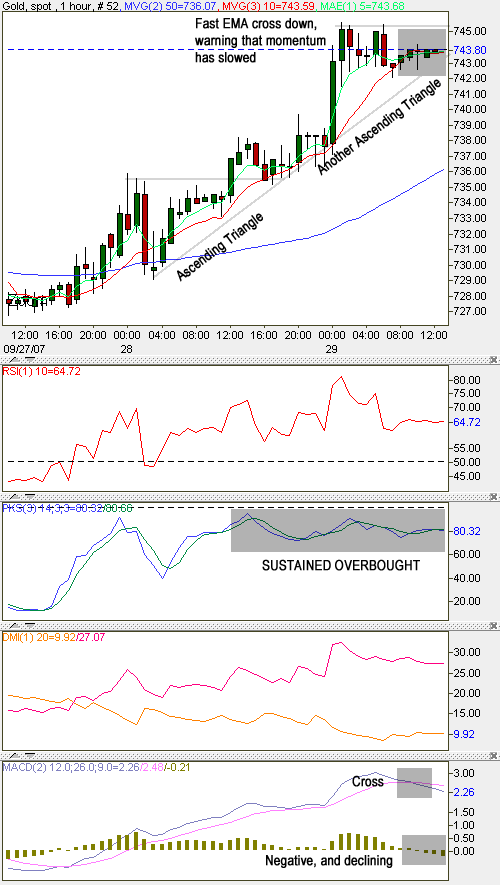
Recent gold chart, one hour interval
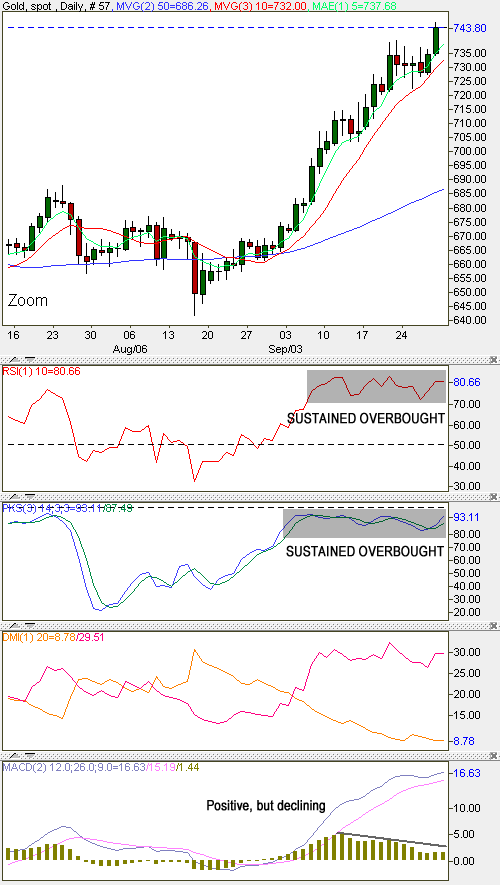
Recent gold chart, one day interval




