U.S. Federal Regulators Close NetBank
September 28th, 2007Watch those FDIC limits, people. (And in any real crisis, forget FDIC.) While the Federal Reserve and the U.S. Government are eroding the value of your dollars by the minute, at least they’re going to guarantee you 100,000 of the things on deposit. How many loaves of bread you’ll be able to buy with your 100 grand, well, that remains to be seen.
Via: CNN:
Federal regulators closed NetBank Inc. (NTBK), a $2.5 billion thrift based in Alpharetta, Ga., on Friday partly due to significant mortgage-related losses the company sustained in 2006 and 2007.
NetBank marked the largest bank to fail since since the early 1990s, which marked the end of the savings and loan crisis. The Office of Thrift Supervision closed NetBank at 3 p.m. EDT, the federal regulator said, and the company was immediately taken into receivership by the Federal Deposit Insurance Corp.
The OTS said weak underwriting standards, failed business strategies, and a lack of proper controls forced NetBank to suffer significant losses starting in 2006.
“They had significant problems with respect to loan underwriting, poor documentation, and a high amount of early payment defaults,” OTS spokesman Kevin Petrasic said. “All of those factors led to fairly significant losses that increased substantially in 2007.”
The OTS said NetBank’s board of directors unsuccessfully tried to orchestrate a private sale of the company.
“These efforts were unsuccessful, and the institution had no remaining prospects for raising capital and achieving profitability,” the OTS said.
NetBank doesn’t have branches, and its business model is based on interacting with customers over the Internet.
Bank failures have become very rare because of recent strong performance by the U.S. banking industry. But problems, particularly related to mortgage lending, has put pressure on many financial institutions, particularly smaller banks. For example, the FDIC said last month that loans at least 90 days past due rose in the second quarter by $11.4 billion, or 36%, compared with the second quarter of 2006.
“A couple of years ago, it was almost impossible for a bank to fail,” said Jaret Seiberg, a financial services policy analyst at the Stanford Group Co. ” Today, that’s no longer true.”
GOLD BREAKOUT HIGHER
September 28th, 2007WARNING: This is not a recommendation to buy, sell or hold any financial instrument.
There it is.
The U.S. dollar is getting slammed again. USDX stands at 78 even.
I’m watching it in realtime and we’ve got EUR/USD printing above 1.42 now. This must be causing a few hairs to be standing on end in and around the power centers of Europe.
Gold is up and out of the previous short term range. Next hurdle: $750.
Remember the last magic number I mentioned? $721 on the gold. Well, that magic number for oil is that $83.90. We’re at $83.60 right now.
The dollar collapse is whipping up a perfect storm in the commodities.
Via: Marketwatch:
Gold futures rose sharply early Friday, buoyed by the dollar’s plunge to a new all-time low against the euro. Gold for December delivery surged $8.60, or 1.1%, at $748.50 an ounce on the New York Mercantile Exchange. The euro hit a fresh all-time high of $1.4197 against the dollar. The common currency was last trading up 0.2% at $1.4182. “Gold remains underpinned by robust oil prices and a renewed rise in the euro against the dollar, which both increase the appeal of the precious metal as a hedge against inflation,” said analysts at Action Economics.
U.S. War on Drugs Outsourcing Contract Worth $15 Billion
September 28th, 2007Security for the CIA’s private opium plantation?
Via: CNN:
The U.S. Defense Department has invited five contractors to bid on elements of a new, multibillion dollar effort to combat the global flow of illegal drugs allegedly used to finance terrorism.
Awarded by the Pentagon’s Counter-Narcoterrorism Technology Program Office in Dahlgren, Va., the contract vehicle has a potential value of $15 billion over five years. One participant is ARINC, a Maryland-based provider of airline communications systems.
“This gives us the opportunity to bid on this work,†said Linda Hartwig, an ARINC spokesperson. “We don’t have a lot of details yet, but we do know that this is an expansion of what [the U.S] is already doing to fight drug trafficking, and that 80 percent of the work will be overseas.â€
Hartwig said the other participating vendors are defense giants Lockheed Martin, Northrop Grumman and Raytheon, and security contractor Blackwater USA. Blackwater confirmed its participation, but the other vendors did not respond to inquiries.
The vendors will compete for a series of task orders covering a wide range of products and services. These could include anti-drug technologies and equipment, special vehicles and aircraft, communications, security training, pilot training, geographic information systems, and in-field support.
Gold Make or Break Right Now
September 28th, 2007WARNING: This is not a recommendation to buy, sell or hold any financial instrument.
Attempting to break higher out of recent range…
Goldbugs adjust stops or otherwise lock and load as necessary.
New Home Sales Hit 7-Year Low
September 27th, 2007The whole show is rigged to blow.
Via: CNN:
The pace of new home sales fell to a seven-year low in August, according to a government report Thursday that showed the battered housing and home building markets even weaker than forecasts.
New homes sold at an annual pace of 795,000 in August, according to the Census Bureau, down 8 percent from the revised 867,000 sales pace in July.
It was the slowest pace of sales since June 2000, as buyers had trouble finding mortgages or selling their existing homes. Economists surveyed by Briefing.com had forecast that sales would fall to a pace of 825,000.
The report also showed the median price of a new home fell 7.4 percent from year earlier levels to $225,700 in the month, as prices were pressured by both the problems in mortgage finance and the excess supply of homes on the market.
The inventory of new homes on the market rose to an 8.2 month supply, as the glut of completed homes without a buyer was near a record high, with 180,000 completed homes listed for sale, just off the record high of 182,000 set in May of this year.
The July report wasn’t the only month revised lower by the Census Bureau; it also dropped its sales estimates for May and June, leaving sales 34,000 below the previous estimates.
Sarkozy Calls for “New World Order” at UN
September 27th, 2007Via: eux.tv:
World powers turned to the United Nations on Tuesday to resolve protracted problems that have defied solutions, from climate change to the equal distribution of wealth and human rights issues.
US President George W Bush urged the UN to uphold the Universal Declaration of Human Rights, the document that led to other human rights conventions over the past 60 years dealing with the freeing of people from tyranny, violence, hunger and diseases.
“As we gather for this 62nd General Assembly, the standards of the declaration must guide our work in the world,” Bush said.
“The mission of the United Nations requires liberating people from tyranny and violence,” Bush told the body, in which many governments had disagreed with his policy in Iraq and global anti-terror campaign.
France’s President Nicolas Sarkozy, in his first appearance before the assembly, called on the UN to avail itself as an instrument for a “new world order of the 21st century.”
“In the name of France, I call upon all states to join ranks in order to found the new world order of the 21st century on the notion that the common goods that belong to all of humankind must be the common responsibility for us all,” he told the General Assembly.
U.S. Dollar Holders Getting Decapitated
September 27th, 2007WARNING: This is not a recommendation to buy, sell or hold any financial instrument.
The U.S. Dollar Index is below 78.20 now.
This morning, bond traders have priced in a 90% chance of ANOTHER Fed rate cut in October. My guess is that the Fed knows about that ARM reset chart I referenced yesterday.
Goldbugs, hope that some central bank doesn’t dump metal and piss on our parade.
Via: IHT / Bloomberg:
The dollar fell to a record low against the euro Tuesday as declines in consumer confidence and home resales fanned expectations that the Federal Reserve would cut borrowing costs for a second time this year.
The U.S. currency weakened to a 15-year low against a basket of six major peers on worries that another decrease in lending rates would make U.S. assets less attractive to international investors. The Fed cut its target overnight rate by a half-percentage point last week to prevent the housing slowdown from weakening the U.S. economy.
“The Only Terrorist Most Americans Will Ever Encounter Is a Policeman with a Badge, Nightstick, Mace and Taser”
September 27th, 2007Via: Populist America:
Bush’s “war on terror” quickly became Bush’s war on Iraqi civilians. So far over one million Iraqi civilians have lost their lives because of Bush’s invasion, and four million have been displaced. Iraq’s infrastructure is in ruins. Disease is rampart. Normal life has disappeared.
Self-righteous Americans justify these monstrous crimes as necessary to ensure their own safety from terrorist attack. Yet, Americans are in far greater danger from their own police forces than they are from foreign terrorists. Ironically, Bush’s “war on terror” has made Americans less safe at home by diminishing US civil liberty and turning an epidemic of US police brutality into a pandemic.
The only terrorist most Americans will ever encounter is a policeman with a badge, nightstick, mace and Taser. A Google search for “police brutality videos” turns up 2,210,000 entries. Some entries are foreign and some are probably duplications, but the number is so large that a person could do nothing but watch police brutality videos for the rest of his life. A search on “You Tube” alone turned up 2,280 police brutality videos. PrisonPlanet has a selection of the most outrageous recent cases.
Police brutality has crossed the line from using excessive force against a resisting Rodney King to unprovoked gratuitous violence against persons offering no resistance, such as the elderly, women, students, and elected officials. Americans are not safe anywhere from police. Police attack Americans in university libraries, in public meetings, and in their own homes.
Orgiastic Spending on Technologies of Political Control
September 27th, 2007Via: Reuters:
Americans are facing a brave new world of post-September 11 technology marvels that could soon find their way into billions of dollars of projected homeland security spending.
Gee-whiz know-how — from swarms of tiny airborne sensors to ever-sharper satellite imagery — is being developed by companies chasing potentially lucrative federal, state and local deals to address 21st-century security threats.
Already in use are such things as infrared cameras with built-in brains that capture license plate images and match them in milliseconds to police records of vehicles of interest to the authorities.
Such license plate recognition systems, fixed and mobile, already are stopping criminals in cars in New York City, Washington D.C. and 23 states, according to Mark Windover, president of Remington ELSAG Law Enforcement Systems, which is marketing its product to 250 U.S. police agencies.
“Seventy percent of all criminal activity can be tied to a vehicle,” he said. “Had to get there, had to go home.”
Remington ELSAG says its algorithms — which turn images into data in the blink of an eye — could guard airports, military bases and other federal facilities as well as crack down on the drug trade, robberies and other crime hinging on stolen cars.
In other surveillance developments, the Department of Homeland Security, or DHS, is defending a plan to make broader use of eyes in the sky that, until now, have mostly fed military and scientific needs.
“The use of geospatial information from military intelligence satellites may turn out to be a valuable tool in protecting the homeland,” Democrats on the House of Representatives Homeland Security Committee wrote to Homeland Security Secretary Michael Chertoff this month.
Lehman Brothers Forced to Juggle Some of Its Own Hand Grenades; Where Are the Rest and When Will They Blow?
September 26th, 2007When the Wall Street Wizard couldn’t unload his mortgage backed securities anymore, he started to scrap bits and pieces his weirder paper generating machinery:
Finance America: Gone
BNC: Gone
Aurora Loan Services: Uh, what’s left of it will see a name change
Lehman Brothers bought these firms because they generated paper, and lots of it. Lehman repackaged and sold that paper to other institutions—like foreign banks—that were flush with cash.
And who wouldn’t want a piece of that big, fat, juicy U.S. real estate bubble? What could possibly go wrong…
As long as interest rates were low and there were buyers for the debt products that Lehman was peddling, the band played on. But as interests rates rose and terms like f@cked buyer and liar loan entered the discussion of the real estate bubble, one by one, Lehman closed down its paper mills and fired employees.
As we know, of course, the music stopped playing and Lehman got caught without a chair.
The fact that they have been forced to take several billion dollars worth of that dog shit paper onto their own books—as the supply of greater fools willing to buy it from them evaporated—seems like a semi-happy ending to this diabolical tale.
Not so fast.
The problem is that the $10.3 billion in paper that Lehman was forced eat represents just the tail end of the thing as the music stopped playing and their racket collapsed.
They have been generating and selling that stuff for years. Where did it wind up, and when is it going to blow?
I think that when might be easier to know than where:
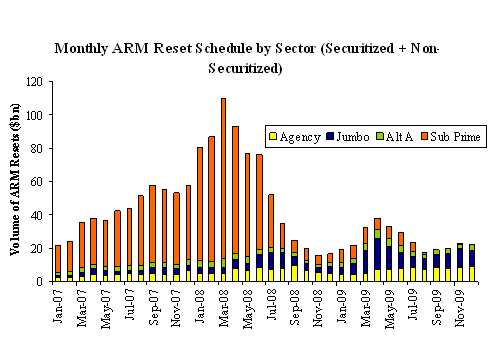
Higher bars = more foreclosures = more liquidity problems months later
We are definitely not out of the woods with the subprime debacle. In fact, we are in for a year of steady increases in foreclosures and liquidity problems. There are no buyers for these securities now. If banks are holding these bombs, they’re stuck with them and the clock is ticking.
As those teaser rate loans reset, and f*cked buyers go bankrupt in increasing numbers (see chart above), banks are going to have serious problems.
Which banks will be affected?
I don’t know.
Oh yeah, Lehman has decided to stop hiding behind the names of the mom and pop shops it acquired to run this game. From here on out, it’s going to be Lehman Mortgage Capital.
Man, if that’s not a name you can trust, I don’t know what is.
Via: Wall Street Journal:
Lehman, a big player in the bond market hit hard by the recent trouble in the “subprime” business of issuing risky mortgages that has shaken the broader stock market, set the tone in terms of markdowns, taking a $700 million loss on assets that have fallen in value in recent months. At the same time, Chief Financial Officer Christopher O’Meara said “the worst of the credit correction is behind us.”
The $700 million in markdowns were cushioned, Mr. O’Meara said, by a combination of short, or bearish, positions on certain securities and a variety of hedges Lehman used to protect itself. More broadly, he added, the firm’s diverse business mix shielded it from more significant losses during the quarter.
Still, Mr. O’Meara said the difficulty of selling loan commitments to third parties and the lack of buyers for securitized mortgages caused Lehman to take $10.3 billion in assets onto its balance sheet, a move it wouldn’t likely have make under calmer market conditions.
Of that total, $4 billion is deal financing, and most of the remaining $6.3 billion is newly originated home loans that haven’t been sold off as part of securitized products, he said. Bringing such loans and securities onto its books could subject Lehman to losses if markets continue to erode. The move also ties up a portion of the firm’s balance sheet it might have wanted to deploy elsewhere.
One data point investors focused on yesterday was the percentage markdown Lehman appeared to be taking on its leveraged loan commitments as it tried to sell off deal financing to third parties at depressed prices.
Research Credit for ARM Reset Crart: Idleworm, Calculated Risk