U.S. Homes Post Steepest Price Drop in 16 Years
September 26th, 2007This is what traders call, “The Big Mo.” Momentum. See these old stories on Cryptogon where I described this in more detail:
Home Sellers Learning Day Trading Skills
Home Sellers Learning Day Trading Skills (Continued…)
Via: AP:
The decline in U.S. home prices accelerated nationwide in July, posting the steepest drop in 16 years, according to the S&P/Case-Shiller home price index released Tuesday.
Home prices have fallen by more every month since the beginning of the year.
An index of 10 U.S. cities fell 4.5 percent in July from a year ago. That was the biggest drop since July 1991.
Quick Magic 8 Ball Update on U.S. Dollar Index
September 26th, 2007WARNING: This is not a recommendation to buy, sell or hold any financial instrument.
The USDX has breached 78.33 and made a feeble attempt at bouncing above that critical point. It has now slipped back under 78.33 again. I have no idea whether it’s going to bounce or collapse, but I have seen this happen many times before: At major support breakdowns, the thing will actually retrace back up before it falls off the cliff.
Not long to wait now, one way or the other.
Finally: Amazon’s MP3 Store
September 26th, 2007I might have titled this story, “If You Can’t Beat ‘Em, Sell ‘Em DRM Free MP3s.”
Years ago, when Apple released iTunes, I looked at the DRM involved and said, “Not only no, f*@% no.” I’m really glad to see an alternative to Apple’s Tamper Proof Vending Machine reality. Of course, I’d rather just pay artists directly for MP3s. If we directly paid an artist $2 for their album on MP3, that would be more than they make when the same ones and zeros have been sold through the middlemen. But we’re not quite there yet.
In long tail economies, though, the middlemen can be good for helping people find artists that they might not have been able to find otherwise. You can’t enter a Google search for, “music I’d like.” But Amazon’s big brother suggestion systems are pretty good. I know, I like Pandora, too, but most people will never hear about that type of thing. Hint: If you’re outside the U.S., you will have to use innovative methods to access Pandora. Or, use LastFM instead.
For artists and music fans alike, a combination of no-middle-man music sales and social networking sites like Pandora and LastFM would be very nice. Must. Try. To. Hold. Breath…
Until then, you can get your consumer crack tunes AND help out Amazon affiliates like Cryptogon. * wink *
Just make sure to remove your iPod before standing in front of the Homeland’s directed energy pain weapon! For U.S. customers only. Your results may vary. Batteries not included.
Check it out: Amazon’s MP3 Store
Step Right Up: Public Demonstrations of Raytheon’s Directed Energy Pain Gun
September 26th, 2007Will it re-heat your freedom fries?
Via: Daily Mail:
“Where do I put my finger? There … OK? Nothing’s happening … is it on?”
“Yes, it’s on. Move your finger a bit closer.”
“Er … ow! OW!” Not good. I try again. “OWWW!” I pull my hand away sharpish. My finger is throbbing, but seems undamaged.
I was told people can take it for a second, maximum. No way, not for a wimp like me.
I try it again. It is a bit like touching a red-hot wire, but there is no heat, only the sensation of heat. There is no burn mark or blister.
Its makers claim this infernal machine is the modern face of warfare. It has a nice, friendly sounding name, Silent Guardian.
I am told not to call it a ray-gun, though that is precisely what it is (the term “pain gun” is maybe better, but I suppose they would like that even less).
And, to be fair, the machine is not designed to vaporise, shred, atomise, dismember or otherwise cause permanent harm.
But it is a horrible device nonetheless, and you are forced to wonder what the world has come to when human ingenuity is pressed into service to make a thing like this.
Silent Guardian is making waves in defence circles. Built by the U.S. firm Raytheon, it is part of its “Directed Energy Solutions” programme.
What it amounts to is a way of making people run away, very fast, without killing or even permanently harming them.
That is what the company says, anyway. The reality may turn out to be more horrific.
I tested a table-top demonstration model, but here’s how it works in the field.
A square transmitter as big as a plasma TV screen is mounted on the back of a Jeep.
When turned on, it emits an invisible, focused beam of radiation – similar to the microwaves in a domestic cooker – that are tuned to a precise frequency to stimulate human nerve endings.
It can throw a wave of agony nearly half a mile.
Because the beam penetrates skin only to a depth of 1/64th of an inch, it cannot, says Raytheon, cause visible, permanent injury.
But anyone in the beam’s path will feel, over their entire body, the agonising sensation I’ve just felt on my fingertip. The prospect doesn’t bear thinking about.
“I have been in front of the full-sized system and, believe me, you just run. You don’t have time to think about it – you just run,” says George Svitak, a Raytheon executive.
Silent Guardian is supposed to be the 21st century equivalent of tear gas or water cannon – a way of getting crowds to disperse quickly and with minimum harm. Its potential is obvious.
Related: Say Hello to the Goodbye Weapon
Deposit Worries Hit Sterling
September 25th, 2007Via: Financial Times:
Sterling took a hit on Tuesday as worries over UK deposit protection raised fresh concerns over the health of the UK financial system in the wake of the recent run on Northern Rock, the troubled mortgage lender.
Analysts said reports that the UK’s deposit protection scheme might not be enough to pay for the government’s plan to guarantee consumers’ deposits up to £100,000 pounds weighed on the currency.
The UK’s Financial Services Compensation Scheme’s resources were estimated at only £4.4m – compared with a comparable fund of $49bn in the US.
IMF: Fallout from Global Financial Crisis Will be Long Lasting
September 25th, 2007Just as long as it’s economic fallout and not some other kind of fallout.
Via: Independent:
The global credit crisis is not over, and its effects will be long lasting, the International Monetary Fund has warned.
The organisation’s twice-yearly Global Financial Stability report warned that many of the lax lending practices of the past few years will have to change, and economic growth will be crimped by the current correction.
Adding to the gloom, Rodrigo Rato, the IMF’s managing director, said yesterday the US will bear the brunt of the economic consequences of the crisis, with the bulk of the impact not being felt until next year.
Debt markets have convulsed after finally recognising the extent to which credit discipline has deteriorated in recent years, the IMF’s report stated. “The potential consequences of this episode should not be underestimated, and the adjustment process is likely to be protracted. Credit conditions may not normalise soon, and some of the practices that have developed in the structured credit markets will have to change.”
The practice of rolling together lots of different kinds of debt, including low quality US mortgage loans, and selling them on piecemeal in the global financial markets has diffused the responsibility for checking that the underlying loans are sound, the IMF said. The use of off-balance sheet funding vehicles has also made it harder to judge the creditworthiness of major banks.
Consumers Cutting Back on Restaurants
September 25th, 2007Via: AP:
More than half of U.S. consumers plan to eat out less in the next three months due to jitters over declining home values, high gas prices and the overall economy, according to a survey by RBC Capital Markets.
The survey of 1,000 people found that 54 percent of Americans said they would eat at restaurants less often over the next three months. Two of five respondents said they are already dining out less frequently than they were six months ago.
“Volatile stock markets, declining home values, higher energy costs and overall concern about the economy are reducing Americans’ appetite for dining out,” RBC analyst Larry Miller said in a statement.
The survey’s results come as many sit-down restaurant chains are struggling to reel in customers, while cheaper fast-food restaurants are generally seeing strong sales.
Tapping Fiber is Easy
September 25th, 2007While some of the people who work aboard the U.S.S. Jimmy Carter might laugh at this, I think it’s pretty interesting.
Via: Tech Republic:
Copper cable has been known as the easily tapped physical transmission medium for years. Conscientious network and security managers either provided tight physical security for cabling or used fiber as an alternative. Many network managers considered fiber relatively safe due to the perceived challenges associated with tapping into an optical cable run. However, fiber is no safer than copper.
For less than $1,000, an attacker can purchase the hardware necessary to tap into a fiber run. The tap consists of bending the fiber to the point that it leaks light.
…
The fiber cable to be tapped is placed into a micro-bend clamping device (1). The light pulses leaking from the cable are detected by the optical photo detector (2) and sent to an optical-electrical converter (3). The converter changes the light pulses to electrical information that is placed on an Ethernet cable attached to an attacker’s laptop. The laptop, running sniffer software, provides the attacker with a view into the data traveling through the tapped fiber cable.
Bank of England: We Don’t Understand the Markets
September 25th, 2007Via: Telegraph:
The Bank of England is looking at improving the way it monitors UK credit conditions after admitting that the growing sophistication of the financial markets has made it more difficult to manage monetary policy.
Bank of England governor Mervyn King speaking to the Commons Treasury Committee
Mervyn King has come under increasing pressure over his handling of the Northern Rock crisis
Amid accusations that it failed to respond quickly enough to the crisis at Northern Rock, the Bank has admitted that it is struggling to determine the impact of the credit meltdown on the economy.
Charles Bean, chief economist, said assessing conditions in the economy is “subject to considerable uncertainty”.
Writing in the Bank’s quarterly bulletin, Mr Bean said: “One important step in analysing monetary demand and supply shocks involves improving the Bank’s information about credit conditions.”
The Bank’s admission that it needs to improve its understanding of the credit markets comes as John McFall, chairman of the Treasury Select Committee, voiced his frustration following the appearance of Bank of England staff before the government watchdog.
In an interview with The Daily Telegraph, Mr McFall said: “The responses that people gave were unconvincing as a whole. I’m looking at the system and asking the question: Is it working? And it’s not working.”
In its bulletin the Bank said that to achieve its core purposes of maintaining confidence in the economy and identifying and reducing threats to the financial system, it needs to better understand “developments in the markets for money and credit”.
Roger Bootle, managing director of Capital Economics, said: “The Bank’s job is getting much tougher. [In the face of more sophisticated markets], I do not think you’ve seen a corresponding increase in technology and monitoring on the Bank’s part. It is a one-sided thing.”
Mervyn King, Governor of the Bank of England, has come under increasing pressure over his handling of the Northern Rock crisis amid accusations the Bank failed to react quickly enough to reduce problems in the money markets.
Gordon Brown yesterday defended Mr King, telling the BBC that he had done a “brilliant” job, but stopped short of backing him for another five-year term as Governor.
The Bank has set out several initiatives to better monitor the credit markets and their impact on inflation and the economy. The Bank said it was examining the effect of institutions such as pension and insurance funds on the supply of money into the UK economy and their impact on inflation. The Bank said: “Improving the understanding of money growth… is a key challenge.”
Bush, the Little Voice in Hillary’s Head
September 25th, 2007I’d be more curious about what Senior is whispering in her ear. The Clintons are decades long servants of the Bush Dynasty.
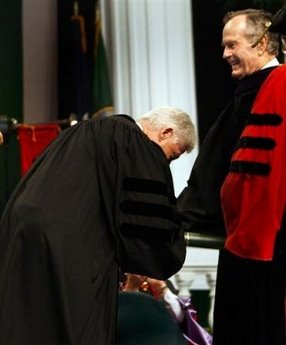
What is thy bidding, my Master?
Former President Bill Clinton bows to former President George H. W. Bush after he receives a honorary degree during the Tulane University Commencement in New Orleans on Saturday May 13, 2006. Former President Clinton also received a degree.(AP Photo/Alex Brandon, Pool)
This isn’t just a Bush/Clinton thing. While they represent the longest running and most sickening example it, this is standard operating procedure in the U.S. as the regime pretends to change every four or eight years. In Tragedy and Hope: A History of the World in our Time, Carroll Quigley wrote:
The argument that the two parties should represent opposed ideals and policies, one, perhaps, of the Right and the other of the Left, is a foolish idea acceptable only to doctrinaire and academic thinkers. Instead, the two parties should be almost identical, so that the American people can “throw the rascals out” at any election without leading to any profound or extensive shifts in policy.
Keep that one in mind as you try to read the following without your guts and valves seizing up on you.
Via: Examiner:
President Bush is quietly providing back-channel advice to Hillary Rodham Clinton, urging her to modulate her rhetoric so she can effectively prosecute the war in Iraq if elected president.
In an interview for the new book “The Evangelical President,†White House Chief of Staff Josh Bolten said Bush has “been urging candidates: ‘Don’t get yourself too locked in where you stand right now. If you end up sitting where I sit, things could change dramatically.’ â€
Bolten said Bush wants enough continuity in his Iraq policy that “even a Democratic president would be in a position to sustain a legitimate presence there.â€
“Especially if it’s a Democrat,†the chief of staff told The Examiner in his West Wing office. “He wants to create the conditions where a Democrat not only will have the leeway, but the obligation to see it out.â€
To that end, the president has been sending advice, mostly through aides, aimed at preventing an abrupt withdrawal from Iraq in the event of a Democratic victory in November 2008.