China’s Energy Sinkhole
January 29th, 2007Via: Economist:
Now there really is a giant sucking sound—not one made by the flight of jobs, but by China ferociously hoovering up commodities and raw materials. Although it accounts for roughly 4% of global GDP (measured at market exchange rates), China consumes 30% of the world’s supply of minerals and other raw materials. This time around, the world has not only heard the sucking sound, but has also felt its effects, as the prices of commodities such as iron ore, copper and zinc have soared, doubling or tripling in just a couple of years.
How has China suddenly developed such a big appetite? The economy has been growing at a dizzying rate, recently by double digits. Much of this growth is driven by fixed-asset investment, which now accounts for more than 50% of GDP a year—a higher proportion than that of any other country at any time in history. This relentless capacity for expansion has created an insatiable demand for raw materials.
China also wastes a lot. Take energy consumption. China required 4.3 times as much energy as America in 2005 to produce one unit of GDP, up from 3.4 times in 2002. It can be argued that much of China’s new investment has not yet reached optimal efficiency. That may be true, but it does not explain why things are getting worse: China consumed 15% more energy per unit of GDP in 2005 than it did in 2002. India, also a rapidly expanding economy, consumes only 61% as much energy as China per unit of GDP.
China’s wasteful growth has brought joy to commodity producers and their bankers and shareholders worldwide. With rising profitability and stock prices, they have been happily expanding mining operations and acquiring or merging with rivals. But there are reasons to believe that the surge in commodity prices worldwide has run out of steam.
There is strong evidence that the current cycle of China’s investment-led growth has peaked. A clear sign of overheating is the increase in accounts receivable. Although sales appear robust, Chinese firms are beginning to find it difficult to get paid in cash, either because their buyers cannot turn over their own stocks fast enough or because they have trouble borrowing money to finance their purchases.
Priming the Pump for a Major Motion Picture on New Energy
January 28th, 2007To suggest that there isn’t easily enough energy available from the oceans, the sun and the wind is ridiculous. Of course, plentiful clean energy would probably lead to cascading resource scarcity in other areas… [Cryptogon reader Cherenkov accurately expanded this one sentence caveat in a comment. Sometimes I expand points in comments, but forget that many people might not be following comments. For the record, I did this re: resource scarcity vs. plentiful energy at the bottom of this comment.]
But this would be an interesting documentary in any event!
I’ve dreamed of making this film myself, believe it or not. I even wrote out a little outline/treatment, and made a list of people I’d like to visit for interviews. (The ‘secret’ project I started, but abandoned due to life circumstances, was about killer robots. The energy doc would have been the next one.) But since I’m obviously not in a position to make this happen on my own, I kicked in a few bucks to help these guys make it happen.
If you think most movies are crap, here’s your chance to help get an interesting one made!
Via: PESN:
What if there were a high-interest feature film about the many feasible New Energy technologies, presented with the level of production skill demonstrated in recent blockbusters like Al Gore’s award-winning movie, An Inconvenient Truth, Who Killed the Electric Car, or What the Bleep do We Know?
That is what the New Energy Movement and its sister organization, the New Energy Congress are intent on accomplishing — in time to make New Energy a buzz word in the campaigns leading up to the 2008 U.S. election.
The film will showcase a myriad of presently available, often little-appreciated renewable energy technologies that could eliminate our reliance on fossil fuels. And they can provide electricity for our homes and businesses, or power for our vehicles at comparable, or even lower prices than what we now pay. It will also look at technologies that are in process of emerging, as well as others that look very promising, which could provide clean, reliable and safe energy at prices far below what we now pay.
Not only do these technologies provide a solid answer to the human-caused problems of global warming, but they could introduce a much-needed revolution in the social fabric of the planet, reducing poverty, increasing quality of life worldwide, and defusing political tensions.
The purpose of this feature documentary will be to present these compelling solutions in both a deeply impacting and entertaining way, so that the level of awareness about them can increase, speeding their acceptance and implementation — a process that otherwise would take much longer.
IRAQ CRASH KILLED KEY U.S. OFFICERS
January 28th, 2007In the wake of U.S. Soldiers Killed by English Speaking “Insurgents†Who Were Armed with American Made Weapons and Driving Black SUVs, I decided to take a closer look at other recent U.S. military deaths in Iraq.
What I found was astonishing.
I didn’t know a helicopter could carry so much brass. Among the dead in this single incident were:
Two colonels – Including the top U.S. Army surgeon in Iraq
One lieutenant colonel
One major
One captain
What the hell is going on over there? Isn’t there some standard operating procedure that would prevent so many officers from flying in a single helicopter over a combat zone?
The full text of this AP story follows.
Via: Los Angeles Times/AP:
Iraq crash killed key U.S. officers
The copter went down last weekend. A missile strike is suspected.
From the Associated Press
January 26, 2007
BAGHDAD — Two colonels, a lieutenant colonel and two command sergeants major were among the 12 U.S. soldiers killed last weekend in the crash of a Black Hawk helicopter northeast of Baghdad, the Pentagon said.
It appeared to be the largest number of key officers and command sergeants killed in a single incident since the Iraq war started nearly four years ago.
The helicopter went down Saturday in Diyala province, one of the volatile regions in the Iraq conflict.
The Army has said the cause of the crash is under investigation. But a Pentagon official has said debris indicates the helicopter was hit by a surface-to-air missile.
Ten of the dead were members of the National Guard, making the crash the deadliest single combat incident for the Guard since at least the Korean War, said Mark Allen, a National Guard Bureau spokesman.
A Pentagon statement Wednesday said the victims included Col. Brian D. Allgood, 46, the top Army surgeon in Iraq, and Col. Paul M. Kelly, 45, assigned to the Joint Force Headquarters of the Virginia Army National Guard in Blackstone, Va.
Also killed were Command Sgt. Maj. Marilyn L. Gabbard, assigned to the Iowa National Guard, and Command Sgt. Maj. Roger W. Haller of the Maryland National Guard.
Command sergeant major is one of the Army’s highest enlisted ranks.
The other victims were Lt. Col. David C. Canegata of the Virgin Islands National Guard; Maj. Michael V. Taylor of the Arkansas National Guard; Capt. Sean E. Lyerly of the Texas National Guard; 1st Sgt. William T. Warren of the Arkansas National Guard; Staff Sgt. Darryl D. Booker of the Virginia National Guard; Sgt. 1st Class John Brown of the Arkansas National Guard; Staff Sgt. Floyd E. Lake of the Virgin Islands National Guard; and Cpl. Victor Langarica of the 86th Signal Battalion, Ft. Huachuca, Ariz.
Raw Milk and Lifting the Veil that has Been Pulled Over Our Eyes
January 28th, 2007As all of you know, I find the “expert” opinions on medicine, energy, economics and several other areas to be riddled with bullshit.
I have found that experimentation always trumps theory. No number of people with PhDs, paid trolls or “peer reviewed” journals are going to convince me that something that works for me isn’t working for me.
The war against raw milk is very interesting and illustrative; it sums up the political and economic situation that has the world in a death grip.

WARNING: Contents may destroy your current perception of reality.
The “authorities” will tell you that raw milk is a profoundly dangerous substance that can only be rendered “safe” for human consumption by pasteurization. It is illegal to sell raw milk in most “advanced economies.”
This is bullshit.
How do I know it’s bullshit? Was it by reading sites like Real Milk and the material published by the Weston A. Price Foundation?
No. That’s not how I know that the pseudo-scientific quackery of the corrupt authorities is bullshit.
And what about the sinus congestion I’ve experienced—my entire life—that accompanied the consumption of pasteurized/homogenized dairy products?
With the whole, unpasteurized milk, these symptoms have been completely eliminated.
Anyone who tries to tell me that this isn’t happening is a dangerous liar. Anyone who tries to tell me that this isn’t happening is a fraud. Any organization that advocates the position that whole raw milk from pasture raised animals is dangerous has no legitimacy and must be outed as as a criminal front. My wife and I are living, breathing proof that what is being said about raw milk by the “authorities” is a lie. I encourage you to look into the complex of issues surrounding raw milk, and prepare for a hard lesson in the politics and economics of unchecked fascism.
Then make raw milk a part of your life.
The truth behind raw milk punches a hole in official reality that is big enough to free your entire consciousness. If so many lies are being told and enforced by people with guns about something as simple as milk, logically, we must conclude that much of what we think we know is dead wrong.
Examine all assumptions. Accept no dogma from ANYONE. You will know the validity of a thing, or not, by the results you get.
Related: The Untold Story of Milk
U.S. Soldiers Killed by English Speaking “Insurgents” Who Were Armed with American Made Weapons and Driving Black SUVs
January 27th, 2007Oh, yeah, the man leading the attack had blond hair.
And what’s the story with the non sequitur about “the computer” mentioned about 2/3 of the way down?
But just wait, you haven’t heard the best part.
According to the story: This was the work of Iranian intelligence agents.
* pause *
The full text of the story follows.
Via: AP:
4 troops abducted, killed in Iraq attack
By STEVEN R. HURST and QASSIM ABDUL-ZAHRA, Associated Press Writers 1 hour, 58 minutes ago
BAGHDAD, Iraq – In perhaps the boldest and most sophisticated attack in four years of warfare, gunmen speaking English, wearing U.S. military uniforms and carrying American weapons abducted four U.S. soldiers last week at the provincial headquarters in the Shiite holy city of Karbala and then shot them to death.
The U.S. military confirmed a report earlier Friday by The Associated Press that three of the soldiers were dead and one was mortally wounded with a gunshot to the head when they were found in a neighboring province, about 25 miles from the compound where they were captured. A fifth soldier was killed in the initial attack on the compound.
The new account contradicted a U.S. military statement on Jan. 20, the day of the raid on an Iraqi governor’s office, that five soldiers were killed “repelling” the attack.
The security breakdown and the dramatic kidnapping and murder of four soldiers leaked out just as
President Bush faces stiffening congressional opposition over his plan to flood Baghdad and surrounding regions with 21,500 more American troops. Two of Congress’s most vocal war critics, House Speaker Nancy Pelosi (news, bio, voting record) and Rep. John Murtha (news, bio, voting record), were in the Iraqi capital as the news broke.
In a statement issued late Friday, the military said two of the soldiers were handcuffed together in the back seat of an SUV near the southern Iraqi town of Mahawil. A third dead soldier was on the ground nearby. The fourth soldier died on the way to the hospital.
The brazen assault, 50 miles south of Baghdad, was conducted by nine to 12 gunmen posing as an American security team, the military confirmed. The attackers traveled in black GMC Suburban vehicles (the type used by U.S. government convoys), had American weapons, wore new U.S. military combat fatigues, and spoke English, according to two senior U.S. military officials as well as Iraqi officials.
None of the American or Iraqi officials would allow use of their names because of the sensitive nature of the information.
The confirmation came after nearly a week of inquiries. The U.S. military in Baghdad initially did not respond to repeated requests for comment on reports that began emerging from Iraqi government and military officials on the abduction and a major breakdown in security at the Karbala site.
Within hours of the AP report that four of the five dead soldiers had been abducted and found dead or dying about 25 miles east of Karbala, the military issued a long account of what took place.
“The precision of the attack, the equipment used and the possible use of explosives to destroy the military vehicles in the compound suggests that the attack was well rehearsed prior to execution,” said Lt. Col. Scott Bleichwehl, spokesman for Multi-National Division-Baghdad.
“The attackers went straight to where Americans were located in the provincial government facility, bypassing the Iraqi police in the compound,” he said. “We are looking at all the evidence to determine who or what was responsible for the breakdown in security at the compound and the perpetration of the assault.”
The Karbala raid, as explained by the Iraqi and American officials, began after nightfall on Jan. 20, while American military officers were meeting with their Iraqi counterparts on the main floor of the Provisional Joint Coordination Center in Karbala.
Iraqi officials said the approaching convoy of black GMC Suburbans was waved through an Iraqi checkpoint at the edge of the city. The Iraqi soldiers believed it to be American because of the type of vehicles, the distinctive camouflage American uniforms and the fact that they spoke English. One Iraqi official said the leader of the assault team was blond, but no other official confirmed that.
A top Iraqi security official for Karbala province told the AP that the Iraqi guards at the checkpoint radioed ahead to the governor’s compound to alert their compatriots that the convoy was on its way.
Iraqi officials said the attackers’ convoy divided upon arrival, with some vehicles parking at the back of the main building where the meeting was taking place, and others parking in front.
The attackers threw a grenade and opened fire with automatic rifles as they grabbed two soldiers inside the compound. Then the guerrilla assault team jumped on top of an armored U.S. Humvee and captured two more soldiers, the U.S. military officials said.
In its statement, the U.S. military said one soldier was killed and three were wounded by a “hand grenade thrown into the center’s main office which contains the provincial police chief’s office on an upper floor.”
The attackers captured four soldiers and fled with them and the computer east toward Mahawil in Babil province, crossing the Euphrates River, the U.S. military officials said.
The Iraqi officials said the four were captured alive and shot just before the vehicles were abandoned.
Police, who became suspicious when the convoy of attackers and their American captives did not stop at a roadblock, chased the vehicles and found the bodies, the gear and the abandoned SUVs.
The military statement said: “Two soldiers were found handcuffed together in the back of one of the SUVs. Both had suffered gunshot wounds and were dead. A third soldier was found shot and dead on the ground. Nearby, the fourth soldier was still alive, despite a gunshot wound to the head.”
The wounded soldier was rushed to the hospital by Iraqi police but died on the way, the military said.
The military also said Iraqi police had found five SUVs, U.S. Army-type combat uniforms, boots, radios and a non-U.S. made rifle at the scene.
Three days after the killings, the U.S. military in Baghdad announced the arrest of four suspects in the attack and said they were detained on a tip from a Karbala resident. No further information was released about the suspects.
Friday’s military statement referred to the attackers as “insurgents,” which usually suggests Sunnis. Although Karbala province is predominantly Shiite, Babil province is heavily populated by Sunnis in the north, near Baghdad. Babil’s central and southern regions are largely Shiite.
A senior Iraqi military official said the sophistication of the attack led him to believe it was the work of Iranian intelligence agents in conjunction with Iraq’s Shiite Mahdi Army militia, which Iran funds, arms and trains.
The Defense Department has released the names of troops killed Jan. 20 but clearly identified only one as being killed because of the sneak attack.
Capt. Brian S. Freeman, 31, of Temecula, Calif., “died of wounds suffered when his meeting area came under attack by mortar and small arms fire.” Freeman was assigned to the 412th Civil Affairs Battalion, Whitehall, Ohio.
The only other troops killed that day in that region of Iraq were four Army soldiers said to have been “ambushed while conducting dismounted operations” in Karbala.
The four were identified as 1st Lt. Jacob N. Fritz, 25, of Verdon, Neb.; Spc. Johnathan B. Chism, 22, of Prairieville, La.; Pfc. Shawn P. Falter, 25, of Homer, N.Y., and Pvt. Johnathon M. Millican, 20, of Trafford, Ala. All were with the 2nd Battalion, 377th Parachute Field Artillery Regiment, 4th Brigade Combat Team, 25th Infantry Division, of Fort Richardson, Alaska.
MORE: IRAQ CRASH KILLED KEY U.S. OFFICERS
In the wake of the story above, I decided to take a closer look at other recent U.S. military deaths in Iraq.
What I found was astonishing.
I didn’t know a helicopter could carry so much brass. Among the dead in this single incident were:
Two colonels – Including the top U.S. Army surgeon in Iraq
One lieutenant colonel
One major
One captain
What the hell is going on over there? Isn’t there some standard operating procedure that would prevent so many officers from flying in a single helicopter over a combat zone?
The full text of this AP story follows.
Via: Los Angeles Times/AP:
Iraq crash killed key U.S. officers
The copter went down last weekend. A missile strike is suspected.
From the Associated Press
January 26, 2007
BAGHDAD — Two colonels, a lieutenant colonel and two command sergeants major were among the 12 U.S. soldiers killed last weekend in the crash of a Black Hawk helicopter northeast of Baghdad, the Pentagon said.
It appeared to be the largest number of key officers and command sergeants killed in a single incident since the Iraq war started nearly four years ago.
The helicopter went down Saturday in Diyala province, one of the volatile regions in the Iraq conflict.
The Army has said the cause of the crash is under investigation. But a Pentagon official has said debris indicates the helicopter was hit by a surface-to-air missile.
Ten of the dead were members of the National Guard, making the crash the deadliest single combat incident for the Guard since at least the Korean War, said Mark Allen, a National Guard Bureau spokesman.
A Pentagon statement Wednesday said the victims included Col. Brian D. Allgood, 46, the top Army surgeon in Iraq, and Col. Paul M. Kelly, 45, assigned to the Joint Force Headquarters of the Virginia Army National Guard in Blackstone, Va.
Also killed were Command Sgt. Maj. Marilyn L. Gabbard, assigned to the Iowa National Guard, and Command Sgt. Maj. Roger W. Haller of the Maryland National Guard.
Command sergeant major is one of the Army’s highest enlisted ranks.
The other victims were Lt. Col. David C. Canegata of the Virgin Islands National Guard; Maj. Michael V. Taylor of the Arkansas National Guard; Capt. Sean E. Lyerly of the Texas National Guard; 1st Sgt. William T. Warren of the Arkansas National Guard; Staff Sgt. Darryl D. Booker of the Virginia National Guard; Sgt. 1st Class John Brown of the Arkansas National Guard; Staff Sgt. Floyd E. Lake of the Virgin Islands National Guard; and Cpl. Victor Langarica of the 86th Signal Battalion, Ft. Huachuca, Ariz.
Related: Two British SAS Soldiers Dressed as Arabs, Shoot at Iraqi Police
China Censorship Damaged Google, Founders Admit
January 27th, 2007Does Sergey Brin have a secret degree in rocket science?
Via: Guardian:
Google’s decision to censor its search engine in China was bad for the company, its founders admitted yesterday.
Google, launched in 1998 by two Stanford University dropouts, Sergey Brin and Larry Page, was accused of selling out and reneging on its “Don’t be evil” motto when it launched in China in 2005. The company modified the version of its search engine in China to exclude controversial topics such as the Tiananmen Square massacre or the Falun Gong movement, provoking a backlash in its core western markets.
Asked whether he regretted the decision, Mr Brin admitted yesterday: “On a business level, that decision to censor… was a net negative.”
UK: Prison Ships to Ease Overcrowding
January 27th, 2007I don’t have any commentary left for what’s happening in Britain.
Via: BBC:
The government is in talks to buy two prison ships to ease the current wave of overcrowding.
An RAF camp is also being considered as one of a number of options to temporarily ease the pressure.
The Home Office has already sent out advice to courts to only jail dangerous and persistent offenders to help ease the situation in England and Wales.
…
The Home Office has considered a number of Army sites, as well as the RAF base now being looked at in the north of England.
Research Credit: Life After the Oil Crash
Countries by Current Account Balance
January 26th, 2007Cryptogon reader David submitted a comment that contained an interesting link to a map that depicts each country of the world in terms of current account balance.
See the data in a table to get a feel for the numbers! Everyone knows who’s at the bottom of that list, right? You know, the country that’s trying to squeeze another carrier strike group into the Persian Gulf…
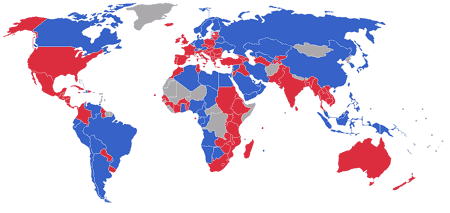
Red = deficit, Blue = surplus, Grey = no data
Life on the Plantation: Biometric Scanners Going Mainstream
January 26th, 2007Via: Reuters:
Every morning Dennis Colson, a surveyor at New York City’s Department of Design and Construction, begins his work day by placing his hand on a scanner to log his time and attendance at the office.
The use of hand geometry and other biometric data, like facial and iris recognition, is not new — the University of Georgia pioneered the use of hand geometry when it installed scanners in its student dining hall in 1974.
But the planned roll-out of hand geometry scanners in all New York City government agencies has sparked union cries of “geoslavery” and assertions that technology developed for security will be used to track, label and control workforces.
…
Jon Forster, of the Civil Service Technical Guild, which represents Department of Design and Construction workers, said the biometric systems gave the city a license to obtain personal, uniquely identifiable data to track workers.
“It’s really a matter of this kind of technology having far outstripped any legislation or even case law in the United States in terms of what are the restrictions,” Forster told Reuters.
“On the one hand I think people might all agree that if you put a GPS system in ambulances then that’s a good thing. On the other hand you have an employer in Ohio who has demanded that two of his employees have chips implanted in their bodies.”
Germans Get by Without the Euro
January 26th, 2007Via: Telegraph:
If you live in the Bavarian region of Chiemgau, you can exist for months at a time in a euro-free zone of hills and lakes with a population of half a million people. Restaurants, bakeries, hairdressers and a network of supermarkets will accept the local currency: the Chiemgauer.
Notes are exchanged freely like legal tender. You can even use a debit card. Petrol stations are still a problem, but biofuel outlets are signing up. Dentists are next.
The Chiemgauer is one of 16 regional currencies that have sprung into existence across Germany and Austria since the launch of the euro five years ago.
Another 49 regios are in the pipeline. They are outside the control of the political authorities, mostly run by activists, farmers, eco-enthusiasts, anti-globalists, and citizen committees.
Some are rural, others circulate like underground money in Berlin and Bremen. Hamburg has two: the Alto and the Hansemark. Italy has its version in the Valchius Valley, in the Alps.
The phenomenon, not seen since the Great Depression, has left experts scratching heads at the Bundesbank. The mighty reserve bank, which issues euro notes and coins worth €146bn for a third of the eurozone economy, is relaxed about the risk of monetary anarchy. But it is sufficiently puzzled to publish a 63-page report probing the eruption of this movement.