Several Readers Contribute to Cryptogon
June 10th, 2007The following Cryptogon readers recently sent contributions:
AS $30
JG $25
Eileen $25
AH $35
Thanks to all of you!
Cryptogon Reader Signs Up for Hosting with Blue Host
June 10th, 2007Thanks to bkblackwell.com for choosing to host with Blue Host. Cryptogon receives $65.
DCA: Letter from Dr. Evangelos Michelakis
June 9th, 2007I’m making a contribution to the University of Alberta to help this research along in a small way. The diabolical pharmaceutical industry will oppose this to the extent possible. It’s up to us to make it happen.
Establishment science could accomplish good things if it wasn’t serving evil most of the time. Let’s help these guys understand more about DCA and how to use it properly. The substance is out there, the pharmaceutical companies can’t make it go away, but we need to know more.
Via: University of Alberta:
Dear Friends,
We continue to be moved by your sustained interest and support of our efforts. We have been working tirelessly over the past several months to bring this research from the laboratory to the level of a clinical trial. This is a very challenging endeavor since it is not supported by the pharmaceutical industry. The process of bringing a drug from animal research to clinical trial takes a few years. However over the past 3 months, we have made significant progress towards achieving our goals. We have received help and input from stakeholders, medical and otherwise, and have received input from our health care partners in Alberta to ensure a clinical trial that can address both efficacy and safety of this potential treatment. We have significantly revised and improved our original protocol for Health Canada’s consideration. We would like to remind you that despite the fact that dichloroacetate has been used in humans for over 20 years the appropriate dose for cancer patients remains unknown. There are several unique features of a cancer patient, from body metabolism to a number of unique drugs that only cancer patients are exposed to, that do not allow extrapolations from other conditions. Therefore, extra caution has to be exercised regarding the strategy to identify an optimal dose.
More importantly, we would like to remind you that this work, at least at its early stages, will not be able to be completed without your ongoing support.
Finally, we are very pleased to see that a number of key findings in scientific literature have surfaced over the past six months and appear to support a proposed theory and the potential effectiveness of dichloroacetate or similar drugs as effective therapies for cancer. Prestigious institutions and journals are now putting our work in context with these new developments and have expressed guarded optimism for these efforts. Such a review was recently published at the prestigious journal “Science†with a title “Metabolic Targeting as an Anti-cancer Strategy; Dawn of a New Era?†A copy of this paper can be found in the media section of our website.
Sincerely yours,
Evangelos D. Michelakis, MD, FACC, FAHA
Associate Professor of Medicine (Cardiology)
Director, Pulmonary Hypertension Program
Canada Research Chair in Pulmonary Hypertension
Vitamin D and Cancer
June 9th, 2007Many of us have known this for years, but as with everything, the Vitamin D issue is much more complex than it appears at first glance. Before reading the Globe and Mail article below, and running out to get a bottle of vitamins, please read these articles:
and…
Vitamin A, Vitamin D and Cod Liver Oil: Some Clarifications
Via: Globe and Mail:
The Canadian Cancer Society plans to announce Friday that all adults should start taking vitamin D, coinciding with the release of a groundbreaking U.S. study indicating the supplement cuts the risk of cancer by an astounding 60 per cent.
The move is believed to be the first time a major public-health organization has endorsed daily use of the sunshine vitamin as a cancer-prevention therapy for an entire population.
It follows a flurry of research suggesting the low-cost vitamin confers a high degree of protection against a wide variety of cancers. There are also striking study results suggesting that people who develop the disease often have low blood levels of vitamin D.
Although it is not known how many of the approximately 160,000 cancer cases diagnosed annually in Canada might be avoided by regular popping of a vitamin D pill, the cancer society said these findings are so compelling it felt it had to start urging people to act on them.
Related to Cancer: DCA
Related to Cancer: Soft Drink and Cell Damage
U.S. Is Dissappearning Children
June 9th, 2007As someone who has studied U.S. atrocities in Central America, I initially passed this over for posting. But maybe people actually don’t know that this is routine behavior for the U.S. and its clients. Anyway… One more for your Family Values file.
Via: Obsidian Wings:
Today, six human rights groups released a report (pdf) on 39 people who they think the US government might be holding in undisclosed locations, and whose location is presently unknown. (Thus, they are not counting anyone known to be at Guantanamo or Bagram; just people who are missing.) That we have disappeared anyone is shocking, and a violation of treaties we have signed and ratified.
This report has gotten a fair amount of play, but in all the coverage I’ve read, only the Philadelphia Inquirer has mentioned what is, to me, the most awful allegation: that we disappeared young children. The report (pp. 24-26) lists five groups of family members; those who are discussed at greatest length are the sons of Khalid Sheikh Mohammed.
FAA Computer Failure Cripples U.S. Air Traffic Control System
June 9th, 2007Via: Washington Post:
A computer glitch at a flight information processing center this morning is delaying flights across the eastern seaboard, according to reports from the Federal Aviation Administration.
FAA spokeswoman Diane Spitaliere said computer systems in Atlanta that process flight plan and weather-related data for flights nationwide failed early this morning, causing delays on the East Coast and in other regions of the country.
Clean Energy and Turning What’s Left Into Trash
June 8th, 2007What if a genuinely viable clean power source became available to people everywhere?
What would happen?
My guess is that the pace of collapse would accelerate.
The clean green energy would allow scenes like the one below to be repeated wherever there are raw materials waiting to be turned into trash. It would, in other words, make the last 150 years, look like a walk in the park.
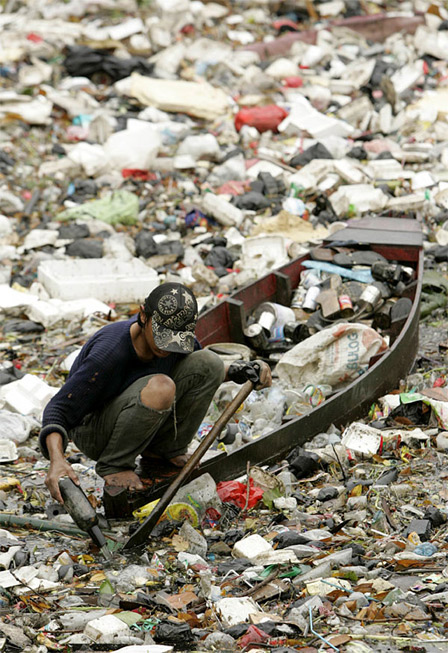
A man picks through garbage in the Citarum river, Indonesia
I’ve written, many times now, that collapse wouldn’t be pretty, but it would be a massive improvement on the way things will look if this system continues on for another twenty years.
If this is the scene in Indonesia now, what will this situation look like after another couple of decades of progress? The pace of progress might even accelerate as the clean energy technologies are rolled out. Progress might even spread to the few remaining places in the world that have not been destroyed by it.
In an ironic twist to that situation you see above, the river is becoming so clogged with trash that the operation of the massive hydropower station at Lake Saguling is threatened. The lights could literally go out because of this. The factories would close.
(Do you have a favorite folly-of-man story? Post a comment about it.)
Is this it in a nutshell? Is this all civilization really does? Choke itself to death on its own trash? Or, will we be able to wield clean power in a way that does not accelerate die off and collapse?
Via: Daily Mail:
It was once a gently flowing river, where fishermen cast their nets, sea birds came to feed and natural beauty left visitors spellbound.
Villagers collected water for their simple homes and rice paddies thrived on its irrigation channels.
Today, the Citarum is a river in crisis, choked by the domestic waste of nine million people and thick with the cast-off from hundreds of factories.
So dense is the carpet of refuse that the tiny wooden fishing craft which float through it are the only clue to the presence of water.
Their occupants no longer try to fish. It is more profitable to forage for rubbish they can salvage and trade – plastic bottles, broken chair legs, rubber gloves – risking disease for one or two pounds a week if they are lucky.
On what was United Nations World Environment Day, the Citarum, near the Indonesian capital of Jakarta, displayed the shocking abuse that mankind has subjected it to.
…
More than 500 factories, many of them producing textiles which require chemical treatment, line the banks of the 200-mile river, the largest waterway in West Java, spewing waste into the water.
On top of the chemicals go all the other kinds of human detritus from the factories and the people who work there.
There is no such luxury as a rubbish collection service here. Nor are there any modern toilet facilities. Everything goes into the river.
The filthy water is sucked into the rice paddies, while families risk their health by collecting it for drinking, cooking and washing.
Its demise began with rapid industrialisation during the late 1980s. The mighty Citarum soon became a garbage bin for the factories.
And the doomsday effect will spread. It is one of two major rivers that feed Lake Saguling, where the French have built the largest power generator in West Java.
Experts predict that as the river chokes, its volume will decrease and the generator will not function properly.
The area will be plunged into darkness.
But at least the factories will be stilled and their waste will stop flowing.
And perhaps the river will begin to breathe again.
Related: All Electric Vehicles and the Concept of Enough
Robot with Friendly Appearance to Rescue Wounded Troops
June 8th, 2007Via: BBC:
The US military is developing a robot with a teddy bear-style head to help carry injured soldiers away from the battlefield.
The Battlefield Extraction Assist Robot (BEAR) can scoop up even the heaviest of casualties and transport them over long distances over rough terrain.
New Scientist magazine reports that the “friendly appearance” of the robot is designed to put the wounded at ease.
It is expected to be ready for testing within five years.
Police at Ed and Elaine Brown’s Property
June 7th, 2007That situation is still simmering away…
Via: wmur:
State, local and federal authorities swarmed the small town of Plainfield on Thursday, fueling speculation that they had come to arrest a couple convicted of tax evasion, but officials said that was not the case.
Ed and Elaine Brown were convicted in January of hiding nearly $2 million in income and not paying taxes on it because they insisted that federal income taxes are invalid. In April, they skipped their sentencing hearings and have been holed up in their house since.
Neighbors spotted heavily armed police near the 110-acre property Thursday morning, but officials said that they were just there to serve a warrant on a dental office owned by the couple in Lebanon.
U.S. Marshal Stephen Monier said that the fire trucks, SWAT tanks and bomb disposal unit that were sent to the Plainsfield property were there only to do surveillance of the area.
Latest Updates: Ed Brown’s Blog
The CIA’s Favorite Form of Torture
June 7th, 2007Via: Salon:
Sensory deprivation, as CIA research and other agency interrogation materials demonstrate, is a remarkably simple concept. It can be inflicted by immobilizing individuals in small, soundproof rooms and fitting them with blacked-out goggles and earmuffs. “The first thing that happens is extraordinary hallucinations akin to mescaline,” explained McCoy. “I mean extreme hallucinations” of sight and sound. It is followed, in some cases within just two days, by what McCoy called a “breakdown akin to psychosis.”
It is therefore as insidious as some forms of obviously abusive coercion that are likely to be forbidden under the new CIA rules, like waterboarding, the technique of strapping a subject to a board with his feet raised and pouring water on his face to produce a sensation of imminent death. Legally, however, sensory deprivation is more nebulous than physical abuse, and that is what worries human rights advocates.