Toyota and Subaru Partner to Make All-Electric SUVs Together
June 6th, 2019Via: Electrek:
Toyota and Subaru, which is partly owned by the latter, have announced that they are partnering to develop a new electric platform in order to launch a couple of all-electric SUVs under each brand.
The two Japanese automakers have been increasingly collaborating over the past decade, including on some hybrid vehicle projects.
Both companies are also viewed as laggers in the all-electric space since neither have a fully-electronic option available to date.
Now they are announcing a partnership to help close that electric gap.
Related: Toyota Speeds Up Electrified Vehicle Schedule
GE Bet on Fossil Fuels, Lost Nearly $200B in Misjudging Renewable Energy Transition
June 6th, 2019
Via: Electrek:
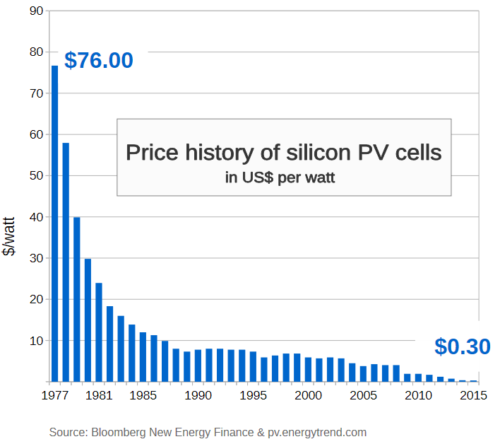
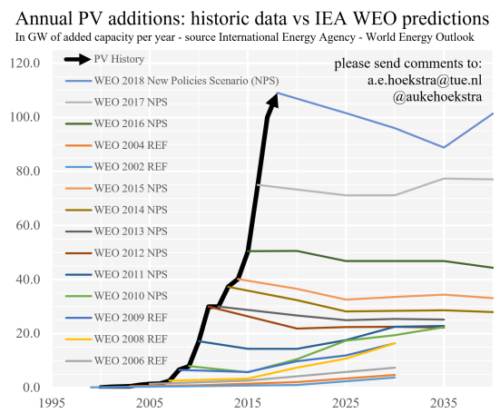
General Electric’s profitability collapse over the past few years can be largely attributed to the company’s inability to judge the accelerating pace of the global energy transition away from fossil fuels and toward renewables, a new study claims.
The analysis comes from the Institute for Energy Economics and Financial Analysis (IEEFA), which says that “GE made a massive bet on the future of natural gas and thermal coal, and lost,” concluding:
GE destroyed an almost unprecedented US$193 billion (bn)1 or 74% of its market capitalization over 2016-2018.
IEEFA acknowledges a number of “other management missteps,” but claims that “this value destruction was driven in large measure by the collapse of the new thermal power construction market globally—a collapse which caught GE entirely by surprise.”
Project Kuiper Initiative: Amazon Will Spend Billions to Build Satellite Internet Service
June 6th, 2019Via: Bloomberg:
Amazon.com Inc. plans to spend billions of dollars building a network of thousands of satellites to provide broadband internet service, Chief Executive Officer Jeff Bezos said.
The Project Kuiper initiative, disclosed earlier this year, is the type of big bet the company needs to keep making as its massive scale renders smaller endeavors less meaningful, Bezos said Thursday at Amazon’s re:MARS conference in Las Vegas.
The project, he said, is “a very good business for Amazon” because it requires a big capital expenditure, Bezos said. “It’s multiple billions of dollars of capex. Amazon is a large enough company now that we need to be doing things that, if they work, can actually move the needle.”
A Glass Battery That Keeps Getting Better?
June 6th, 2019As usual, never hold your breath waiting for disruptive battery technology to transition from the lab to a product that you can buy.
But this is a weird one…
Via: IEEE:
Is there such a thing as a battery whose capacity to store energy increases with age? One respected team of researchers say they have developed just such a technology. Controversy surrounds their claims, however, in part because thermodynamics might seem to demand that a battery only deteriorates over many charge-discharge cycles.
The researchers have a response for that critique and continue to publish peer-reviewed papers about this work. If such claims came from almost any other lab, they might be ignored and shunned by the broader community of battery researchers, the same way physicists turn their noses up at anything that smacks of a perpetual motion machine.
But this lab belongs to one of the most celebrated battery pioneers today—and one of the inventors of the lithium-ion battery itself. John Goodenough, who at 96 continues to research and publish like scientists one-third his age, last year joined with three co-authors in publishing a paper that grabbed headlines. (Spectrum had profiled him and his battery technology the year before, following an initial announcement about his group’s new glass battery.)
Goodenough and collaborators claimed they’d developed a non-flammable lithium battery (whose electrolyte was based on a glass powder) that had twice the energy density of traditional lithium-ion batteries. They also published a graph that showed an increase in capacity over more than 300 charge-discharge cycles. (This increase, however, pales in comparison to the cell’s at least 23,000-cycle lifespan.)
New Algorithm Allows Modification of Talking Head Videos as Easily as Editing Text
June 6th, 2019Via: Stanford:
In television and film, actors often flub small bits of otherwise flawless performances. Other times they leave out a critical word. For editors, the only solution so far is to accept the flaws or fix them with expensive reshoots.
Imagine, however, if that editor could modify video using a text transcript. Much like word processing, the editor could easily add new words, delete unwanted ones or completely rearrange the pieces by dragging and dropping them as needed to assemble a finished video that looks almost flawless to the untrained eye.
A team of researchers from Stanford University, Max Planck Institute for Informatics, Princeton University and Adobe Research created such an algorithm for editing talking-head videos – videos showing speakers from the shoulders up.
Towing an Iceberg to South Africa
June 6th, 2019Via: Bloomberg:
“To make it economically feasible, the iceberg will have to be big,” Sloane says. Ideally, it would measure about 1,000 meters (3,281 feet) long, 500 meters wide, and 250 meters deep, and weigh 125 million tons. “That would supply about 20% of Cape Town’s water needs for a year.”
Sloane has already assembled a team of glaciologists, oceanographers, and engineers. He’s also secured a group of financiers to fund the pioneer tow, which he calls the Southern Ice Project. The expected cost is more than $200 million, much of it to be put up by two South African banks and Water Vision AG, a Swiss water technology and infrastructure company.
Amazon Claims Prime Air Drones Will Start Delivering Packages ‘Within Months’
June 6th, 2019Via: USA Today:
Within a matter of months, your future Amazon orders could be delivered by a self-driving drone.
Officials with the online shopping giant unveiled the latest Prime Air drone design Wednesday at Amazon’s re:MARS Conference (Machine Learning, Automation, Robotics and Space) in Las Vegas.
“We’ve been hard at work building fully electric drones that can fly up to 15 miles and deliver packages under five pounds to customers in less than 30 minutes,” Jeff Wilke, CEO of Amazon Worldwide Consumer, wrote in a blog post this week. “And, with the help of our world-class fulfillment and delivery network, we expect to scale Prime Air both quickly and efficiently, delivering packages via drone to customers within months.”
The exact timing and where the drones will be making deliveries was not announced.
TSA Allowing Illegal Migrants to Fly Without Proper Documents
June 6th, 2019Via: Washington Examiner:
The federal agency tasked with overseeing security at transportation hubs has been violating its own policy by allowing migrants who have been released from federal custody onto flights despite not having required documents, according to several Department of Homeland Security officials.
For the past six months, the Transportation Security Administration has allowed migrants released from the custody of other Homeland Security agencies to board flights to other parts of the country despite the passengers lacking any of the 15 documents it states are the only acceptable forms of identification.
Pentagon Eyes Rare Earth Supplies in Africa in Push Away from China
June 6th, 2019In other news: Maybe Africa Really Will Be the New China.
Via: Reuters:
The U.S. Department of Defense has held talks with Malawi’s Mkango Resources Ltd and other rare earth miners across the globe about their supplies of strategic minerals, part of a plan to find diversified reserves outside of China, a department official said on Wednesday.
The push comes as China threatens to curb exports to the United States of rare earths, a group of 17 minerals used in a plethora of military equipment and high-tech consumer electronics.
Although China contains only a third of the world’s rare earth reserves, it accounts for 80% of U.S. imports of minerals because it controls nearly all of the facilities to process the material, according to U.S. Geological Survey data.
“We are looking for any source of supply outside China. We want diversity. We don’t want a single-source producer,” Jason Nie, a material engineer with the Pentagon’s Defense Logistics Agency, said on the sidelines of the Argus U.S. Specialty Metals conference in Chicago.
Police Building Surveillance Networks with Amazon’s Ring Doorbells
June 5th, 2019Via: Cnet:
While residential neighborhoods aren’t usually lined with security cameras, the smart doorbell’s popularity has essentially created private surveillance networks powered by Amazon and promoted by police departments.
Police departments across the country, from major cities like Houston to towns with fewer than 30,000 people, have offered free or discounted Ring doorbells to citizens, sometimes using taxpayer funds to pay for Amazon’s products.
…
“Our township is now entirely covered by cameras,” said Captain Vincent Kerney, detective bureau commander of the Bloomfield Police Department. “Every area of town we have, there are some Ring cameras.”