CombiBar
January 6th, 2013Don’t leave home without it. *chortle*
Gold CombiBar
Via: Reuters:
Private investors in Switzerland, Austria and Germany are lining up to buy gold bars the size of a credit card that can easily be broken into one gram pieces and used as payment in an emergency.
Now Swiss refinery Valcambi, a unit of U.S. mining giant Newmont, wants to bring its “CombiBar” to market in the United States and build up its sales presence India – the world’s largest consumer of gold where the precious metal has long served as a parallel currency.
More: CombiBar
Christopher Tolkien on the Evisceration of His Father’s Work
January 6th, 2013Via: WorldCrunch:
Christopher Tolkien gave his first ever press interview with Le Monde, shedding light on his father’s vision and sharing his own deep dismay with Hobbit director Peter Jackson.
…
This commercial galaxy is now worth several billion dollars — most of which does not go to Tolkien’s heirs, and thus complicates the management of his heritage for his family, which is polarized not over the images or objects, but over the respect for Tolkien’s words. Through a curious coincidence, the situation recalls the plot of Lord of the Rings, where everything starts with an inherited problem: Frodo Baggins, the hero, receives from the aging hero Bilbo the famous magic ring, whose possession attracts envy from every quarter, and ultimately provokes evil.
…
Invited to meet Peter Jackson, the Tolkien family preferred not to. Why? “They eviscerated the book by making it an action movie for young people aged 15 to 25,” Christopher says regretfully. “And it seems that The Hobbit will be the same kind of film.”
This divorce has been systematically driven by the logic of Hollywood. “Tolkien has become a monster, devoured by his own popularity and absorbed into the absurdity of our time,” Christopher Tolkien observes sadly. “The chasm between the beauty and seriousness of the work, and what it has become, has overwhelmed me. The commercialization has reduced the aesthetic and philosophical impact of the creation to nothing. There is only one solution for me: to turn my head away.”
Original in French: Tolkien, l’anneau de la discorde
Intraoperative Recall: The Perplexing Phenomenon of People Who ‘Awaken’ Under General Anesthesia
January 6th, 2013Via: The Atlantic:
While subduing consciousness is the most urgent aspect of Tononi’s work, he is especially animated when discussing consciousness in its fullest, brightest state. In his office in Madison, he described a hypothetical device called a “qualiascope” that could visualize consciousness the same way telescopes visualize light waves, or thermal goggles visualize heat. The more integrated the information—that is, the more conscious the brain—the brighter the qualiascope would glow. Using the device in an operating room, you would watch a patient’s consciousness fade to a dull pulse. If he woke up mid-operation, you might see a flicker.
But if you turned your gaze away from the operating room, you would gain an astonishing perspective on the universe. “The galaxy would look like dust,” Tononi told me. “Within this empty, dusty universe, there would be true stars. And guess what? These stars would be every living consciousness. It’s really true. It’s not just a poetic image. The big things, like the sun, would be nothing compared to what we have.”
Professor Jorge L. Duarte on Yildiz Magnet Motor
January 6th, 2013
Via: PESN:
In the past, many inventors have claimed the possibility of building permanent magnet motors that could operate in a self-sustainable way. However, due to one or another reason, to date, no one has succeeded in bringing forward this alleged performance to the open public.
The situation with Mr. Yildiz is radically different.
California Now Officially Tolerates Some Homemade Food Businesses
January 5th, 2013Via: Bloomberg:
Granola makers, homemade vinegar producers, and other foodies in California have cause to rejoice today. As of Jan. 1, a new state law allows people who make food at home to sell it to restaurants and grocery stores.
Leave it to California to upend decades of public health consensus that food businesses need commercial licenses to ensure their food is safe and free of harmful contaminants. The California Homemade Food Act creates a new category of food production called a “cottage food operation.”
To qualify for a state permit under the law, aspiring cottage food operators must attend a food safety class and pass an exam developed by the California Department of Public Health. They have to label their products, pay a small fee, and submit to an annual kitchen inspection by health officials. Like commercial enterprises, the food producers aren’t allowed to smoke or keep pets in the kitchen. When you consider the slim margins most commercial food businesses operate on, this streamlined regulatory process is probably a good deal for food sellers.
‘Can a $1 Trillion Coin End Debt Ceiling Crisis?’
January 5th, 2013There’s a lot of laughter about this, but the proposal is not altogether different from what the U.S. is doing already in slow motion. The key difference between simply minting trillion dollar coins and the way the debt scam is currently done is as follows:
If the U.S. Government prints x number of trillion dollar coins today, tomorrow you would wind up with a North American version of the Zim buck.
That would be bad—for a while. It would shock people and immediately cause severe dislocations.
The current debt financing system, however, is much worse and insidious in the long term. It’s a nightmare that is increasingly being forced on future generations. The process moves much slower than the overnight creation of a Zim buck, but unless one happens to take an interest in these matters, one probably wouldn’t notice it. For the average bewildered adult, life, in general, goes from bad to worse.
In short, the process looks like this:
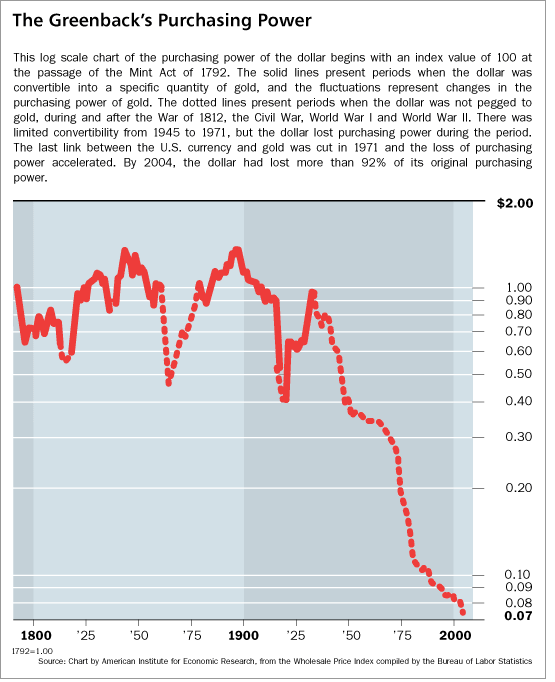
U.S. Dollar Purchasing Power
The piece below states, “Creating money out of thin air is hardly a solution.” And everyone laughs. HAHA. But that’s exactly what the Federal Reserve is doing.
See: In 2011, the Federal Reserve Purchased a Stunning 61% of U.S. Debt:
The recently released Federal Reserve Flow of Funds report for all of 2011 reveals that Federal Reserve purchases of Treasury debt mask reduced demand for U.S. sovereign obligations. Last year the Fed purchased a stunning 61% of the total net Treasury issuance, up from negligible amounts prior to the 2008 financial crisis. This not only creates the false appearance of limitless demand for U.S. debt but also blunts any sense of urgency to reduce supersized budget deficits.
Still, the outdated notion of never-ending buyers for U.S. debt is perpetuated by many.
…
The Fed is in effect subsidizing U.S. government spending and borrowing via expansion of its balance sheet and massive purchases of Treasury bonds. This keeps Treasury interest rates abnormally low, camouflaging the true size of the budget deficit. Similarly, the Fed is providing preferential credit to the U.S. government and covering a rapidly widening gap between Treasury’s need to borrow and a more limited willingness among market participants to supply Treasury with credit.
So, laugh all you want about a trillion dollar coin.
In effect, the same scam has already been implemented.
Via: CNN:
What if the threat of a voluntary default by the United States could be erased by simply turning one tiny scrap of platinum into a coin?
That’s right. No debt ceiling problem. No bickering in Congress. No market jitters. The only thing needed is for the Treasury Department to mint a platinum coin with a face value of $1 trillion.
Of course, this is not going to happen. Creating money out of thin air is hardly a solution. It could lead to even more concerns from those worried about inflation. Critics of the Federal Reserve’s monetary easing programs would likely be apoplectic if the Treasury Department trumped Ben Bernanke’s “helicopter drop” by minting a trillion more new dollars.
How Bankers Help Drug Traffickers and Terrorists
January 5th, 2013Via: New York Times:
LAST month, HSBC admitted in court pleadings that it had allowed big Mexican and Colombian drug cartels to launder at least $881 million. The bank also admitted to using various schemes to move hundreds of millions of dollars to nations subject to trade sanctions, including Iran, Cuba and Sudan, in violation of the Trading With the Enemy Act. “On at least one occasion,” according to a statement by Assistant Attorney General Lanny A. Breuer, “HSBC instructed a bank in Iran on how to format payment messages so that the transactions would not be blocked or rejected by the United States.”
Those were some of the transgressions uncovered during a two-year investigation led by the Justice and Treasury Departments and acknowledged by HSBC in a settlement, known as a deferred prosecution agreement, that was filed in a federal court in December. Not a single executive was charged with a crime. Instead, the bank paid $1.9 billion in fines and forfeitures — or roughly 10 percent of the pretax profits it earned in just 2010, one of the more than five years during which it admitted to criminal conduct.
Related:
Banks Financing Mexico Gangs Admitted in Wells Fargo Deal
DEA Launders Mexican Profits of Drug Cartels
Research Credit: ottilie
1,200 Pages of New ‘Food Safety’ Regulations
January 5th, 2013Via: Washington Post:
The rules, which span 1,200 pages, are aimed at creating safer conditions from farm to fork. Produce farmers would be required to ensure that their crops aren’t contaminated by bad water or animal waste. Some will likely be compelled to build fences to keep out wildlife and to provide adequate restrooms and hand-washing facilities for field workers.
America’s Real Criminal Element: Lead
January 5th, 2013Via: Mother Jones:
In 1994, Rick Nevin was a consultant working for the US Department of Housing and Urban Development on the costs and benefits of removing lead paint from old houses. This has been a topic of intense study because of the growing body of research linking lead exposure in small children with a whole raft of complications later in life, including lower IQ, hyperactivity, behavioral problems, and learning disabilities.
But as Nevin was working on that assignment, his client suggested they might be missing something. A recent study had suggested a link between childhood lead exposure and juvenile delinquency later on. Maybe reducing lead exposure had an effect on violent crime too?
That tip took Nevin in a different direction. The biggest source of lead in the postwar era, it turns out, wasn’t paint. It was leaded gasoline. And if you chart the rise and fall of atmospheric lead caused by the rise and fall of leaded gasoline consumption, you get a pretty simple upside-down U: Lead emissions from tailpipes rose steadily from the early ’40s through the early ’70s, nearly quadrupling over that period. Then, as unleaded gasoline began to replace leaded gasoline, emissions plummeted.
ntriguingly, violent crime rates followed the same upside-down U pattern. The only thing different was the time period: Crime rates rose dramatically in the ’60s through the ’80s, and then began dropping steadily starting in the early ’90s. The two curves looked eerily identical, but were offset by about 20 years.
So Nevin dove in further, digging up detailed data on lead emissions and crime rates to see if the similarity of the curves was as good as it seemed. It turned out to be even better: In a 2000 paper (PDF) he concluded that if you add a lag time of 23 years, lead emissions from automobiles explain 90 percent of the variation in violent crime in America. Toddlers who ingested high levels of lead in the ’40s and ’50s really were more likely to become violent criminals in the ’60s, ’70s, and ’80s.
And with that we have our molecule: tetraethyl lead, the gasoline additive invented by General Motors in the 1920s to prevent knocking and pinging in high-performance engines. As auto sales boomed after World War II, and drivers in powerful new cars increasingly asked service station attendants to “fill ‘er up with ethyl,” they were unwittingly creating a crime wave two decades later.
It was an exciting conjecture, and it prompted an immediate wave of…nothing. Nevin’s paper was almost completely ignored, and in one sense it’s easy to see why—Nevin is an economist, not a criminologist, and his paper was published in Environmental Research, not a journal with a big readership in the criminology community. What’s more, a single correlation between two curves isn’t all that impressive, econometrically speaking. Sales of vinyl LPs rose in the postwar period too, and then declined in the ’80s and ’90s. Lots of things follow a pattern like that. So no matter how good the fit, if you only have a single correlation it might just be a coincidence. You need to do something more to establish causality.
As it turns out, however, a few hundred miles north someone was doing just that. In the late ’90s, Jessica Wolpaw Reyes was a graduate student at Harvard casting around for a dissertation topic that eventually became a study she published in 2007 as a public health policy professor at Amherst. “I learned about lead because I was pregnant and living in old housing in Harvard Square,” she told me, and after attending a talk where future Freakonomics star Levitt outlined his abortion/crime theory, she started thinking about lead and crime. Although the association seemed plausible, she wanted to find out whether increased lead exposure caused increases in crime. But how?
The answer, it turned out, involved “several months of cold calling” to find lead emissions data at the state level. During the ’70s and ’80s, the introduction of the catalytic converter, combined with increasingly stringent Environmental Protection Agency rules, steadily reduced the amount of leaded gasoline used in America, but Reyes discovered that this reduction wasn’t uniform. In fact, use of leaded gasoline varied widely among states, and this gave Reyes the opening she needed. If childhood lead exposure really did produce criminal behavior in adults, you’d expect that in states where consumption of leaded gasoline declined slowly, crime would decline slowly too. Conversely, in states where it declined quickly, crime would decline quickly. And that’s exactly what she found.
Caffeinated Seas Found off U.S. Pacific Northwest
January 5th, 2013Via: National Geographic:
The Pacific Northwest may be the epicenter of U.S. coffee culture, and now a new study shows the region’s elevated caffeine levels don’t stop at the shoreline.
The discovery of caffeine pollution in the Pacific Ocean off Oregon is further evidence that contaminants in human waste are entering natural water systems, with unknown consequences for wildlife and humans alike, experts say.
Scientists sampled both “potentially polluted” sites—near sewage-treatment plants, larger communities, and river mouths—and more remote waters, for example near a state park.
Surprisingly, caffeine levels off the potentially polluted areas were below the detectable limit, about 9 nanograms per liter. The wilder coastlines were comparatively highly caffeinated, at about 45 nanograms per liter.