FBI Broke Law for Years in Phone Record Searches
January 19th, 2010* pfft *
But rest easy, citizen, “FBI officials said they are confident that the safeguards enacted in 2007 have ended the problems.”
Conveniently, the article doesn’t mention domestic NSA intercept operations.
Via: Washington Post:
The FBI illegally collected more than 2,000 U.S. telephone call records between 2002 and 2006 by invoking terrorism emergencies that did not exist or simply persuading phone companies to provide records, according to internal bureau memos and interviews. FBI officials issued approvals after the fact to justify their actions.
E-mails obtained by The Washington Post detail how counterterrorism officials inside FBI headquarters did not follow their own procedures that were put in place to protect civil liberties. The stream of urgent requests for phone records also overwhelmed the FBI communications analysis unit with work that ultimately was not connected to imminent threats.
A Justice Department inspector general’s report due out this month is expected to conclude that the FBI frequently violated the law with its emergency requests, bureau officials confirmed.
Japan Airlines Files for Bankruptcy Protection
January 19th, 2010Via: AP:
Japan Airlines filed for bankruptcy Tuesday in one of the nation’s biggest corporate failures ever, entering a restructuring that will shrink Asia’s top carrier and its presence around the world.
Staggering under a $25.6 billion debt mountain, the carrier applied for protection from creditors under the Corporate Rehabilitation Law — Japan’s version of Chapter 11 — with the Tokyo District Court.
Japan’s flagship airline will slash nearly 16,000 jobs, reduce pensions for retired staff, cut routes and shift to more fuel-efficient aircraft as part of its restructuring.
Some $10 billion of government cash will keep JAL’s planes in the air during the reorganization. Lenders will forgive $8 billion in debt, and JAL shares will be removed from the Tokyo Stock Exchange on Feb. 20, wiping out investors.
There was no word on the outcome of a fierce tug-of-war between Delta Air Lines and American Airlines for a slice of JAL’s business. Despite its woes, the airline’s access to Asia is a mouthwatering prize for foreign airlines.
A state-backed turnaround agency pledged 900 billion yen ($10 billion) in financial support for JAL — 600 billion yen in credit lines and a 300 billion yen cash infusion. The bankruptcy is the fourth-largest in Japan, according to figures from Teikoku Databank, which tracks corporate failures.
One in Seven U.S. Mortgages In Foreclosure or Delinquent
January 19th, 2010Green shoots. Recovery.
Via: Reuters:
A record one in seven U.S. mortgages were in foreclosure or at least one payment past due in the third quarter, according to fresh data signaling the recovery in the housing market will be tepid at best.
U.S. mortgage delinquency rates and the percentage of loans that entered the foreclosure process also jumped to records from July to September, the Mortgage Bankers Association said on Thursday.
Rising job losses were behind the increasingly bleak portrait of the housing market in a trend that will continue into next year, the group said in data that adds to recent evidence of a still-struggling housing market.
Housing and related business account for about 20 percent of the economy and recovery is essential to bring unemployment down from a 26-1/2-year high and kick-start economic growth.
Yet record foreclosures will add to the growing supply of unsold homes, sapping the housing market as it attempts to recover from the worst slump since the Great Depression.
Three-Year-Olds with Iphones?
January 19th, 2010Via: TheAppleBlog:
My three year old daughter now has her own iPhone, though without service so it is effectively an iPod touch. And how did I create a monster, you might ask? Easy. Her first words upon waking from sleep are “Where’s my iPhone?” Her reaction to her parents call to come to the dinner table, head upstairs for a bath or get ready for bed is to clutch her iPhone and cry. Even though I loaded her iPhone with some of her favorite apps from her mom’s phone (by re-downloading to our black Macbook, as I couldn’t get iTunes Home Sharing to work with my wife’s Macbook Air), she only really uses it to watch a small handful of videos that I ripped or downloaded. And she uses it constantly: sitting in a chair, laying on the floor, walking from room-to-room… head down, focused on the iPhone screen, it can be a challenge to get her to disengage with the device and engage with us.
So how can this be a good thing, or at least not bad? For one, I long ago read “Everything Bad is Good for You” by Steven Berlin Johnson, and take solace that her use of the iPhone at this early stage is at least teaching her some valuable skills, including human-computer interaction (for example, she is still mastering the art of touching a video then touching again on the appropriate icon to pause or play it). The videos I loaded are generally good quality educational content, so there are learning moments in them. And her ability to use the iPhone or not has quickly become the “carrot” and “stick” motivation we’ve long needed: she responds to our threats to take it away or promise to let her use it as with nothing that came before it.
As the novelty of watching videos begins to wear off, I expect our daughter to explore all of the possibilities that her iPhone offers. We’re already using the built-in clock to learn to tell time, Camera to take pictures, and Weather to see if it will snow today. I can imagine using apps like Best Camera to learn more about art and photography, or Vocabulearn Tagalog to learn her mom’s families native language (which I need to do before we go to the Philippines in a year or two). In the meantime, she’s already started to use some of the toddler apps I installed, like Kid Art, Voice Toddler Cards, and the Curious George Coloring Book.
The real challenge will be to help our daughter use her iPhone as an educational device, and avoid the trap of becoming too immersed to the detriment of social, motor, and other skills development. The real question is whether I’m a bad dad for giving a three year old an iPhone. What do you think?
U.S. Military Weapon Sights Inscribed With Bible References
January 18th, 2010Via: ABC News:
Coded references to New Testament Bible passages about Jesus Christ are inscribed on high-powered rifle sights provided to the United States military by a Michigan company, an ABC News investigation has found.
The sights are used by U.S. troops in Iraq and Afghanistan and in the training of Iraqi and Afghan soldiers. The maker of the sights, Trijicon, has a $660 million multi-year contract to provide up to 800,000 sights to the Marine Corps, and additional contracts to provide sights to the U.S. Army.
U.S. military rules specifically prohibit the proselytizing of any religion in Iraq or Afghanistan and were drawn up in order to prevent criticism that the U.S. was embarked on a religious “Crusade” in its war against al Qaeda and Iraqi insurgents.
One of the citations on the gun sights, 2COR4:6, is an apparent reference to Second Corinthians 4:6 of the New Testament, which reads: “For God, who commanded the light to shine out of darkness, hath shined in our hearts, to give the light of the knowledge of the glory of God in the face of Jesus Christ.”
Other references include citations from the books of Revelation, Matthew and John dealing with Jesus as “the light of the world.” John 8:12, referred to on the gun sights as JN8:12, reads, “Whoever follows me will never walk in darkness, but will have the light of life.”
Trijicon confirmed to ABCNews.com that it adds the biblical codes to the sights sold to the U.S. military. Tom Munson, director of sales and marketing for Trijicon, which is based in Wixom, Michigan, said the inscriptions “have always been there” and said there was nothing wrong or illegal with adding them. Munson said the issue was being raised by a group that is “not Christian.” The company has said the practice began under its founder, Glyn Bindon, a devout Christian from South Africa who was killed in a 2003 plane crash.
The company’s vision is described on its Web site: “Guided by our values, we endeavor to have our products used wherever precision aiming solutions are required to protect individual freedom.”
“We believe that America is great when its people are good,” says the Web site. “This goodness has been based on Biblical standards throughout our history, and we will strive to follow those morals.”
Spokespeople for the U.S. Army and the Marine Corps both said their services were unaware of the biblical markings. They said officials were discussing what steps, if any, to take in the wake of the ABCNews.com report. It is not known how many Trijicon sights are currently in use by the U.S. military.
The biblical references appear in the same type font and size as the model numbers on the company’s Advanced Combat Optical Guides, called the ACOG.
A photo on a Department of Defense Web site shows Iraqi soldiers being trained by U.S. troops with a rifle equipped with the bible-coded sights.
“It’s wrong, it violates the Constitution, it violates a number of federal laws,” said Michael “Mikey” Weinstein of the Military Religious Freedom Foundation, an advocacy group that seeks to preserve the separation of church and state in the military.
‘Firearms of Jesus Christ’
“It allows the Mujahedeen, the Taliban, al Qaeda and the insurrectionists and jihadists to claim they’re being shot by Jesus rifles,” he said.
Weinstein, an attorney and former Air Force officer, said many members of his group who currently serve in the military have complained about the markings on the sights. He also claims they’ve told him that commanders have referred to weapons with the sights as “spiritually transformed firearm[s] of Jesus Christ.”
He said coded biblical inscriptions play into the hands of “those who are calling this a Crusade.”
According to a government contracting watchdog group, fedspending.org, Trijicon had more than $100 million in government contracts in fiscal year 2008. The Michigan company won a $33 million Pentagon contract in July, 2009 for a new machine gun optic, according to Defense Industry Daily. The company’s earnings from the U.S. military jumped significantly after 2005, when it won a $660 million long-term contract to supply the Marine Corps with sights.
“This is probably the best example of violation of the separation of church and state in this country,” said Weinstein. “It’s literally pushing fundamentalist Christianity at the point of a gun against the people that we’re fighting. We’re emboldening an enemy.”
Research Credit: coxsone
Bush as President Occasionally Phoned Clinton
January 18th, 2010But first…
From: Bush, the Little Voice in Hillary’s Head:
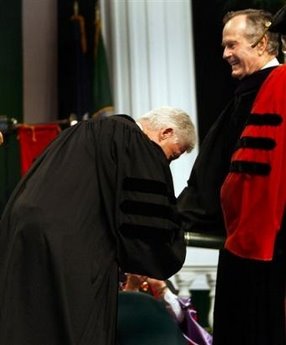
What is thy bidding, my Master?
And this set from: Change We Can Believe In: Obama Honors George H.W. Bush for Public Service:
Obama Senior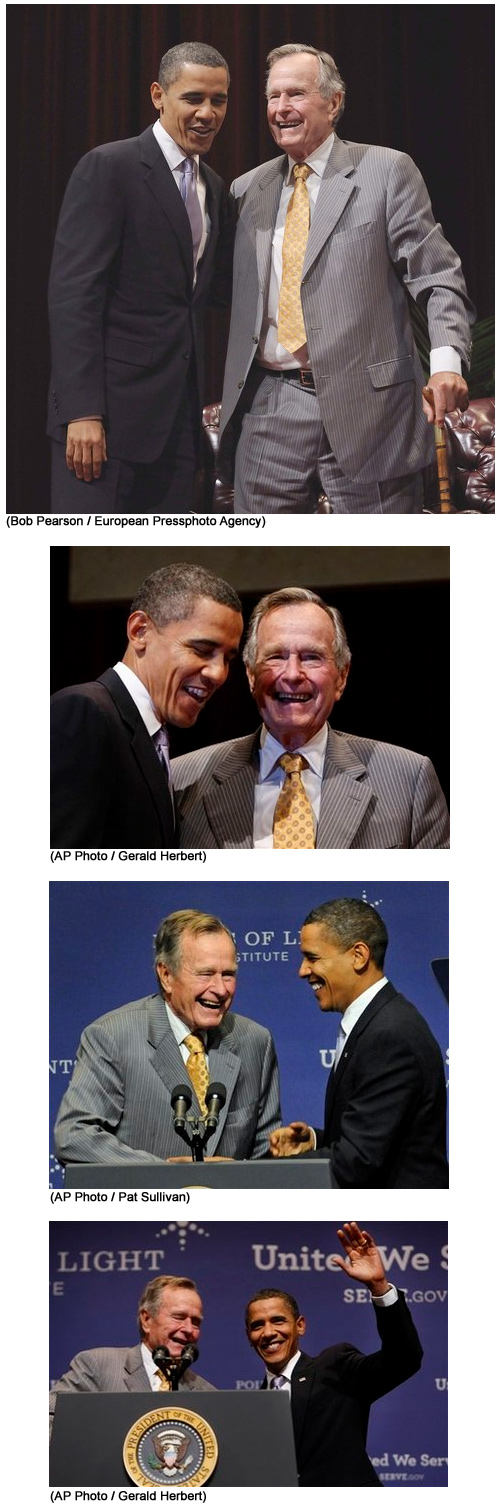
And now back to our regularly scheduled programming.
Via: AP / New York Times:
George W. Bush had a special phone friend during his White House years: Bill Clinton.
Asked on CBS’ ”Face the Nation” whether it was true that he often called Clinton, Bush replied: ”I don’t know about often, but I did. I called him. He didn’t call me because he knows how busy a president is. I called him and we chatted on occasion.”
Neither Republican nor Democrat Clinton said just what they discussed.
”I was always pleased when he called me,” Clinton said as he sat beside Bush for the interview. ”I make it a practice never to bother the president. I don’t call President Obama either. … They got plenty to do.”
Bush’s eight years in office followed Clinton’s two terms. While poles apart politically, the ex-presidents said they consider themselves to be friends.
”We have developed a very honest, good friendship,” Clinton said. ”And we’ve made our disagreements respectful and we’ve had a good time doing it.”
The two met President Barack Obama at the White House on Saturday and taped segments for five Sunday news shows to appeal for private donations for Haiti relief.
Former Morgan Stanley Infrastructure and Energy Specialist, Who Was Also Director of Private-Equity Firm EQT Partners, Found Dead in Back of Delivery Van in Munich
January 18th, 2010Via: Bloomberg / Business Week:
A director of private-equity firm EQT Partners AB who previously worked for Morgan Stanley may have been murdered as he was trying to sell his Audi A8 luxury sedan, Munich police said.
Dirk von Poschinger-Camphausen, 36, was killed by 10 to 13 gunshots, detective Markus Kraus said at a press conference in the Bavarian capital today. Police arrested three men, who are being investigated for robbery and murder. One of the suspects is a German aged 40, and a 54 year-old Macedonian and Croatian citizen is also in custody. A third person has since been released.
The body of Poschinger-Camphausen, a German native, was discovered in a delivery van in the western suburb of Laim early on Jan. 16. His car was parked nearby. Police said he had been trying to sell his Audi on the Internet. The Munich-based newspaper Abendzeitung said he’d offered the car for 54,000 euros ($77,000) as part of preparations for a move to the U.S.
Poschinger-Camphausen joined the Munich office of Stockholm-based EQT last year after four years at Morgan Stanley in Frankfurt, where he specialized in infrastructure and energy mergers and acquisitions, according to EQT’s Web site.
He was last seen alive on Jan. 14 when he left his apartment in the central Munich district of Bogenhausen at about 9:30 a.m., police spokesman Markus Dengler said yesterday. His wife reported him missing that afternoon. Police are working on the assumption that Pochinger-Camphausen took his suspected killers for a test drive in the car. No weapon has yet been found.
Prior to working at Morgan Stanley, Poschinger-Camphausen spent four years at JPMorgan and Dresdner Kleinwort in London, according to EQT’s Web site.
Italy to Require Anyone Who Uploads Video to the Internet to Obtain Government Authorization
January 17th, 2010Via: The Industry Standard:
New rules to be introduced by government decree will require people who upload videos onto the Internet to obtain authorization from the Communications Ministry similar to that required by television broadcasters, drastically reducing freedom to communicate over the Web, opposition lawmakers have warned.
The decree is ostensibly an enactment of a European Union (EU) directive on product placement and is due to go into effect at the end of January after being subjected to a nonbinding appraisal by parliament.
On Thursday opposition lawmakers held a press conference in parliament to denounce the new rules — which require government authorization for the uploading of videos, give individuals who claim to have been defamed a right of reply and prevent the replay of copyright material — as a threat to freedom of expression.
“The decree subjects the transmission of images on the Web to rules typical of television and requires prior ministerial authorization, with an incredible limitation on the way the Internet currently functions,” opposition Democratic Party lawmaker Paolo Gentiloni told the press conference.
Article 4 of the decree specifies that the dissemination over the Internet “of moving pictures, whether or not accompanied by sound,” requires ministerial authorization. Critics say it will therefore apply to the Web sites of newspapers, to IPTV and to mobile TV, obliging them to take on the same status as television broadcasters.
“Italy joins the club of the censors, together with China, Iran and North Korea,” said Gentiloni’s party colleague Vincenzo Vita.
Companies Building Credit Profiles Based on Twitbook Traffic?
January 17th, 2010Not The Onion.
Via: creditcard.com:
You probably don’t analyze the chatter or quality of your social media connections, but creditors may be doing just that.
In their quest to identify creditworthy customers, some are tapping into the information you and your friends reveal in the virtual stratosphere. Before calling the privacy police, though, understand how it’s really being used.
According to Nielsen Online, 67 percent of the global online population uses Facebook, Twitter, Linkedin or a similar social media network to stay in touch with friends, grow their business or just have fun. If you’re among them and your settings are turned to “public,” who you’re talking to and what you’re discussing is available to those wanting to sell their wares — and that includes banks and other credit issuers.
…
Another reason credit issuers are looking to this data is to reduce lending risk. Social graphs allow credit issuers to know if you’re connected to a community of great credit customers. Creditors can see if people in your network have accounts with them, and are free to look at how they are handling those accounts.
The presumption is that if those in your network are responsible cardholders, there is a better chance you will be, too. So, if a bank is on the fence about whether to extend you credit, you may become eligible if those in your network are good credit customers.
George W. Obama
January 17th, 2010Via: Village Voice:
Before President Obama, it was grimly accurate to write, as I often did in the Voice, that George W. Bush came into the presidency with no discernible background in constitutional civil liberties or any acquaintance with the Constitution itself. Accordingly, he turned the “war on terror” over to Dick Cheney and Donald Rumsfeld—ardent believers that the Constitution presents grave obstacles in a time of global jihad.
But now, Bush’s successor—who actually taught constitutional law at the University of Chicago—is continuing much of the Bush-Cheney parallel government and, in some cases, is going much further in disregarding our laws and the international treaties we’ve signed.