Chinese Armed Drones Now Flying Across Mideast Battlefields
October 3rd, 2018Via: AP:
High above Yemen’s rebel-held city of Hodeida, a drone controlled by Emirati forces hovered as an SUV carrying a top Shiite Houthi rebel official turned onto a small street and stopped, waiting for another vehicle in its convoy to catch up.
Seconds later, the SUV exploded in flames, killing Saleh al-Samad, a top political figure.
The drone that fired that missile in April was not one of the many American aircraft that have been buzzing across the skies of Yemen, Iraq and Afghanistan since Sept. 11, 2001. It was Chinese.
Across the Middle East, countries locked out of purchasing U.S.-made drones due to rules over excessive civilian casualties are being wooed by Chinese arms dealers, who are world’s main distributor of armed drones.
“The Chinese product now doesn’t lack technology, it only lacks market share,” said Song Zhongping, a Chinese military analyst and former lecturer at the People’s Liberation Army Rocket Force University of Engineering. “And the United States restricting its arms exports is precisely what gives China a great opportunity.”
U.S. Government Can’t Account for $21 Trillion Since 1998
October 3rd, 2018This is from December 2017.
Via: USA Watchdog:
Michigan State University economics professor Mark Skidmore made an astounding discovery about the finances and budgets of the U.S. federal government earlier this year. He and a team of graduate students discovered $21 trillion missing in the federal budget going back to 1998. Dr. Skidmore, who specializes in public finance, explains, “We know from official government sources that indicate $21 trillion is, in some way, unaccounted for. Furthermore, if we come back to the Constitution, all spending needs to be authorized by Congress. It looks to me, and I think I can conclude with a high degree of certainty, there is money flowing in, as well as out, that is unaccounted for. . . . That’s the one thing we know from these documents, that there is $21 trillion in unaccounted funds.”
In one example, Skidmore found a huge transfer from the Treasury Department to the Army that, again, was not authorized. Keep in mind, the Army has an approved budget of a little more than $120 billion a year. Skidmore says, “In this one report . . . there is an appendix table that indicates there was a transfer from Treasury to the Army of about $800 billion. That’s almost a trillion dollars flowing in. There is a note that says we had to do this in order to reconcile past years. That doesn’t make sense to me either because, these earlier years, you have a transfer from the Treasury of your $120 billion or $130 billion, and every year, the Army is granted the authority to spend this money in the ways they say they will. How can you get (an additional) $800 billion in and call that an ‘adjustment’? I tried to call and talk to the office of the Inspector General to talk to the people who helped generate these reports. I haven’t been successful, and I stopped trying when they disabled the links.”
More: Solari – The Missing Money
Humanoid Construction Robot Installs Drywall by Itself
October 2nd, 2018Via: The Verge:
If Japan’s Advanced Industrial Science and Technology Institute has its way, construction workers might be a thing of the past. Researchers have built HRP-5P, a humanoid bot that can handle a variety of construction tasks when there’s either a staffing shortage or serious hazards. The prototype uses a mix of environment detection, object recognition and careful movement planning to install drywall by itself — it can hoist up boards and fasten them with a screwdriver.
New Zealand: Travelers Refusing Digital Search Now Face $5000 Customs Fine
October 2nd, 2018Via: Radio New Zealand:
Travellers who refuse to hand over their phone or laptop passwords to Customs officials can now be slapped with a $5000 fine.
The Customs and Excise Act 2018 – which comes into effect today – sets guidelines around how Customs can carry out “digital strip-searches”.
Previously, Customs could stop anyone at the border and demand to see their electronic devices. However, the law did not specify that people had to also provide a password.
The updated law makes clear that travellers must provide access – whether that be a password, pin-code or fingerprint – but officials would need to have a reasonable suspicion of wrongdoing.
“It is a file-by-file [search] on your phone. We’re not going into ‘the cloud’. We’ll examine your phone while it’s on flight mode,” Customs spokesperson Terry Brown said.
If people refused to comply, they could be fined up to $5000 and their device would be seized and forensically searched.
High Sugar Content of Modern Fruit Varieties Causing Illnesses in Zoo Animals
October 1st, 2018Via: Sydney Morning Herald:
Selective breeding has made the fruit we eat so full of sugar, Melbourne Zoo has had to wean its animals off it.
…
“The issue is the cultivated fruits have been genetically modified to be much higher in sugar content than their natural, ancestral fruits,” says Dr Michael Lynch, the zoo’s head vet.
“It’s interesting. After doing a lot with nutrition here, I tend to eat less fruit.”
Monkeys love bananas. But now, says Dr Lynch, the zoo’s primates don’t get any fruit at all.
Research Credit: DF
DEF CON Report: “Grave and Undeniable” Security Issues with Electronic Voting Systems
October 1st, 2018Via: Ars Technica:
Today, six prominent information-security experts who took part in DEF CON’s Voting Village in Las Vegas last month issued a report on vulnerabilities they had discovered in voting equipment and related computer systems. One vulnerability they discovered—in a high-speed vote-tabulating system used to count votes for entire counties in 23 states—could allow an attacker to remotely hijack the system over a network and alter the vote count, changing results for large blocks of voters. “Hacking just one of these machines could enable an attacker to flip the Electoral College and determine the outcome of a presidential election,” the authors of the report warned.
…
The report authors…documented dozens of other severe vulnerabilities found in voting systems. They found that four major areas of “grave and undeniable” concern need to be addressed urgently. One of the most critical is the lack of any sort of supply-chain security for voting machines—there is no way to test the machines to see if they are trustworthy or if their components have been modified.
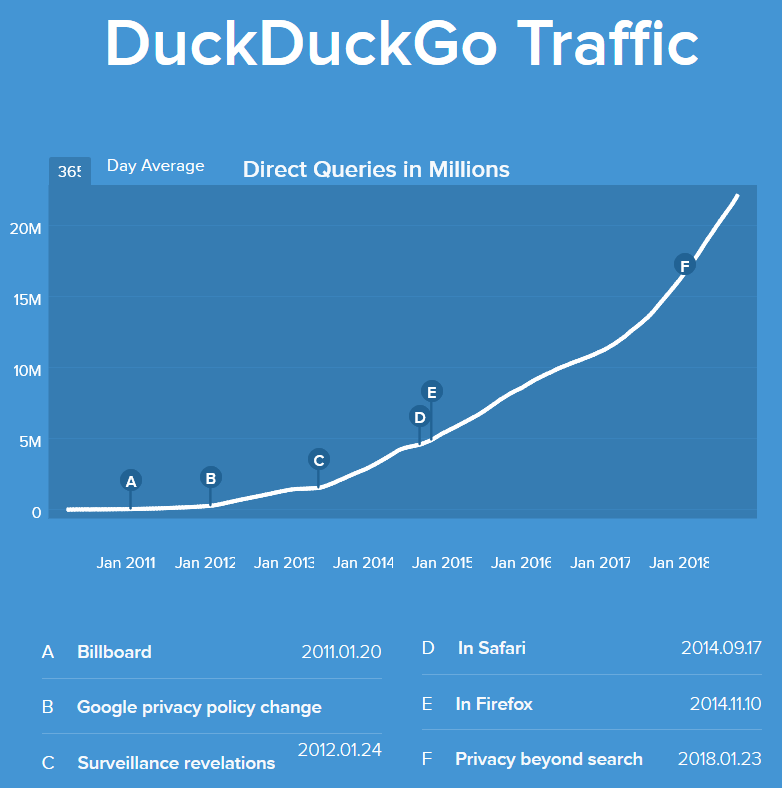
DuckDuckGo Traffic
September 29th, 2018Via: DuckDuckGo:
Tim Berners-Lee Working on Decentralized Apps and Data Storage
September 29th, 2018Via: Fast Company:
On his screen, there is a simple-looking web page with tabs across the top: Tim’s to-do list, his calendar, chats, address book. He built this app–one of the first on Solid–for his personal use. It is simple, spare. In fact, it’s so plain that, at first glance, it’s hard to see its significance. But to Berners-Lee, this is where the revolution begins. The app, using Solid’s decentralized technology, allows Berners-Lee to access all of his data seamlessly–his calendar, his music library, videos, chat, research. It’s like a mashup of Google Drive, Microsoft Outlook, Slack, Spotify, and WhatsApp.
The difference here is that, on Solid, all the information is under his control. Every bit of data he creates or adds on Solid exists within a Solid pod–which is an acronym for personal online data store. These pods are what give Solid users control over their applications and information on the web. Anyone using the platform will get a Solid identity and Solid pod. This is how people, Berners-Lee says, will take back the power of the web from corporations.
For example, one idea Berners-Lee is currently working on is a way to create a decentralized version of Alexa, Amazon’s increasingly ubiquitous digital assistant. He calls it Charlie. Unlike with Alexa, on Charlie people would own all their data. That means they could trust Charlie with, for example, health records, children’s school events, or financial records. That is the kind of machine Berners-Lee hopes will spring up all over Solid to flip the power dynamics of the web from corporation to individuals.
Bizarre, High Energy Particles Flying Out of Antarctica’s Ice
September 27th, 2018Via: LiveScience:
There’s something mysterious coming up from the frozen ground in Antarctica, and it could break physics as we know it.
Physicists don’t know what it is exactly. But they do know it’s some sort of cosmic ray — a high-energy particle that’s blasted its way through space, into the Earth, and back out again. But the particles physicists know about — the collection of particles that make up what scientists call the Standard Model (SM) of particle physics — shouldn’t be able to do that. Sure, there are low-energy neutrinos that can pierce through miles upon miles of rock unaffected. But high-energy neutrinos, as well as other high-energy particles, have “large cross-sections.” That means that they’ll almost always crash into something soon after zipping into the Earth and never make it out the other side.
And yet, since March 2016, researchers have been puzzling over two events in Antarctica where cosmic rays did burst out from the Earth, and were detected by NASA’s Antarctic Impulsive Transient Antenna (ANITA) — a balloon-borne antenna drifting over the southern continent.
ANITA is designed to hunt cosmic rays from outer space, so the high-energy neutrino community was buzzing with excitement when the instrument detected particles that seemed to be blasting up from Earth instead of zooming down from space. Because cosmic rays shouldn’t do that, scientists began to wonder whether these mysterious beams are made of particles never seen before.
SEC Sues Elon Musk, Seeks to Ban Him from Running Tesla or Any Public Company
September 27th, 2018Update: Musk to Resign as Tesla Chairman, Remain as CEO in SEC Settlement
Via: Reuters:
Tesla and Elon Musk have agreed to pay $20 million each to financial regulators and the billionaire will step down as the company’s chairman but remain as chief executive, under a settlement that caps a tumultuous two months for the car-maker.
—
Via: Mercury News:
In a blockbuster move Thursday, the U.S. Securities and Exchange Commission filed fraud charges against Tesla Chief Executive Elon Musk, and is seeking to ban the electric-car maker’s high-profile boss from running any publicly traded company.
Filed in the U.S. District Court for the Southern District of New York, the charges are related to Musk’s August announcement that he wanted to take Tesla private for $420 a share. Musk dropped the bombshell idea in an August 7 tweet in which he said he had “funding secured” to take Tesla private, but provided no financing details at that time.
“Neither celebrity status, nor reputation as a technological innovator, provide an exemption from the federal securities laws,” said Stephanie Avakian, co-director of enforcement for the SEC, during a press conference Thursday.




